Cramér's theorem states that the means of independent and identically distributed random variables in satisfy a large deviation principle at large-deviation speed , with good rate function equal to the Legendre-Fenchel transform of their cumulant-generating function, provided the moment-generating function is finite on a neighborhood of zero.
Here the exponential distribution hasFor , maximize . Its derivative is and its second derivative is negative, so the maximizing parameter is . Therefore the rate function of an exponential sample mean isFor , letting in the same supremum gives , including the logarithmic divergence when . The moment-generating function is finite near zero, so Cramér's theorem supplies the full large deviation principle.
The rate function is nonnegative, with its unique minimum at ; . It tends to infinity both as and as . Its finite sublevel sets are closed bounded intervals contained in , hence compact. Thus it is a good rate function.
For fixed , independence and the product large-deviation principle give the vector the good rate function . Since the minimum is a continuous map, the contraction principle for large deviations givesIn every vector in this fibre, at least one coordinate equals and all others are at least . The large-deviation rate of a minimum of independent copies therefore reduces the infimum toIf , the other coordinates can equal and cost zero. If , the rate function is increasing on , so every coordinate costs at least and equality is achieved when all coordinates equal . For the cost is infinite. ThusAt the threshold both expressions are zero. Goodness follows from the contraction principle for large deviations. A small minimum requires only one atypically small mean; a large minimum requires all means to be atypically large, which explains the two costs.
Varadhan's lemma states that if has a large deviation principle with good rate function and large-deviation speed , then for every bounded continuous real function ,For a continuous function unbounded above, the same conclusion holds under the exponential tail extension of Varadhan's lemma, for example when the weighted contribution from is superexponentially negligible as .
The scalar clipping map is continuous. The rate function under scalar clipping has endpoint costs and . Since and the costs decrease towards from the left and increase to its right, both infima are attained at the corresponding endpoints. Thus the good rate function of equals on and is infinite outside. The function is bounded and continuous on that compact interval, soOn , the derivative of is , so the maximum there is . On , the derivative is , with negative second derivative. Its unconstrained maximizer isIt lies in whenever . The right-hand objective increases initially at , so this maximizer dominates the whole left-hand interval. Substitution gives the limit for high moments of a clipped minimum of exponential sample meansThe moment here is the expectation of the th power. If the printed notation were instead read as , its logarithmic limit would be , since boundedness and convergence in probability give .
A large deviation principle for random elements in a Hausdorff space , at large-deviation speed , has a lower semicontinuous rate function . For every open set and every closed set ,Equivalently, for every Borel set , the lower and upper bounds use its interior and closure, respectively. The conventions are and . A good rate function has compact sublevel sets for every finite . Here take ; the different speeds in the moderate deviation principle are stated explicitly when used.
The contraction principle for large deviations says that if has a large deviation principle in with good rate function , and is a continuous map between Hausdorff spaces, then has the same large-deviation speed and good rate functionFor an open set , its inverse image is open, so the input lower bound givesFor a closed set , its inverse image is closed, giving the corresponding upper bound with .
It remains to prove goodness, including the endpoint issue in the infimum. Each fibre is closed. If , compact sublevel sets and lower semicontinuity make attain its infimum on that fibre: intersect it with the compact set and use the closed nested sublevels tending down to . Hence for each finite ,The right-hand side is compact, being a continuous image of a compact set, and is closed because the target is Hausdorff. Thus is lower semicontinuous and good, completing the proof.
The family is exponentially tight at large-deviation speed if for every there is a compact set such thatFor this question . The definition says that escape from an appropriate compact set can be made negligible at any prescribed exponential rate. Requiring a strict inequality instead gives the same notion, by choosing a larger .
Use the standard Hausdorff state-space convention, so compact sets are closed. Let be any closed set and choose from exponential tightness. The weak large deviation principle applies to the compact set , whileThe principle of the largest exponential term givesLet . This is the full closed-set upper bound; the open-set lower bound was already present.
For goodness, fix and choose . The complement is open. Its lower bound and its exponential-tightness upper estimate implyThus and . Lower semicontinuity makes this sublevel set closed, so it is a closed subset of a compact set and therefore compact. This proves that exponential tightness upgrades a weak large deviation principle to the full principle with the same good rate function.
Write . Its Poisson distribution has mean , since the probability-generating functions of the independent summands multiply. DefineThe scaled cumulant-generating function isA Taylor expansion of the exponential, valid for each fixed because , givesThe remainder is . The limit is finite and differentiable on all of , hence satisfies the essential-smoothness hypotheses of the Gärtner–Ellis theorem. Its Legendre-Fenchel transform isThis proves the Poisson moderate deviation principle with large-deviation speed and a good rate function.
For an arbitrary open set , the lower bound uses and the upper bound uses . These infima agree: every point of the closure is a limit of points of and is finite and continuous. Thus the logarithmic probabilities of open sets for a continuous rate function give the stated logarithmic limit for every open , not just intervals. The empty-set case follows from the usual infinite-value conventions.
In this bufferless queue, queue overflow is the eventThe Poisson moderate deviation principle therefore givesThe same infimum is obtained for , so replacing by gives the same logarithmic exponent. Any integer rounding of the service rate of a queue changes the scaled threshold by a quantity tending to zero.
The bufferless queue output isPut . Since , we have for all sufficiently large . Consequently the two queue overflow events are exactly equal eventually:Apply the Poisson moderate deviation principle with exponent to obtainThere is also an exponential equivalence proof, which describes the whole output law at this smaller scale. For each ,The right side has strictly negative logarithmic exponent at speed . Dividing instead by multiplies that negative exponent by , giving . Thus the centered, scaled input and output are exponentially equivalent and have the same good rate function. This is the moderate deviations below a bufferless queue cap.
The downstream service rate of a queue now exceeds the upstream cap for all sufficiently large , sinceBut the bufferless queue output is always at most . Therefore the downstream queue overflow probability is eventually exactly zero, andThis is a deterministic cap argument, stronger than merely proving superexponentially small probability.
The input admits positive moderate deviations on every scale with . The bufferless queue output retains exactly the same overflow events at thresholds below the cap, so clipping does not improve the exponents on the smaller scale. It removes every positive burst at thresholds on the larger scale.
At the cap's own scale , apply the contraction principle for large deviations to the map . The output has good rate functionAt the cost is . Thus the burstiness of queue input has been reduced in its sufficiently large positive tail, while its smaller-scale rare fluctuations persist. These are the moderate deviation scales of a clipped Poisson aggregate.
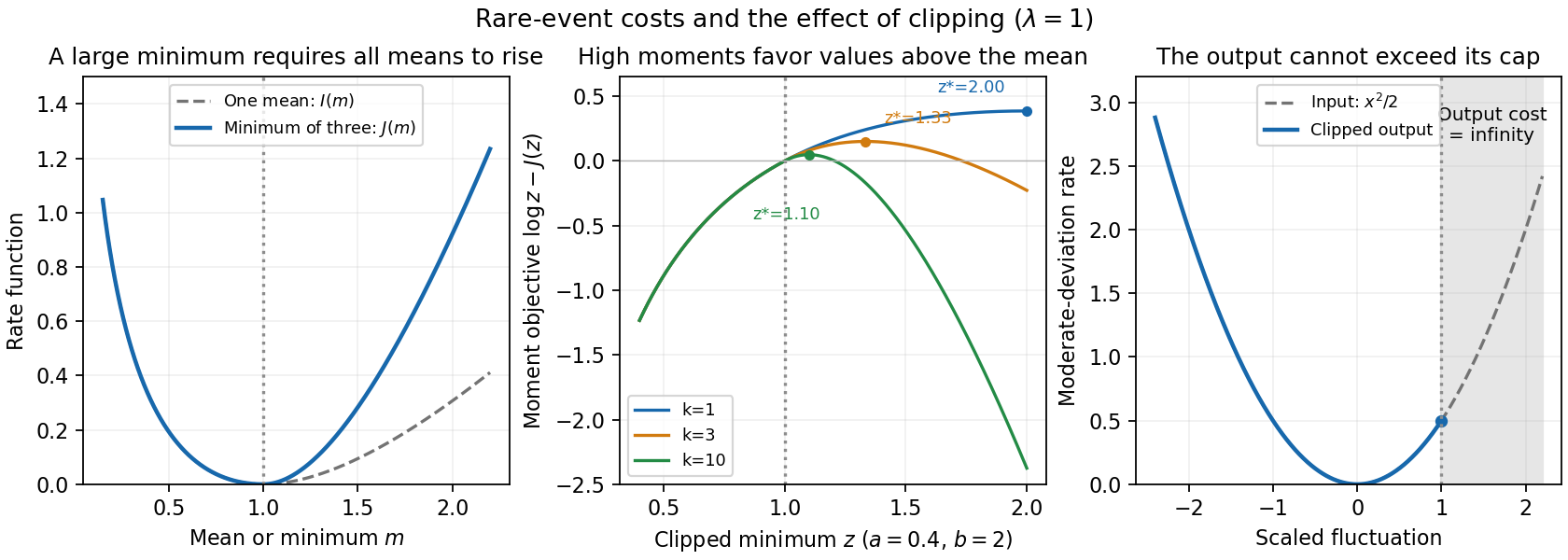
Exponential-mean minimum costs, moment optimization, and the moderate-deviation rate of clipped Poisson input
. Details. 
Write for work arriving in slot and for the service rate of a queue. For a work-conserving single-server queue, the Lindley recursion is . For stable independent and identically distributed random variables with mean , its stationary workload supremum has the formDifferent scaling limits of a queue concern different quantities growing large; they need not share either a probability speed or a likely path to overflow.
For large-buffer queue scaling, fix the input law and and let the buffer size of a queue . Assume finite exponential moments around a positive root of . An overflow accumulated in slots requires an average input about , so Cramér's theorem assigns logarithmic cost . Optimizing the duration gives the Cramér-Lundberg workload exponentFor an interior root with , Fenchel–Young inequality verifies the minimization: the lower bound is because , and equality occurs at . The exponential workload bound from cumulative arrival moments gives the upper exponent for every ; an exponentially tilted positive-drift path or the duration calculation gives the matching lower exponent. In effective bandwidth notation, . This regime measures long accumulation into a large buffer with a fixed positive stability margin.
For many-source queue scaling, superpose independent copies of an input process, give the server capacity , and give it buffer size . For each lookback horizon , the average of the source cumulative arrivals has a large deviation principle with rate function . Overflow at that horizon costs . Optimizing the lookback horizon suggestsFor independent slots, , giving . The integer horizon is important in a slotted system. For temporally dependent sources, use the cumulative-input cumulant-generating function, rather than multiplying a one-slot formula by . The heuristic needs uniform control of the tail of the stationary supremum to justify optimizing an unbounded set of horizons; stability and suitable exponential-moment estimates provide this in the usual models. The growing quantity here is the number of independent sources, while per-source capacity and buffer remain fixed.
For moderate-deviation queue scaling, consider a bufferless queue with aggregate Poisson input of mean and capacity , . The spare capacity is much larger than the ordinary central limit theorem scale but much smaller than . The Poisson sample-mean rate function near its minimum has expansionWith , the cost is asymptotic to . Hence Poisson moderate deviations give . The quadratic cost comes from a shrinking neighborhood of the mean, rather than from a fixed macroscopic overload. The regime is useful for a large aggregate whose service margin lies between its typical fluctuation scale and its mean scale.
For a heavy-traffic limit of a queue, instead hold the input law fixed with mean and positive finite variance , and let with and . In slots the net input has mean about and random fluctuation of size . Thus the functional central limit theorem, followed by the Skorokhod reflection map on the half-line, suggestswhere is reflected Brownian motion with negative drift and variance parameter . The stationary law of negatively drifted reflected Brownian motion has tail . When passing the stationary distribution through the limit is justified, this predictsFor dependent input satisfying a suitable invariance principle, replace by its long-run variance of a stationary process. This regime is appropriate near critical load and on long time scales; a functional transient limit alone does not automatically justify the stationary-limit interchange.
A different large-service regime holds the input law fixed. With Poisson distribution of mean and bufferless capacity , let . The single-point lower bound and the optimized Chernoff bound for , using Stirling's formula, give the Poisson large-service overflow asymptoticHere the service rate grows while the input mean does not. A quadratic moderate-deviation approximation would describe the wrong part of the Poisson tail.
To choose a regime, compare the spare capacity, typical fluctuations, number of sources and buffer size before selecting a formula. Use the large-buffer exponent for a fixed stable input and a long overload episode; use the many-source variational cost when independent flows and resources grow together; use moderate deviations for an intermediate safety margin; use the heavy-traffic diffusion when the stability margin tends to zero; and use the fixed-input Poisson tail when service alone becomes very large. Check temporal dependence and exponential-moment assumptions. For heavy-tailed subexponential distributions, a single exceptionally large arrival can dominate overflow, so a finite exponential workload root and a Brownian approximation to the far tail need not apply. These comparisons explain why the same nominal queueing theory system can have different useful asymptotic descriptions.
Articles by others on the same topic
There are currently no matching articles.