The derived series of a Lie algebra is defined recursively by and , where the bracket denotes the linear span of all brackets of pairs of elements. A solvable Lie algebra is one whose derived series of a Lie algebra terminates at zero:The solvable radical of a finite-dimensional Lie algebra is its largest solvable ideal of a Lie algebra. A semisimple Lie algebra has no nonzero solvable ideals of a Lie algebra, equivalentlyThese are definitions; identifying semisimplicity with a direct sum of simple ideals additionally uses the structure theorem in characteristic zero. The calculations and representation theorems below are over , as in the complex representation setting of this paper.
Let and be left and right multiplication by on the vector space . Then . On matrix units, or from , one obtainsFor example, the coefficient of in is ; summing over proves the mixed-trace identity. Expanding the product of the two adjoint operators therefore gives the Killing form of the general linear Lie algebra:For in the special linear Lie algebra, both individual traces vanish. Furthermore , and every adjoint operator kills the scalar summand, so its product has the same trace on and on . Consequently the Killing form of the special linear Lie algebra isNo uniqueness theorem for invariant bilinear forms on a Lie algebra is needed: this calculation establishes the constant directly. For the degenerate case , the Lie algebra is zero, both forms vanish, and proportionality does not determine a unique constant.
For this diamond Lie algebra, every bracket lies in , and each of these three vectors occurs as a bracket. Thus its derived algebra is exactly . Inside that subalgebra the only nonzero bracket is a multiple of , so . Centrality of then gives . HenceIn particular it is a solvable Lie algebra, although its lower central series of a Lie algebra does not terminate: . Solvability does not imply nilpotence.
Define a symmetric bilinear form by pairing with and with , each with value one, and setting all other pairings of basis vectors to zero. Its Gram matrix in the order isThe determinant is one, so this is a nondegenerate bilinear form.
For invariance, put . The nonzero values on distinct basis triples are generated byand the reversed triples have value minus one. Every value involving , or a repeated basis vector, vanishes. Thus is an alternating trilinear form, explicitly . In particular . By symmetry of , this reads , the defining identity for an invariant bilinear form on a Lie algebra.
Suppose a finite-dimensional Lie algebra representation realized this form as . The Lie theorem says that every finite-dimensional representation of a complex solvable Lie algebra admits a basis in which all representing matrices are upper triangular. A commutator of upper triangular matrices has zero diagonal, hence is strictly upper triangular. Therefore is strictly upper triangular, and its product with any representing matrix still has zero diagonal. It follows thatThis is the general fact that trace forms of solvable Lie algebras annihilate the derived algebra. Here , so such a trace form would have , contradicting the constructed value one. Thus the nondegenerate invariant form exists, but no finite-dimensional representation has it as its trace form. Finite dimensionality is implicit in the ordinary representation trace; no trace on arbitrary infinite-dimensional endomorphisms is being assumed.
Put and let denote a matrix unit. The antidiagonal matrix satisfies , so the orthogonal condition is , or entrywise . Consequently the diagonal Cartan subalgebra isWe first take . Since , the matrix root basis of the even orthogonal Lie algebra givesThe zero weight space is ; its basis is . No vector of weight occurs, because the corresponding matrix unit is forced to be its own negative. These spaces account for dimensions, exhausting the Special orthogonal Lie algebra. Thus its decomposition as a -module and its Dn root system areEach nonzero root space has dimension one; the zero weight has multiplicity .
The upper triangular root spaces are precisely those of weights and with . ThereforeThese roots form the simple roots. To check that they generate the chosen positive system with nonnegative coefficients, write . For ,and for use . Empty sums are zero. Their linear independence and these expansions identify the base of the root system.
Equip the real span of the roots in with the inner product making the orthonormal. All roots then have squared length two. The coroots of are , so the fundamental weights of Dn, characterized by , areTaking their pairings with and verifies the defining identities directly. For each pair , the sum of its two positive roots is . Hence the half-sum of positive roots is
The Dynkin diagram has a chain ending at , which is joined to both and . Every edge is a single bond because the root lengths agree; the nonzero off-diagonal simple-root pairings are minus one. The labelled Dn Dynkin diagram and its low-rank versions are shown below.
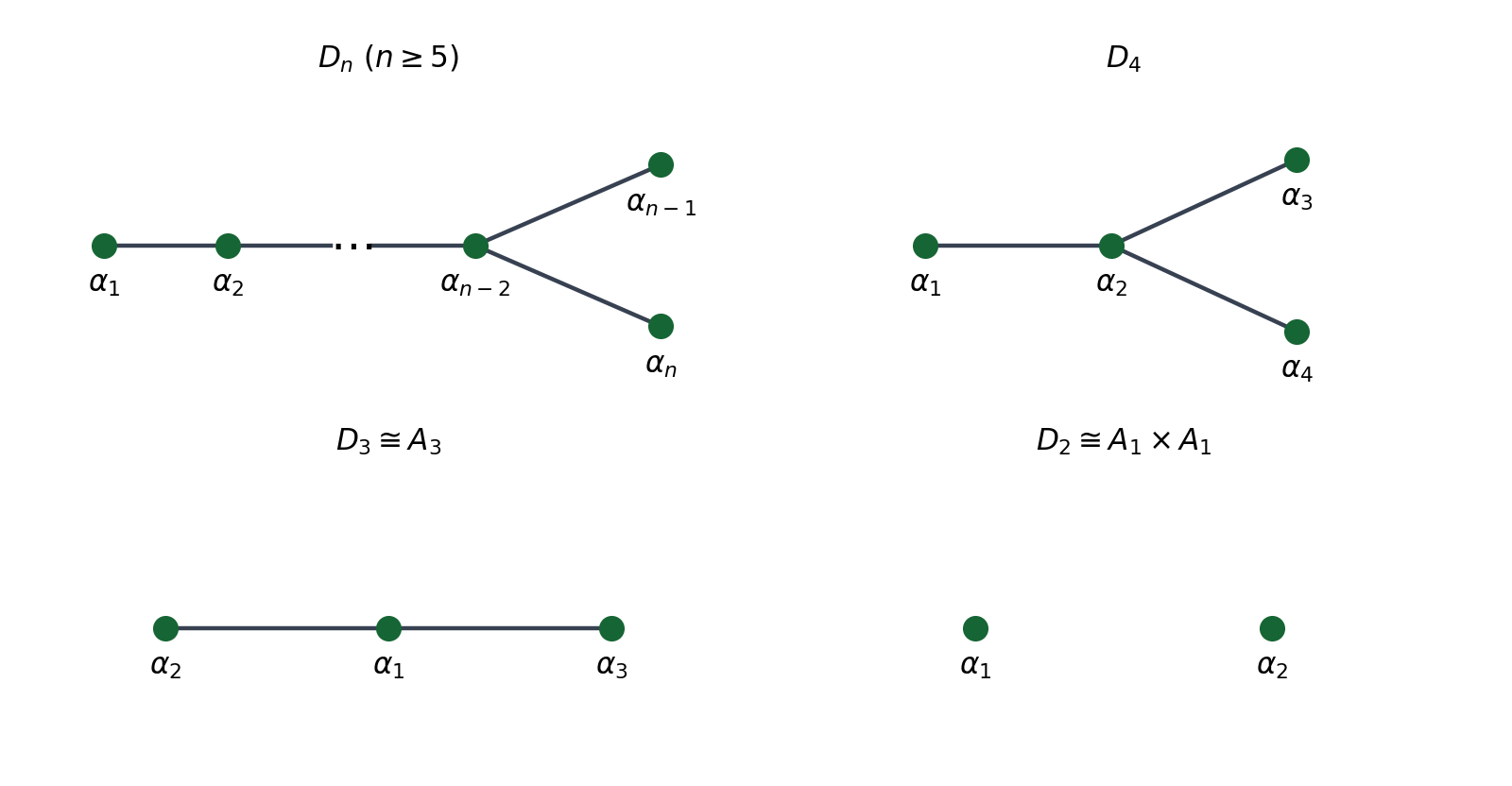
Labelled D-type Dynkin diagrams, including the low-rank cases
. Details. For , and are orthogonal, giving two disconnected A1 root systems. For , the diagram is the chain , of type A3 root system; the displayed weight formulas still apply. If is allowed, is one-dimensional and abelian: there are no roots or fundamental weights, and .
In dimension four, the two positive roots are and . Using the matrix root basis of the even orthogonal Lie algebra, defineThe matrix unit identity gives , , and for . Thus each triple spans an sl2 Lie algebra.
The two triples commute. Their Cartan actions on one another vanish because ; their mixed root-vector brackets vanish because none of , namely and , is a root. This can equally be checked from the displayed matrix units. The six vectors are linearly independent, occupying the four distinct root spaces and two independent Cartan directions, so they exhaust the six-dimensional so4 Lie algebra. The two commuting spans are consequently ideals, andThis gives an explicit Chiral decomposition of the complexified so4 Lie algebra, including generators for both factors.
Identify with the coordinate vector through . A root reflection is . Since , for the two possibilities areEvery other coordinate is unchanged, and , so these formulas cover every root. The complete diagonal matrix is reconstructed with its last entries the reversed negatives of the first entries.
The Weyl group of Dn consists of all permutations of the coordinates together with an even number of coordinate sign changes. Equivalently,Its order is . The difference-root reflections give ordinary transpositions; composing a sum-root reflection with the corresponding difference-root reflection negates precisely the two selected coordinates. These describe the generators of all even signed permutations. For the group has four elements; for the toral case it is trivial.
In the defining representation , the basis vectors and have weights and , respectively, each with multiplicity one. Thus its formal character isThe vector is killed by every positive root space, since all positive-root matrices are upper triangular, and is a highest-weight vector. Any nonzero invariant subspace splits into weight spaces and therefore contains one of the natural weight vectors, since those weight spaces are one-dimensional. The root matrices connect that vector to all the others, so this representation is irreducible for . In terms of the fundamental weights of Dn, its highest weight is for and for .
The flip of the two tensor factors is equivariant, henceUse the invariant symmetric bilinear form . Contraction is an equivariant map to the trivial Lie algebra representation. Its inverse-form tensoris invariant and satisfies . ConsequentlyThe traceless summand contains the highest-weight vector of weight . The Weyl complete reducibility theorem states that every finite-dimensional complex semisimple Lie algebra representation is a direct sum of irreducible representations, so the submodule generated by this highest vector is . The Weyl dimension formula verifies that it is the entire traceless space: only positive roots involving change their factors, andThis equals . Thus the traceless symmetric square of the defining even orthogonal representation is irreducible, including .
For the other summand, the exterior square of the defining orthogonal representation has the equivariant identificationThe image is skew relative to , and in a basis making the identity the images are the independent elementary skew matrices. The map is therefore an isomorphism onto the Adjoint representation of a Lie algebra. For , the connected Dn Dynkin diagram gives a simple Lie algebra (with ); its adjoint module is irreducible because its invariant subspaces are exactly its ideals. Its highest weight is , and is a highest vector. The tensor-square decomposition of the defining even orthogonal representation is consequentlyThe three dimensions are , and one, adding to . The highest weights are , and zero for ; for the middle weight is .
For , the Chiral decomposition of the complexified so4 Lie algebra splits the adjoint module into its two three-dimensional ideals. ThusThe weights are , , and zero. Equivalently, labelling highest weights by the two sl2 Lie algebra factors, this is . If is allowed, the abelian algebra has and ; there is then no single highest weight for an irreducible natural module.
Let be a finite-dimensional complex semisimple Lie algebra, choose a Cartan subalgebra and a set of positive roots, and write for the Weyl group. Let be a dominant integral weight and the finite-dimensional irreducible highest-weight representation with that highest weight. If denotes its weight space of weight , its formal character is . The symbols belong to the group algebra of the weight lattice and multiply by ; they are formal symbols, not matrix exponentials.
Put , the half-sum of positive roots, and let be the Coxeter length of , the least number of simple reflections expressing it. Then in the real reflection representation. The Weyl character formula statesBy the Weyl denominator formula, the denominator is , giving the equivalent expressionThe quotient can be interpreted in the fraction field of the formal group algebra; the theorem says it simplifies to the finite formal character above. In particular the apparent denominator does not mean that the representation has infinitely many weights.
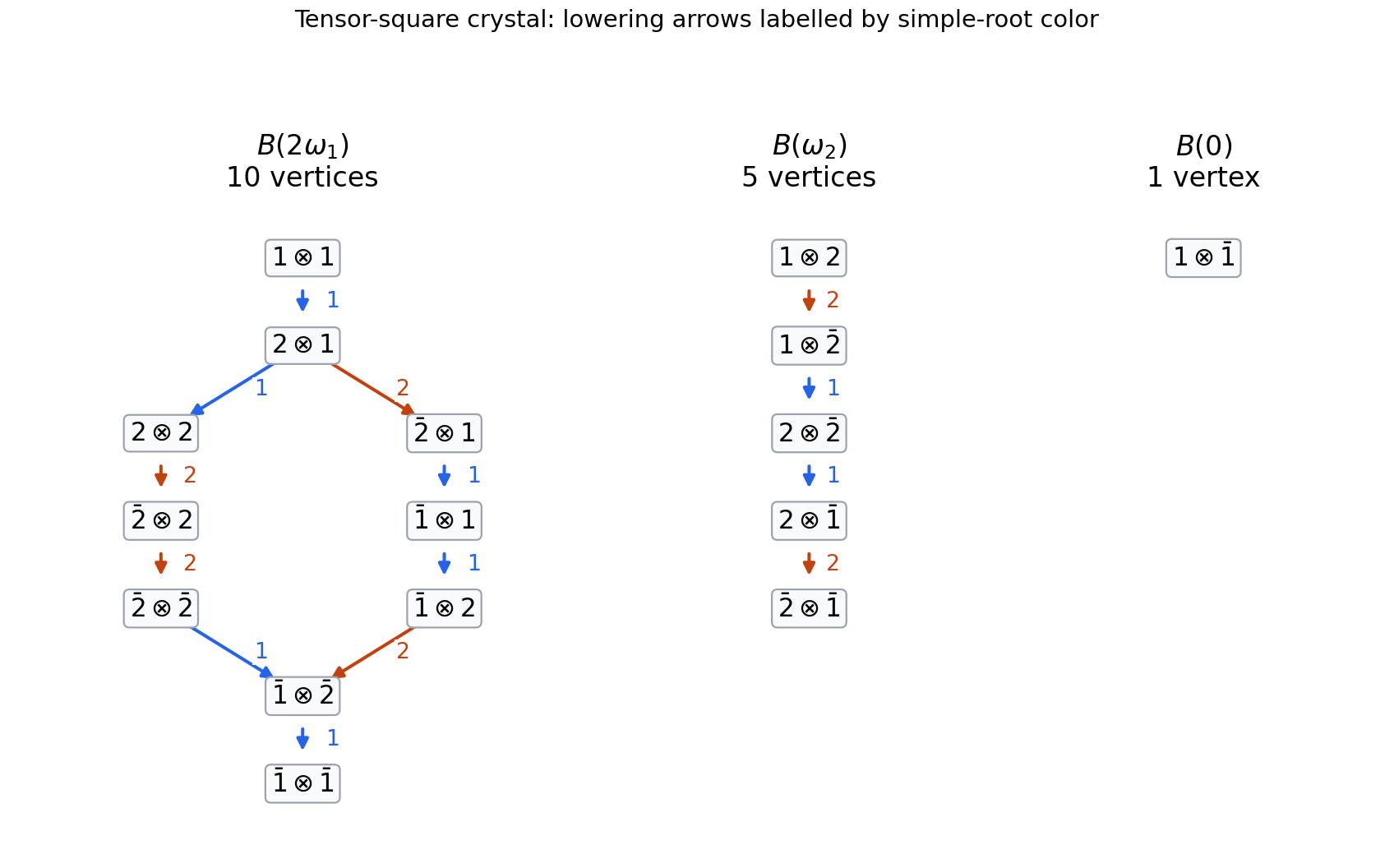
Name the four vertices in their displayed order. This is the crystal of the defining symplectic representation in rank two, of highest weight for the C2 root system. Its weights are respectively , with simple roots and . Each lowering arrow subtracts the corresponding simple root. Thus and .
Use the crystal tensor-product rule in which acts on the first factor if , and on the second factor otherwise. The raising operator acts on the first factor for , on the second otherwise. Here and count the raising and lowering steps available in color . The data for the four vertices areThe strictness difference between raising and lowering ensures that they are inverse along each colored edge. Testing the sixteen ordered tensor vertices gives exactly three vertices killed by both raising Kashiwara operators:Their highest weights are , and zero.
For completeness, successive lowering generates the following connected components of the tensor product of crystals:
They have sizes ten, five and one, are disjoint, and exhaust all sixteen vertices. This proves the tensor square of the defining C2 crystal decompositionEquivalently, the representation decomposes as . The dimensions agree with the Weyl dimension formula for C2, . The ordered highest vertices would change under the opposite tensor convention, but the irreducible decomposition would be the same.


Use the standard sl2 Lie algebra relations , and . The classification of finite-dimensional sl2 representations says that every finite-dimensional complex module is a direct sum of , , where has weights . The raising operator and lowering operator move weights by two and minus two. On each therefore has st power zero. There is consequently one integer such that on all of .
The matrix exponentials are thus finite polynomials in nilpotent operators:Each is a well-defined endomorphism, and its inverse is obtained by negating the argument. Their product is therefore a linear automorphism,This Weyl reflection lift in an sl2 representation is algebraically defined by finite sums; no choice of topology or convergence of an infinite series is needed.
Let be the highest vector of the Verma module and set . The Poincaré-Birkhoff-Witt theorem implies that is a basis, so none of these vectors vanishes. The actions areThe raising operator is a locally nilpotent operator: on every vector, repeated application of eventually removes all its finitely many basis terms. Thus its algebraic exponential of a locally nilpotent operator is defined, and . But the middle factor in the proposed product would have to send this vector towhich has infinitely many nonzero, linearly independent basis coefficients. An element of the algebraic Verma module is a finite linear combination of the , so this expression is not in . In particular the lowering operator is not locally nilpotent.
Even for integral , is nonzero in the Verma module; it becomes zero only in its finite-dimensional irreducible quotient . Hence is not defined as the displayed composition of endomorphisms of the algebraic Verma module. Working in a completion would be a different problem and is not part of the module specified here.
The classification of finite-dimensional sl2 representations identifies with . In the defining two-dimensional representation,so andOn the th tensor power, the infinitesimal operator associated with is the sum of its actions on the individual factors. These actions commute, so exponentiating their sum is the tensor product of the individual exponentials; the same holds for . Restricting to the symmetric power consequently identifies the operator on with . It follows thatIndeed contributes one minus sign from each of the tensor factors. The Weyl reflection lift in an sl2 representation can therefore square to minus the identity, even though its image in the Weyl group is an involution.
Articles by others on the same topic
There are currently no matching articles.