The gradient of is . On the upper cone, its Euclidean norm is . Thus the upward unit normal to an upper circular cone isPut and . The hypotheses imply and . The Cauchy-Schwarz inequality therefore givesThis is also a direct instance of self-duality of a second-order cone: both and the chosen unit normal belong to the closed Lorentz cone.
In the standard spherical coordinate system, is measured from the positive axis. The radial unit vector in spherical coordinates isThe coordinate forms of the elliptic paraboloid are given in the labelled parts below.
For the other surface, converts toFor , this is a two-sheeted hyperboloid, with two disconnected sheets starting at and opening along the axis. For , it is a one-sheet hyperboloid:Its waist is the circle , . Both are surfaces of revolution about the axis and approach the cone far from the origin.
The figure shows and ; scaling all coordinates by gives the other magnitudes.
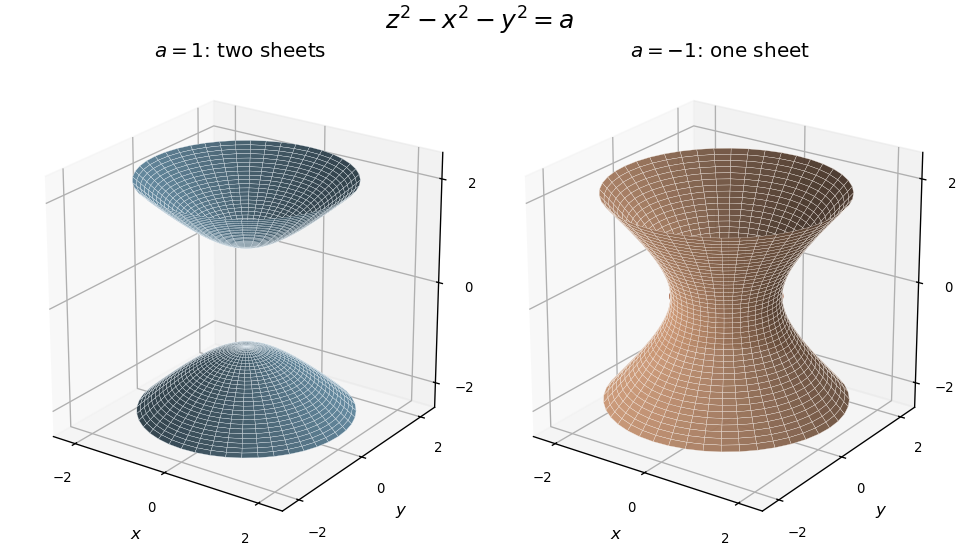
Two-sheeted and one-sheet hyperboloids for positive and negative values of a
. Details. 
In spherical coordinates, and , so the elliptic paraboloid has equationAway from the origin this is , with . The undivided equation also includes the origin, where angular coordinates are not unique.
The series converges to when its partial sums have limit of a sequence : for every , there is such that for all .
Its averages are the Cesàro means of the sequence of partial sums. To prove their convergence, choose with for . ThenThe finite first sum divided by tends to zero. This proves the Cesàro theorem for convergent sequences in this setting, andThe converse fails. Take , so for odd and for even . The partial sums do not converge, butThus the alternating series is Cesàro summable without having an ordinary sum.
Use these standard facts about a power series: it is absolutely convergent at every point strictly inside its radius of convergence and divergent at every point strictly outside it. Also, the triangle inequality implies that a sum or difference of two absolutely convergent series is absolutely convergent.
Suppose . If , choose a finite with and choose of complex modulus . The sum series and the series both converge absolutely there, socontradicting . Thus . Interchanging the series covers , proving the sum of power series with unequal radii of convergence rule:The argument also covers a zero radius or an infinite larger radius. When the two radii are equal, cancellation can enlarge the radius, so the inequality of the radii matters.
For , the squared Euclidean norm of the orthogonal projection residual is nonnegative:This proves the Cauchy-Schwarz inequality . Equality holds exactly when is a scalar multiple of . If , equality is automatic. Equivalently, equality means the two vectors are linearly dependent, including the cases with a zero vector.
For a point equidistant from the coordinate vertices,must be independent of . Thus all are equal, and their sum is one. The centroid is thereforeFor every in the base probability simplex, the Cauchy-Schwarz inequality gives . Equality forces the same coordinates as . Thus is the unique closest point of a probability simplex to the origin.
A positively oriented planar rotation matrix acts byFor a unit vector in three dimensions, the parallel and perpendicular orthogonal projections areOn the plane perpendicular to , the map preserves lengths and turns vectors through a positive right angle about . It squares to minus the identity there. Thus rotates that component, while the parallel component remains fixed. This proves the Rodrigues rotation formulaIts component form uses the Levi-Civita symbol:Since and , its matrix trace is .
For the given matrix, the matrix trace is with , so . In the stated angular range, . The antisymmetric entries giveTherefore the two axis-angle pairs areReversing the axis and the angle leaves the Rodrigues rotation formula unchanged, so these describe the same rotation.
Let denote the cross product matrix, with . ThenThe two eigenvalue calculations use an orthonormal basis adapted to .
If , use the positively oriented orthonormal basis . The cross product identities give , and . In this basis,Its characteristic polynomial is , so
If , then . On the perpendicular plane, vanishes and is a signed right-angle rotation, whose square is minus the identity. Hence its complex eigenvalues are , and
A trace-zero Hermitian matrix has the unique formSet , and . Then it is exactly ; these assignments also prove uniqueness. This is the real Pauli matrix representation .
For a unitary matrix, . Thusand invariance of the matrix trace under similarity transformations gives . Therefore conjugation maps the space to itself.
For every integer , De Moivre's theorem states . Taking the real part for givesReplace by and expand:The resulting polynomial is the fifth Chebyshev polynomial.
For the general Möbius transformation, its finite fixed points satisfyWith and nonzero discriminant, the quadratic formula gives the two distinct fixed points of a Möbius transformation:The fixed-point equation for also gives . ThereforeDividing yields the conjugation of a Möbius transformation with two distinct fixed points:Neither factor in this quotient vanishes, since . The formula extends over the Riemann sphere, including the transformation's pole. For the special transformation and the ordering , .
The intermediate value theorem states that a continuous real-valued function on takes every value between and . To prove it, suppose and repeatedly bisect the interval, keeping endpoints whose function values bracket . The resulting nested closed intervals have lengths tending to zero and a common point by completeness of the real numbers. Both endpoint sequences tend to , so continuity implies . Endpoint values are immediate, and reversing the inequalities handles .
For the derivative assertion, put . The intermediate secant slope from endpoint derivatives can be constructed in three cases. If , take . If , the functionis continuous on : differentiability at supplies the endpoint limit, and differentiability elsewhere implies continuity. Since , the intermediate value theorem gives with . Take .
If , use insteadIts continuous endpoint extension satisfies , so there is with . Take . In every case,The mean value theorem on this subinterval now givesThis proves the Darboux theorem for derivatives without assuming that is continuous.
The Taylor formula with integral remainder isFor , this is the fundamental theorem of calculus. Integration by parts givesRearranging and applying mathematical induction proves the displayed expansion. The oriented integral also covers .
For , the chain rule and product rule giveThusBecause Gaussian decay dominates every power, as . Hence , and the derivative formula extends continuously to zero. Repeating the argument replaces by another polynomial at each step: . All derivative difference quotients at zero tend to zero, so the polynomial multiples of a Gaussian flat function are smooth functions withThe Taylor polynomial about zero is therefore identically zero for every degree, andA nonzero polynomial has only finitely many roots of a polynomial, so for every sufficiently small nonzero . At each such fixed , this remainder never tends to zero. The flat function is therefore smooth but not real analytic at zero.
A real sequence has limit if, for every , there is such that for all . It tends to if, for every real , eventually ; it tends to if eventually for every real .
The Bolzano-Weierstrass theorem states that every bounded sequence of real numbers has a real convergent subsequence. This proves the claim for bounded sequences. If the sequence is unbounded above, every tail remains unbounded above because a finite prefix is bounded. Choose indices increasing with . This subsequence tends to . If it is unbounded below, choose to obtain a subsequence tending to . This proves the extended real subsequence theorem.
For the final example, a bounded sequence with vanishing increments need not converge. TakeThe mean value theorem givesNevertheless, along , the square-root rounding error tends to zero, so . Along , it tends to . These two subsequences have different limits, proving nonconvergence.
For a bounded function on an interval , write for its oscillation of a function on an interval. For a partition , the difference between its upper Darboux sum and lower Darboux sum is . The Riemann integrability criterion says that this can be made arbitrarily small.
Since , choose good partitions for the two functions and take their common refinement. Darboux sum refinement monotonicity makes both oscillation sums small on this refinement, so their sum is Riemann integrable. The same argument handles differences and scalar multiples.
Both and are Lipschitz continuous with constant one. Thus and . This calculation shows that Lipschitz composition preserves Riemann integrability, so the positive part and the absolute value are integrable.
The converse for the absolute value is false. Define on rational numbers and on irrational numbers. Then is integrable, but every interval has supremum one and infimum minus one, so every Darboux difference for is . Hence is not Riemann integrable.
Finally,is integrable by the closure properties just proved. This establishes that Riemann integrability is closed under addition and maximum.
A countable supremum can fail, even for a uniformly bounded family. Enumerate the rational points of as and set . Each singleton indicator function is Riemann integrable with integral zero: isolate its single nonzero point in intervals of arbitrarily small total length. Butis the nonintegrable Dirichlet function. This proves that a pointwise supremum need not preserve Riemann integrability.
Articles by others on the same topic
There are currently no matching articles.