The gradient of is . On the upper cone, its Euclidean norm is . Thus the upward unit normal to an upper circular cone isPut and . The hypotheses imply and . The Cauchy-Schwarz inequality therefore givesThis is also a direct instance of self-duality of a second-order cone: both and the chosen unit normal belong to the closed Lorentz cone.
In the standard spherical coordinate system, is measured from the positive axis. The radial unit vector in spherical coordinates isThe coordinate forms of the elliptic paraboloid are given in the labelled parts below.
For the other surface, converts toFor , this is a two-sheeted hyperboloid, with two disconnected sheets starting at and opening along the axis. For , it is a one-sheet hyperboloid:Its waist is the circle , . Both are surfaces of revolution about the axis and approach the cone far from the origin.
The figure shows and ; scaling all coordinates by gives the other magnitudes.
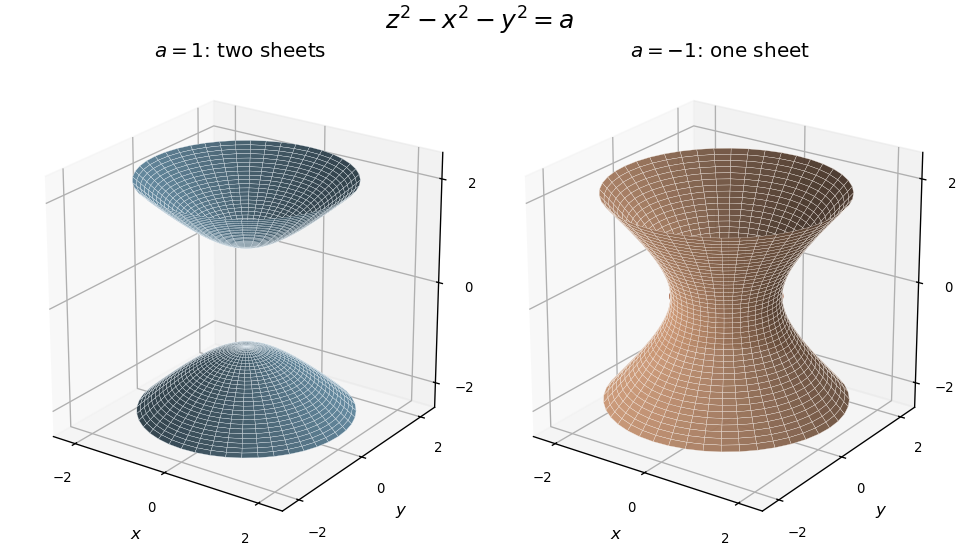
Two-sheeted and one-sheet hyperboloids for positive and negative values of a
. Details. 
In spherical coordinates, and , so the elliptic paraboloid has equationAway from the origin this is , with . The undivided equation also includes the origin, where angular coordinates are not unique.
The series converges to when its partial sums have limit of a sequence : for every , there is such that for all .
Its averages are the Cesàro means of the sequence of partial sums. To prove their convergence, choose with for . ThenThe finite first sum divided by tends to zero. This proves the Cesàro theorem for convergent sequences in this setting, andThe converse fails. Take , so for odd and for even . The partial sums do not converge, butThus the alternating series is Cesàro summable without having an ordinary sum.
Use these standard facts about a power series: it is absolutely convergent at every point strictly inside its radius of convergence and divergent at every point strictly outside it. Also, the triangle inequality implies that a sum or difference of two absolutely convergent series is absolutely convergent.
Suppose . If , choose a finite with and choose of complex modulus . The sum series and the series both converge absolutely there, socontradicting . Thus . Interchanging the series covers , proving the sum of power series with unequal radii of convergence rule:The argument also covers a zero radius or an infinite larger radius. When the two radii are equal, cancellation can enlarge the radius, so the inequality of the radii matters.
For , the squared Euclidean norm of the orthogonal projection residual is nonnegative:This proves the Cauchy-Schwarz inequality . Equality holds exactly when is a scalar multiple of . If , equality is automatic. Equivalently, equality means the two vectors are linearly dependent, including the cases with a zero vector.
For a point equidistant from the coordinate vertices,must be independent of . Thus all are equal, and their sum is one. The centroid is thereforeFor every in the base probability simplex, the Cauchy-Schwarz inequality gives . Equality forces the same coordinates as . Thus is the unique closest point of a probability simplex to the origin.
A positively oriented planar rotation matrix acts byFor a unit vector in three dimensions, the parallel and perpendicular orthogonal projections areOn the plane perpendicular to , the map preserves lengths and turns vectors through a positive right angle about . It squares to minus the identity there. Thus rotates that component, while the parallel component remains fixed. This proves the Rodrigues rotation formulaIts component form uses the Levi-Civita symbol:Since and , its matrix trace is .
For the given matrix, the matrix trace is with , so . In the stated angular range, . The antisymmetric entries giveTherefore the two axis-angle pairs areReversing the axis and the angle leaves the Rodrigues rotation formula unchanged, so these describe the same rotation.
Let denote the cross product matrix, with . ThenThe two eigenvalue calculations use an orthonormal basis adapted to .
If , use the positively oriented orthonormal basis . The cross product identities give , and . In this basis,Its characteristic polynomial is , so
If , then . On the perpendicular plane, vanishes and is a signed right-angle rotation, whose square is minus the identity. Hence its complex eigenvalues are , and
A trace-zero Hermitian matrix has the unique formSet , and . Then it is exactly ; these assignments also prove uniqueness. This is the real Pauli matrix representation .
For a unitary matrix, . Thusand invariance of the matrix trace under similarity transformations gives . Therefore conjugation maps the space to itself.
For every integer , De Moivre's theorem states . Taking the real part for givesReplace by and expand:The resulting polynomial is the fifth Chebyshev polynomial.
For the general Möbius transformation, its finite fixed points satisfyWith and nonzero discriminant, the quadratic formula gives the two distinct fixed points of a Möbius transformation:The fixed-point equation for also gives . ThereforeDividing yields the conjugation of a Möbius transformation with two distinct fixed points:Neither factor in this quotient vanishes, since . The formula extends over the Riemann sphere, including the transformation's pole. For the special transformation and the ordering , .
The intermediate value theorem states that a continuous real-valued function on takes every value between and . To prove it, suppose and repeatedly bisect the interval, keeping endpoints whose function values bracket . The resulting nested closed intervals have lengths tending to zero and a common point by completeness of the real numbers. Both endpoint sequences tend to , so continuity implies . Endpoint values are immediate, and reversing the inequalities handles .
For the derivative assertion, put . The intermediate secant slope from endpoint derivatives can be constructed in three cases. If , take . If , the functionis continuous on : differentiability at supplies the endpoint limit, and differentiability elsewhere implies continuity. Since , the intermediate value theorem gives with . Take .
If , use insteadIts continuous endpoint extension satisfies , so there is with . Take . In every case,The mean value theorem on this subinterval now givesThis proves the Darboux theorem for derivatives without assuming that is continuous.
The Taylor formula with integral remainder isFor , this is the fundamental theorem of calculus. Integration by parts givesRearranging and applying mathematical induction proves the displayed expansion. The oriented integral also covers .
For , the chain rule and product rule giveThusBecause Gaussian decay dominates every power, as . Hence , and the derivative formula extends continuously to zero. Repeating the argument replaces by another polynomial at each step: . All derivative difference quotients at zero tend to zero, so the polynomial multiples of a Gaussian flat function are smooth functions withThe Taylor polynomial about zero is therefore identically zero for every degree, andA nonzero polynomial has only finitely many roots of a polynomial, so for every sufficiently small nonzero . At each such fixed , this remainder never tends to zero. The flat function is therefore smooth but not real analytic at zero.
A real sequence has limit if, for every , there is such that for all . It tends to if, for every real , eventually ; it tends to if eventually for every real .
The Bolzano-Weierstrass theorem states that every bounded sequence of real numbers has a real convergent subsequence. This proves the claim for bounded sequences. If the sequence is unbounded above, every tail remains unbounded above because a finite prefix is bounded. Choose indices increasing with . This subsequence tends to . If it is unbounded below, choose to obtain a subsequence tending to . This proves the extended real subsequence theorem.
For the final example, a bounded sequence with vanishing increments need not converge. TakeThe mean value theorem givesNevertheless, along , the square-root rounding error tends to zero, so . Along , it tends to . These two subsequences have different limits, proving nonconvergence.
For a bounded function on an interval , write for its oscillation of a function on an interval. For a partition , the difference between its upper Darboux sum and lower Darboux sum is . The Riemann integrability criterion says that this can be made arbitrarily small.
Since , choose good partitions for the two functions and take their common refinement. Darboux sum refinement monotonicity makes both oscillation sums small on this refinement, so their sum is Riemann integrable. The same argument handles differences and scalar multiples.
Both and are Lipschitz continuous with constant one. Thus and . This calculation shows that Lipschitz composition preserves Riemann integrability, so the positive part and the absolute value are integrable.
The converse for the absolute value is false. Define on rational numbers and on irrational numbers. Then is integrable, but every interval has supremum one and infimum minus one, so every Darboux difference for is . Hence is not Riemann integrable.
Finally,is integrable by the closure properties just proved. This establishes that Riemann integrability is closed under addition and maximum.
A countable supremum can fail, even for a uniformly bounded family. Enumerate the rational points of as and set . Each singleton indicator function is Riemann integrable with integral zero: isolate its single nonzero point in intervals of arbitrarily small total length. Butis the nonintegrable Dirichlet function. This proves that a pointwise supremum need not preserve Riemann integrability.
The logistic equation has the constant solutions and . For a nonconstant solution, separation of variables givesSolving and imposing the initial value yieldsThis expression also includes the two equilibria when or . For other initial values it is taken on the maximal interval containing on which its denominator does not vanish.
The phase portrait follows from the sign of : arrows point left for , right for , and left for . Thus zero is an unstable equilibrium point and one is asymptotically stable. The requested sketch is shown below.
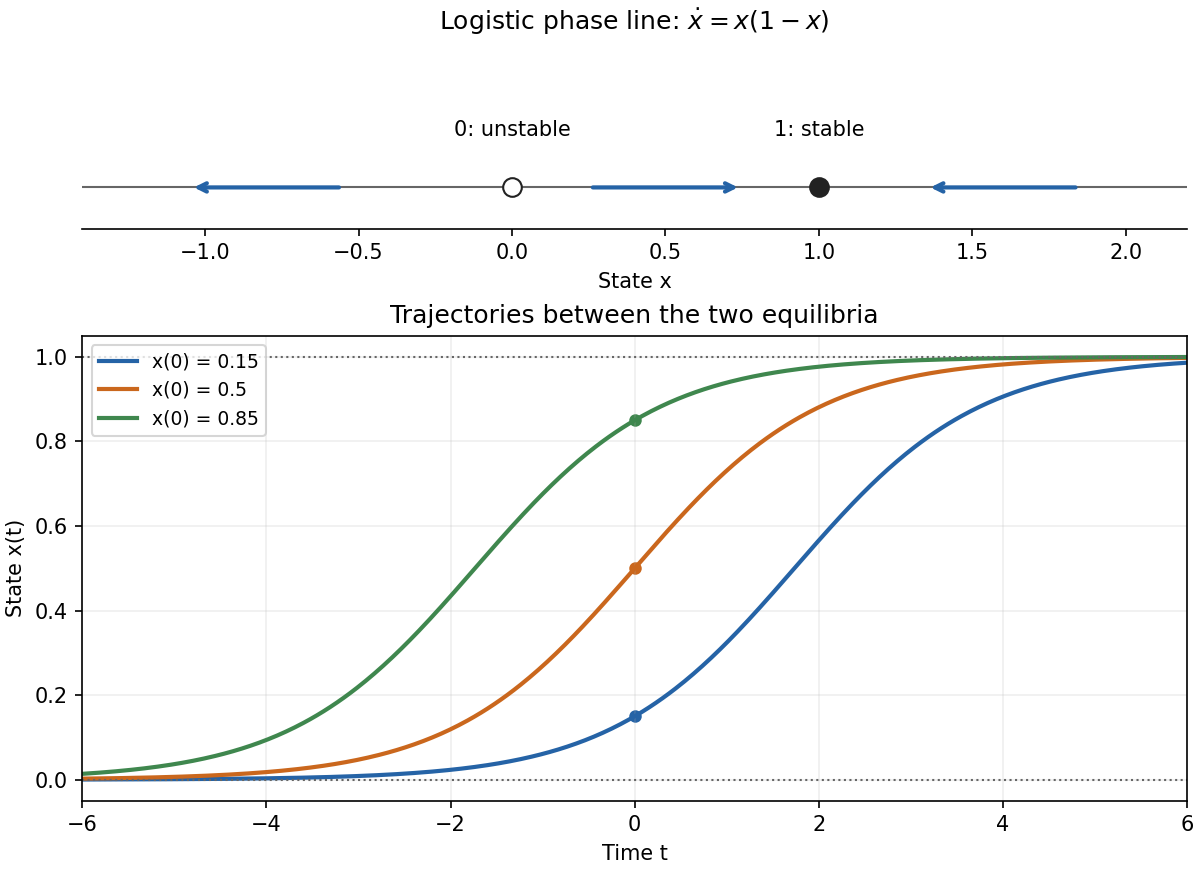
Logistic phase portrait and representative trajectories between the equilibria
. Details. 
If , the denominator is positive for every real . The solution stays between the equilibria and increases monotonically, withMore precisely in the remote past and in the remote future. Outside that interval there is a finite-time pole: for it occurs in the future, and for in the past, at . This does not affect the globally defined trajectories requested between zero and one.
Substituting an exponential particular solution gives , or . Since is not an eigenvalue of , the matrix is invertible. The exponential forcing of a constant-coefficient differential system therefore hasFor the specified matrix, . Solving , gives , soDifferentiation verifies both component equations directly. If a general solution were desired, the homogeneous term would be added, with the matrix exponential here equal to because .
A real function on an interval is a convex function iffor all in its domain and . For a finite-valued random variable with values and probabilities , Jensen's inequality statesApply this with equal probabilities to and the convex function on the nonnegative axis:Multiplying by proves the sharp two-term convex power bound. Conversely taking forces . ThusFor the inequality is equality for every pair; for equality occurs when .
Writing , the ordinary probability generating function isIts finite sum can be differentiated termwise, givingThe Dirichlet probability generating function is the different transform . Evaluating at gives the first ordinary moment, whereas differentiation gives . ThereforeThere is no convergence issue because the support is finite and all its values are positive.
First solve the closed linear system of differential equations for . Its coefficient matrix is , with characteristic polynomial . Corresponding eigenvectors are and . The homogeneous solution is thereforeUse separate exponential particular solutions for the two forcing frequencies. Solving and gives and . HenceThe third equation then gives . Integrating,The three arbitrary constants span the general solution: two arise from the first-order subsystem and one from integrating .
Apply the chain rule to . Holding fixed while differentiating in gives , while and . Thus the advection-diffusion equation becomesThe moving coordinate follows the unit-speed advection, leaving the heat equation with a transformed source.
For , the Heaviside function vanishes, so . For , , giving . Continuity of and at zero requires and . Consequently the general continuously differentiable profile isIts second derivative jumps from zero to minus one. The equation is satisfied classically away from zero and in the weak, or distributional, sense across it; no globally twice-differentiable function can have the prescribed step as its second derivative. There is no Dirac delta contribution because is continuous. The value assigned to the Heaviside function at a single point does not change this weak solution.
Under the moving-coordinate transformation, the forcing is . Choose a stationary solution , which requires precisely . The left spatial limit of is zero only if . Therefore one solution is the transported step forcing in an advection-diffusion equation profileIt has and , so their sum vanishes; almost everywhere , canceling the source. The first derivatives are continuous on the moving interface. For each fixed , the profile is zero far to the left and tends to minus infinity to the right, as required. The PDE holds pointwise off that interface and weakly across it, consistently with the requested continuously differentiable regularity.
The Wronskian satisfies Abel identity. Differentiating and substituting the homogeneous equations givesso . The two homogeneous solutions are therefore independent.
Define the variation of parameters kernelFor fixed , it satisfies the homogeneous differential equation in . Direct evaluation gives and . For , differentiation under the integral therefore yieldsCombining these identities proves ; both initial values vanish. Continuity of the coefficients gives uniqueness of this initial value problem, establishing the proposed formula rather than merely recognizing it as a standard method.
For the oscillator, , and , so the kernel is . HenceUsing and givesThe factor reflects resonance with the homogeneous oscillator frequency.
Seek a power series . The initial values give and . Matching the coefficient of for gives . Induction yields , henceThe ratio of successive absolute terms is , so the series and its derivatives converge on every compact interval and satisfy the equation and initial values.
The first recursive approximations are , and . The general formula isIt holds for . Assuming it for , twice integrating with the required initial values gives the Volterra integral equation iterationEach monomial integrates by , producing precisely the next truncated series and proving the induction. The integrand is continuous at zero by its limiting value, since each previous iterate has zero constant term. Thus the Volterra iteration for a singular power-series problem produces successive partial sums, converging with derivatives on compact sets to the analytic solution already found.
Condition on the current generation size. By independence of offspring families, . Taking the expected value gives the probability generating function recursionInduction therefore proves the branching-process generating-function iterationwhere the right side means -fold composition, not an ordinary power.
Let and be the offspring mean and variance, assuming a finite second moment. Differentiating the generating-function recursion at one gives and, with ,Since , this impliesIteration and summation of the geometric progression give the mean and variance of a Galton-Watson generation:For the offspring count is identically zero, so every later generation has zero variance. The zeroth generation always has zero variance. Finiteness of the needed moments is an assumption for this finite-valued variance formula, not a consequence of merely having a probability generating function. With finite positive mean but infinite offspring variance, all positive-generation variances are infinite.
For the total count, make the generation convention explicit. If the first generations include the ancestor, put and , with . Given children of the ancestor, each starts an independent depth- descendant tree with generating function . The ancestor contributes an additional factor , soThis is the finite-horizon total progeny generating function. If instead “first generations” means descendants , excluding , write for that convention. Conditioning on the children now gives , with and . The two conventions encode the same tree but different counts.
Independence gives the joint probability density function on . The inverse transformation isIts Jacobian matrix has absolute determinant . One way to see the determinant is to use polar coordinates: , , with . Then . The change-of-variables formula for probability densities givesand zero outside that support. Integrating over the complementary variable givesThese are respectively a unit-rate exponential distribution and a unit-scale half-Cauchy distribution. Their product equals the joint probability density function, so and are independent. This radial-ratio independence of two half-normal variables results from the radial symmetry of the positive-quadrant joint probability density function.
After the top card is fixed, precisely three of the remaining fifty-one cards have the same rank. Thus a fresh uniformly shuffled deck has matching probabilityIn each independent round, the algorithm repeats with probability and stops with probability . A match always stops. Summing the probabilities over the possible number of repeated rounds givesFor the stopping probability per round is at least , so termination is almost sure.
Permutation of the thirteen rank labels preserves both the uniform shuffle and the stopping rule. The two marginal distributions are consequently uniform:To establish independence, it is necessary to check the joint probability distribution, not just these marginals. For a specified rank , the fresh-shuffle diagonal probability is . For different specified ranks , it is . Reweight by the acceptance probability and sum over repeated rounds to obtainThe diagonal must equal for independence, forcing and thereforeAt this value the off-diagonal expression is also , proving sufficiency for every ordered pair. This is an example of match-biased reshuffling preserves uniform rank marginals: state-dependent rejection sampling changes dependence even though both individual rank distributions remain uniform.
Normalization uses , henceEach variable therefore has the standard Cauchy distribution. Let . We prove by induction that its probability density function isIt holds for . If it holds for , independence and convolution of probability densities giveThe supplied integral identity makes this , completing the induction. Thus addition increases the Cauchy scale to .
For , the density transformation is , givingThe Cauchy sample mean has an unchanged distribution. In particular, for every ,independently of , so the average does not converge in probability to zero.
There is no contradiction with the usual weak law of large numbers, whose finite-first-moment hypothesis is absent: . The positive and negative parts of both have infinite expectations, so is undefined. Its symmetric principal value is zero, but a principal value is not an expected value. The law therefore supplies no conclusion that these sample averages must approach zero.
Let . A concrete real matrix isIts first coordinate has eigenvalue . The lower block has characteristic polynomial , whose roots are . Thus this example has all three required eigenvalues. It is also an orthogonal matrix, but orthogonality is not forced by its spectrum, as the second part shows.
True. All three eigenvalues are distinct in , so their nonzero eigenvectors are linearly independent. Here is a direct proof of that assertion. If , apply to obtainDistinctness makes both scalar factors nonzero, hence . Applying the analogous products gives . The three eigenvectors therefore form a basis of . Taking them as the columns of givesThis proves that every such matrix is a diagonalizable matrix over , rather than merely showing it for the example.
False. Consider the real matrixIt is block upper triangular, so its characteristic polynomial is the same as that of and it has the required eigenvalues. Its second column, however, has squared Euclidean norm , whereas every column of an orthogonal matrix has norm one. ThusUnit-modulus eigenvalues alone do not imply orthogonality; they do not control the geometry of the eigenvectors.
False; in fact no matrix with this spectrum is diagonalizable over . If a real invertible gave with a real diagonal matrix, all eigenvalues of would be the real diagonal entries of . But two of the required eigenvalues have nonzero imaginary parts. This contradiction provesThe real block form in the initial example is consistent with this: a two-dimensional rotation block is not a real diagonalization.
Both subgroups contain the identity element, so is nonempty. If , then belongs to both and , hence to their intersection. This gives closure under inverses by setting , and closure under products by using the inverse of . Therefore is a subgroup of , and also of both and .
Lagrange's theorem for finite groups states that the order of a subgroup divides the order of its finite ambient group; more precisely for . Applying it twice givesSince and are coprime, their only positive common divisor is one. Thus
Take the unit normal to point outwards. The divergence of the field isThe divergence theorem turns the closed surface integral into a volume integral over :For a direct check of the surface integral, on the outward component is , contributing . On it vanishes. On both and , . On , , whereas on the field component is and the outward normal is , giving a contribution . The six face contributions are therefore , again totaling 2. The positive bottom-face contribution is a consequence of its outward orientation.
Use suffix notation, summing repeated indices, and write . For a twice continuously differentiable vector field, mixed derivatives commute. Thus the divergence of its curl satisfiesbecause the derivatives are symmetric in , while the Levi-Civita symbol is antisymmetric in those indices. HenceFor the second identity, use the contraction of two Levi-Civita symbols:Rearranging each component proves the vorticity cross-product identityThe second identity needs first derivatives; the first additionally uses equality of the mixed second derivatives.
For the centralizer of a subset, the identity commutes with every . If commute with each member of , then for every such ,Also implies after multiplication by on both sides. Thus identity, products and inverses lie in , proving that it is a subgroup.
For the conjugation action, identity acts trivially, andThese are the defining laws of a left group action. Its orbits of a group action are the conjugacy classes. The stabilizer of is exactly its centralizer, since if and only if . The orbit-stabilizer theorem therefore givesA class has one element exactly when that element commutes with all of , so the singleton classes are precisely the elements of , the centre of a group. Partitioning into all its conjugacy classes now proves the class equationFor , Lagrange's theorem for finite groups makes every class size a power of . A nonsingleton class has size at least and is therefore divisible by . Reducing the class equation modulo yields , because . The identity lies in , so its order is positive and divisible by . ConsequentlyThis proves the nontrivial center of a finite p-group directly from the conjugation classes.
A group homomorphism sends identity to identity. For in its image,which is still in the image; hence the image of a group homomorphism is a subgroup of . Let . It is a subgroup by the same identity, and for and ,Thus , and replacing by gives equality, proving that is a normal subgroup.
Define a map from the quotient group byIf , then and , so the map is well defined. Conversely equality of the images implies , giving injectivity. It is onto by the definition of image, and . This proves the first isomorphism theorem for groups in this case:An orthogonal matrix has , so . The determinant is therefore a group homomorphism , with image both signs because has determinant . Its kernel is the special orthogonal group . Hence is normal in , andFor the last request, the determinant-twist projection in odd dimension gives an explicit example:Indeed , and scalar factors commute, so . If , then , making or . Both lie in the kernel, which is therefore exactly , of order two. The map also fixes every member of , so it is onto.
Since is a group homomorphism, , , and . The product is closed on . Its two associative bracketings giveand coincide by the homomorphism property. The identity element is , and the two-sided inverse isFor example, multiplying on the right gives , and multiplying on the left gives . Thus this law defines a group, specifically a semidirect product.
If it is an abelian group, comparing and gives for every . Hence for every . Conversely this trivial action makes the product ordinary vector addition. Therefore the unique action giving a commutative group isFor the final condition, compare and . They are and respectively. They coincide for every exactly when for every . The first column of is then ; since it lies in the special linear group, its determinant is one and its other diagonal entry is also one. ThusMatrix multiplication gives . Conversely any such additive function gives a homomorphism into fixing and therefore makes these translations central. This proves the full characterization of the central translations in a linear semidirect product:No continuity or measurability is assumed, so it would be unjustified to restrict the answer to .
Let , with . If , then anda composition of a nonzero scaling and a translation. If , rearrange the fraction asThus every Möbius transformation is a composition, in order, of translation by , reciprocal inversion, nonzero scaling by , and translation by . All formulas act on the Riemann sphere, including zero and infinity. The scaling parameter must be nonzero for that factor to be a Möbius transformation.
For three distinct finite points, define the cross-ratio normalizationIt sends to respectively. If , use ; if , use ; if , use . These are the corresponding limits of the same formula and cover all possible triples. Form the analogous normalization of the target triple. Thenhas all three specified images, proving existence. For uniqueness, the quotient of any two such maps fixes the three source points. Conjugating by gives a Möbius transformation fixing . Fixing zero and infinity forces it to be , and fixing one forces . The quotient is identity, so the two maps are equal.
The Möbius transformations permuting three points are therefore in one-to-one correspondence with permutations of the triple. For the normalized set the six maps and their ordered images of areThey realize all six permutations. The action map to the symmetric group is a homomorphism, is injective by the three-point uniqueness proof, and is onto by this list. Hence
On the first leg and decreases from one to zero; on the second and increases from zero to one. Adding their line integrals givesThe negative sign in the first term follows from the direction of traversal.
For the anticlockwise arc use , , . Since and , the line integral becomesThe two integrals multiplying each equal , by substituting and respectively. The remaining integral equals one. Thus
When , all three values reduce to . To prove path independence for every piecewise smooth path, construct a global potential rather than infer it from agreement on only three paths. Integrating the coefficient of and then matching the coefficient of givesIndeed and . The integrand is the exact differential throughout . The fundamental theorem for line integrals therefore gives, for every such path from to ,
Articles were limited to the first 100 out of 249 total.
Articles by others on the same topic
There are currently no matching articles.