The defining rule for a derivation of a Lie algebra is linear in the operator, so is a vector subspace of the general linear Lie algebra . Its Lie bracket is the operator commutator. If are derivations of a Lie algebra, expand both compositions:Subtracting cancels the mixed terms and givesThus is again a derivation of a Lie algebra, proving that the derivation Lie algebra is a Lie subalgebra of . This calculation works in every characteristic of a field.
The Jacobi identity states . It first shows that is a derivation of a Lie algebra, and then givesThe map is linear, so this identity proves it is a Lie algebra homomorphism.
Finally, for any derivation of a Lie algebra ,ConsequentlyThis proves that the inner derivations of a Lie algebra form an ideal of a Lie algebra in .
Equip with the inner product defining the root system, so the Weyl group acts by orthogonal transformations. As usual, the root system spans its ambient space . Let be an invariant subspace for the reflection representation of a Weyl group. Its orthogonal complement is also invariant.
For a root , the Weyl reflection satisfiesIf for every , then . Otherwise choose with . Both and belong to , and their difference is a nonzero multiple of , so . HenceThe two sets are mutually orthogonal and individually closed under their root reflections. If both were nonempty, this would decompose into two orthogonal root systems, contradicting that it is an irreducible root system. All roots therefore lie in one of the two subspaces. Because they span , either or , the latter giving . Thus the reflection representation is an irreducible representation.
Use the traceless diagonal Cartan subalgebra of the special linear Lie algebra . Write , so . The standard coordinate vectors are weight vectors of weights , and the tensor product of Lie algebra representations has basisThe weight of this basis vector is . There are two possibilities:The first has basis , with the wedge ordered if necessary. In the second, the tensor's first factor can be any one of the three indicated coordinate vectors. No two different listed coefficient patterns restrict to the same functional on the traceless diagonal Cartan subalgebra: their difference would have to be a multiple of , but its coefficient sum is zero. All unlisted weight spaces are zero. As a check,For , the distinct-index weight is zero and has multiplicity three.
To determine the irreducible summands, take the upper triangular raising operators. The vector is killed by every such operator and has highest weight . The exterior product mapis a Lie algebra representation homomorphism. It has an equivariant right inverseIndeed . The vector is a highest-weight vector of weight .
The Weyl complete reducibility theorem and highest-weight representation theory show that generates an irreducible summand in . To check that it exhausts this kernel, use the Weyl dimension formula with the partition :This equals . The exterior-power Lie algebra representation is irreducible, with highest weight for , and is the one-dimensional trivial representation for . Therefore the tensor product of the standard representation with its exterior square givesEach summand occurs once; their dimensions are and .
Write an element of the symplectic Lie algebra in blocks. Direct multiplication in givesThe diagonal Cartan subalgebra consists of . Define . Under the Adjoint representation, the off-diagonal matrix units in have weights ; the symmetric entries in have weights , including on the diagonal; those in have the negatives of these weights. All nonzero root spaces are one-dimensional, while the zero weight space is the diagonal Cartan subalgebra. Thus the Cn root system isChoose the positive roots and simple roots asTheir highest root and Weyl vector areFor the last identity, each pair contributes before division by two, and the long positive root contributes another afterward. Successive simple roots have equal length except for , whose squared length is twice that of . The Cn Dynkin diagram is a chain with a double last bond, whose arrow points toward , the short root:
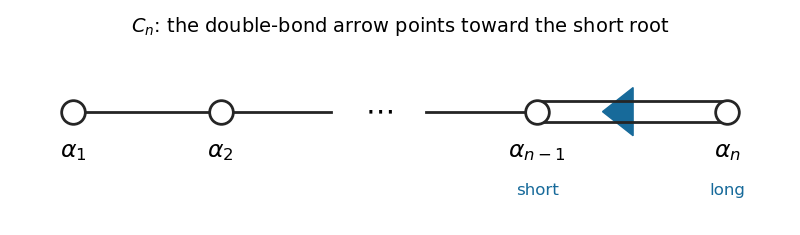

The displayed schematic is for ; omit intermediate nodes for . For the diagram has just the single node .
Let with its nondegenerate alternating bilinear form. Its inverse-form bivector is invariant under the symplectic Lie algebra, and . Choose . The exterior product defines a symmetric bilinear form on byIt is symmetric because two-forms commute under the wedge product. It is nondegenerate because each basis wedge pairs with its complementary basis wedge. Since , the five-dimensional orthogonal complementalso has a nondegenerate symmetric bilinear form. This is the primitive exterior square, equivalently the kernel of symplectic contraction of an exterior square.
Every element of fixes and preserves volume, since its trace is zero. The induced exterior-power Lie algebra representation consequently preserves and satisfies . Thus it gives a Lie algebra homomorphismWe check injectivity explicitly. If acts as zero on , it also kills , and therefore acts as zero on all of . For three distinct indices , the coefficient of in is , so all off-diagonal entries of vanish. Its action on is then . All these sums vanish, which in characteristic zero forces every diagonal entry to vanish. Hence .
Finally,The injective Lie algebra homomorphism is therefore surjective. Over , every nondegenerate symmetric bilinear form admits a basis in which its matrix is the identity, so this constructs the exceptional isomorphism between sp4 and so5:
Identify the diagonal Cartan subalgebra with through its coordinates , and identify real roots with coordinate vectors using the invariant Euclidean inner product. A Weyl reflection is . It does not change when is replaced by . For the Cn root system, its explicit actions areEvery coordinate not displayed stays fixed. Thus each generating Weyl reflection is a signed permutation, so the Weyl group is contained in the signed symmetric group. Conversely, the first row supplies each independent sign change and the second supplies every coordinate transposition; these generate the entire signed symmetric group. This proves the Cn Weyl group identification, including its size:
Suppose that is not a discrete subgroup. The identity is then an accumulation point of nonidentity subgroup elements: translate any failure of isolation to the identity. Choose with , and use a local exponential chart to write , where and in the real Lie algebra .
Choose a norm on this finite-dimensional vector space. By compactness of its unit sphere, pass to a subsequence with , where . For an arbitrary real , choose an integer nearest to . Then andEvery left-hand element belongs to , including for negative . Closedness gives . Since was arbitrary and , the limit directions of a closed subgroup provide a nontrivial one-parameter subgroup in . Its derivative at zero is , so it cannot be the constant subgroup.
For , we prove closure under addition using the Lie product formula in a Lie group. In the local exponential chart, let . Smooth multiplication has differential at the identity, so Taylor's theorem givesFor each fixed real and all sufficiently large positive integers ,Every term belongs to , and is closed, proving . Thus is a real vector subspace. It is also closed: if with , continuity of the Exponential map of a Lie group gives for each .
For the Lie bracket, use the Adjoint representation of a Lie group. Conjugating a one-parameter subgroup givesConsequently . For , linearity puts in . Its limit as is . Closedness of therefore gives , proving that the Lie algebra of a closed subgroup is a Lie subalgebra of .
Choose a real vector subspace complementary to , so . The smooth maphas differential at , an isomorphism. The inverse function theorem makes a diffeomorphism from a sufficiently small product neighborhood onto an open neighborhood of the identity in .
There is a neighborhood of zero in in which implies . Otherwise choose nonzero tending to zero with . A normalized subsequence tends to a unit vector . The limit directions of a closed subgroup from part (a) give , contradicting . Shrink the product neighborhood so that this exclusion holds throughout its first factor.
If , then by the definition of , and hence . The exclusion forces . Conversely, every belongs to . Thus the local product coordinates for a closed subgroup identify near the identity exactly with the smooth coordinate slice .
Left translation by each element of gives the same description around that element, so is an embedded submanifold of in its subspace topology. The multiplication and inversion maps of restrict to smooth maps on this embedded submanifold, making a Lie group and an embedded Lie subgroup. Its tangent space at the identity is , because is the identity on this coordinate slice. It remains closed by hypothesis. This proves the closed-subgroup theorem, with no prior smoothness assumption on .
Articles by others on the same topic
There are currently no matching articles.