In Landau-Ginzburg theory, a scalar order parameter distinguishes macroscopic phases: for an Ising model it is the magnetization per site, while near a liquid–gas endpoint it can be a shifted density. An ordered pure thermodynamic phase has a nonzero value even when the conjugate field is removed. For a symmetry-related pair, take the thermodynamic limit before ; a finite-volume symmetric ensemble instead has zero average.
Coarse-grain to a slowly varying real field and use a local, symmetry-constrained free-energy density. A useful convention isFor spin inversion symmetry, odd powers other than the externally imposed source are absent. Take when the quartic coefficient can be negative; for an ordinary transition already stabilizes the quartic truncation. The gradient energy penalizes spatial variations. In the Landau approximation, minimize this functional, usually first over constant fields. The corresponding statistical field theory also integrates fluctuations with weight . The order parameter identifies the phase; its spatial field describes both equilibrium order and its fluctuations.
A first-order phase transition exchanges two distinct global minima of the Landau free energy. The equilibrium free energy remains continuous, but a first derivative such as the magnetization or entropy jumps. A temperature-driven transition generically has latent heat; crossing between symmetry-related ordered phases instead has a magnetization jump without requiring latent heat. A continuous phase transition has no such order-parameter jump and usually has a divergent correlation length and nonanalytic higher responses.
For , and crossing zero, minimizing gives for and for . The minima merge continuously at zero. The curvature vanishes there, so the long-distance response becomes singular.
For , put . A nonzero stationary minimum satisfies . Equality with the free energy givesThe finite separation demonstrates the first-order phase transition. Metastability occurs where a nonglobal local minimum persists; its disappearance at a spinodal point is not the equilibrium coexistence criterion.
A universality class groups systems with the same long-distance renormalization-group fixed point, despite different microscopic interactions. Spatial dimension, order-parameter symmetry, interaction range and additional soft modes matter; microscopic lattice spacing or a change in a short-range coupling usually does not change the critical exponents. Irrelevant microscopic distinctions decay under renormalization-group flow.
For example, a three-dimensional short-range Ising model and a simple-fluid liquid–gas critical endpoint share the scalar Ising universality class. The fluid density deviation plays the role of the order parameter, with appropriately mixed thermal and field-like control variables. Their critical temperatures and dimensional amplitudes differ, but critical powers and suitable dimensionless amplitude ratios agree. Landau theory predicts a common set of mean-field critical exponents; fluctuations can replace these values below the upper critical dimension. Universality concerns the long-distance singular behavior, not equality of microscopic parameters.
A critical exponent specifies a leading singular power in a response or order parameter as the thermodynamic critical point is approached. Analytic backgrounds and the selected thermodynamic branch must be distinguished from that singular part. Write , , and first take . The equation of state is .
At zero field on the ordered branch, , giving the order-parameter critical exponent . Differentiating the equation of state gives : above the transition , below it , so the magnetic-susceptibility critical exponent is . At , , giving the critical-isotherm exponent .
The minimized singular free-energy density is above and below. Two temperature derivatives produce a finite specific-heat jump, corresponding to the heat-capacity critical exponent . The inverse quadratic fluctuation kernel is , so gives ; the critical propagator proportional to gives . ThusThese mean-field critical exponents follow from minimization and linear response. More generally, linearize the renormalization group and differentiate its singular free-energy scaling form to obtain the actual fluctuation-controlled exponents.
In a smooth scalar Landau free energy, a line of coexistence between two distinct minima can end by those minima and the intervening maximum coalescing. At a generic endpoint with no competing third phase,The first condition is stationarity, the second removes the inverse susceptibility, and the third is needed because nonzero cubic curvature at a zero-quadratic point would prevent it being a stable minimum. After shifting and mixing two control parameters, the local potential is , . Its two-phase coexistence line reaches , with and diverging magnetic susceptibility. This is the familiar critical endpoint of a quartic Landau free energy.
The word “must” needs the two-phase endpoint assumptions. A first-order line can instead end at a triple point or a boundary of the available control parameters. There is an explicit scalar counterexample in the sextic potential: fix and vary . The coexistence line at , ends when the phase also becomes globally stable. At that triple point the nonzero minima remain ; their jump does not vanish. Thus the literal unrestricted assertion is false. The continuous-endpoint argument above establishes the intended case and distinguishes it from this counterexample.
Consider the plane at for , with fixed . For , the continuous boundary is : above it the global minimum is zero, and below it there are two symmetry-related ordered pure thermodynamic phases. For , the equilibrium boundary is the tricritical three-phase lineAbove this curve the disordered minimum wins; below it the two ordered minima win. On the curve,Its three zeros are exactly and , proving equality of three global minimum values. Spin inversion symmetry enforces the equality of the two ordered phases automatically, so tuning a single remaining coefficient can produce three-phase coexistence on a line in this symmetry plane. This does not contradict the generic phase-rule counting without symmetry restrictions.
The tricritical point is , where the discontinuity vanishes, the first-order boundary meets the continuous boundary, and the positive sextic term becomes the leading stabilizer. The local metastability limits and , , bracket the first-order curve but are not phase boundaries. In the full parameter space, the zero-field line is attached to tricritical wings; a nonzero field splits the equality of the two ordered phases.
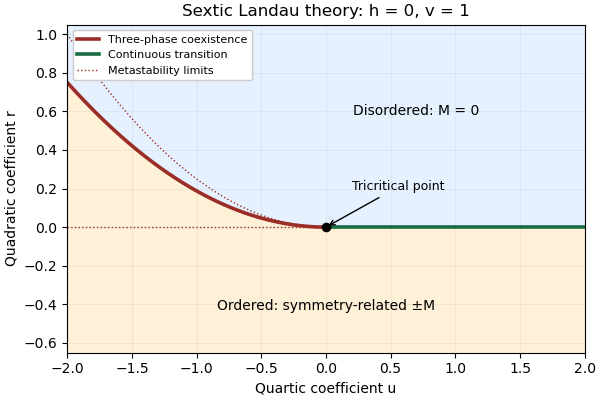
Zero-field sextic Landau phase diagram, showing the continuous boundary and three-phase coexistence line
. Details. 
At the tricritical point, tune , hold , and let cross zero. The equation of state becomes . At , , while the inverse susceptibility on the ordered branch is . On the disordered side it is . At , . Therefore , and .
The minimized singular free-energy density isTwo temperature derivatives give a singular heat capacity proportional to on the ordered side. Consequently the mean-field tricritical exponent calculation givesThe displayed scaling relations for critical exponents hold numerically:These are Landau theory values with both relevant coefficients tuned: along a generic path with fixed , the asymptotic transition is ordinary rather than tricritical. The sextic upper critical dimension is three, so fluctuations can change the powers below three dimensions, and logarithmic corrections are possible at three. The vanishing disordered mean-field singular amplitude does not invalidate the ordered-side exponent.
Use a selected translationally invariant pure thermodynamic phase and define the connected lattice correlation functionAway from criticality its long-distance tail has an exponential factor , possibly multiplied by a power. Equivalently when this limit exists; different directions can have different lengths on an anisotropic lattice. At a thermodynamic critical point the correlation length diverges and the tail becomes algebraic. Differentiate with respect to the physical field appearing in the energy Statistical Hamiltonian. With , the correlation-function susceptibility sum rule isIn physical continuum coordinates the sum becomes . Differentiating with respect to the dimensionless source instead removes the explicit inverse-temperature factor. Below the transition, take a one-sided pure-phase limit rather than a macroscopic symmetric mixture.
A normalized blocking kernel assigns a probability or a delta constraint to a coarse configuration for each microscopic one, with . Define the blocked Boltzmann weight bySumming over proves exact equality of the partition functions. Repeated real-space renormalization group steps compose the kernels and integrate out shorter-scale variables. To retain equality one must keep all generated interactions and the field-independent constant; a finite truncation is an approximation. Long-distance observables are mapped through the corresponding coarse observables, not identified blindly with microscopic spins. In physical units,A subsequent coordinate rescaling restores the reference lattice spacing while expressing couplings in cutoff units.
Let be free energy per microscopic site. Invariance of givesThe constant transforms as . Therefore, with , the identity-operator contribution to renormalization-group free energy givesThe second equality follows by substitution and induction. The inhomogeneous term records eliminated-mode entropy, determinants, and normalization factors, all multiplying the identity operator; it is not an interaction with the retained spins. Strictly, this can contain regular background terms. After an analytic subtraction of an inhomogeneous renormalization recursion, the genuinely singular part satisfies the homogeneous scaling equation, except for possible logarithmic resonances.
A renormalization-group fixed point satisfies . Linearize in scaling coordinates : . A relevant operator has , an irrelevant operator has , and a marginal operator has and needs nonlinear analysis. These are logarithmic scaling eigenvalues; the discrete Jacobian eigenvalues are , not . The critical surface is the stable manifold obtained by tuning all relevant coordinates to zero. A repulsive renormalization-group trajectory leaves the fixed point along a relevant direction as the coarse-graining length grows. Stable and unstable manifolds become curved away from linear order.
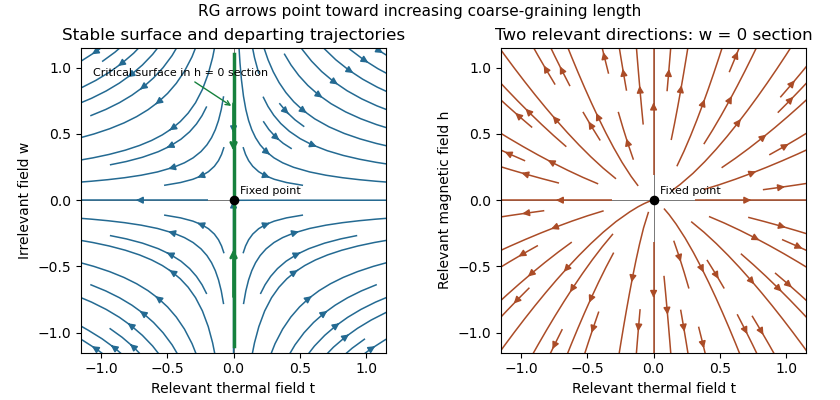
Linear renormalization-group flows: attraction along a critical surface and repulsion in two relevant directions
. Details. 
The left section has , one irrelevant coordinate and a relevant thermal coordinate . Its critical surface is in that section. With two relevant variables, the full critical surface has codimension two: the second section shows repulsion in the plane at .
Assume an isolated fixed point with two relevant scaling fields, analytic changes from physical controls to , short-range isotropic scaling, no dangerously irrelevant variable in the thermodynamic scaling function, and no marginal or resonant logarithm. Let denote their scaling eigenvalues. The homogeneous singular free-energy density obeysChoose a stopping scale so the renormalized thermal field is order one. Irrelevant fields vanish at this scale. With and ,Continuous scale interpolation absorbs the immaterial integer stopping-scale convention. Nonuniversal thermal, field and free-energy metric factors can be included explicitly; the normalized functions depend only on the universality class. The and labels refer to and , which flow to different sides of the critical surface.
For clarity about the additive terms, let solve . If , its analytic coefficients areprovided the denominators do not vanish. Subtracting makes the recursion homogeneous. A vanishing denominator is a resonance and generically produces logarithms, which the simple power-law hypothesis excludes. In a convention where the regular field-dependent background has been subtracted, write and . This yields the requested formThe contain branch-dependent matching contributions; only is physically determined. The are nonsingular functions analytic through the thermodynamic critical point and represent the same regular Taylor background on the two sides, though either branch may be used to describe them. For the full free energy at nonzero field, the regular background is generally , not just . Adding an analytic identity-operator contribution proportional to provides a direct counterexample to an exact unrestricted formula; it changes no singular exponents. The printed expression is justified for the leading singular scaling form with that analytic field background removed. Confluent corrections from irrelevant fields are also omitted in this leading form.
Differentiate the singular scaling form, with one-sided derivatives in the ordered phase. It givesThe length transforms as , so . Thus the Rushbrooke scaling relation and hyperscaling relation follow by direct substitution:The same reasoning also gives . Hyperscaling relation relies on the assumptions above and can fail above an upper critical dimension because of a stabilizing dangerously irrelevant coupling.
For the universal specific-heat amplitude ratio, write at . Two temperature derivatives multiply both branches by the same dimensional and thermal metric factors. Away from logarithmic resonances and exceptional zero amplitudes, with the same heat-capacity sign convention on both sides. HenceThe functions and their matched branch constants are tied to the fixed-point theory; the constants are not independent arbitrary experimental parameters. If , this means the amplitudes of the subleading singular contribution after subtracting the analytic specific-heat background. A finite background ratio itself need not be universal.
Take a positive gradient coefficient , a positive squared mass, a finite-volume regulator and an ultraviolet cutoff. Use the dimensionless statistical action convention : inverse temperature is absorbed into the coefficients. If denotes dimensional energy instead, the exponent below gains a factor and the covariance gains . These conventions cannot be mixed.
Choose the Fourier transform conventionIntegration of the quadratic gradient and source terms givesComplete the square with . Translation of the regulated real Gaussian variables leaves their measure unchanged, so the Gaussian integral givesHere is the source-free Gaussian partition function. For independent regulated real coordinates and a positive quadratic matrix , it is under Lebesgue normalization. The continuum determinant needs the stated regulator and a measure convention. Reality pairs the nonzero Fourier modes, so they must not be counted as two independent real fields.
A connected correlation function subtracts the product of the means. The logarithm generates its cumulants: differentiating twice with respect to the source, using the measure in the functional derivative convention, yieldsThe source changes the mean but not the covariance; the stated zero-source limit therefore follows immediately. Momentum conservation uses , appropriate for a real field without complex conjugation on either displayed factor.
For the continuum massive Gaussian field correlation tail, set and . Fourier inversion givesThe large-argument Modified Bessel function of the second kind has . Hence is proportional to at large distance andAt zero mass the exponential length diverges. For the critical continuum tail is algebraic, ; in lower dimensions infrared regulation needs additional care.
For a uniform source , perform a momentum-shell renormalization group step: separate slow modes and fast modes . In a Gaussian field theory they decouple; the uniform source couples only to the retained zero mode. Integrating fast modes contributes only a field-independent determinant to the free energy. Restore the cutoff by , andThe factors from the measure, gradient and two fields cancel in the gradient term. The mass term gains , and the linear source gains . ThereforeHere is the positive mass; for signed thermal coordinates it is the squared-mass relation that applies. The Gaussian fixed point has thermal scaling eigenvalue , source eigenvalue and zero anomalous dimension.
Under the formal homogeneous Gaussian scaling hypothesis, substitution of those eigenvalues givesThe last two values are independently visible in and , agreeing with Landau-Ginzburg theory. The specific-heat power follows directly from the determinant: after two thermal derivatives its singular contribution is proportional toThe change of variables proves this power because the rescaled integral converges at large exactly when . The two-dimensional free energy itself has a resonance, while its second derivative still has the indicated power.
The printed magnetization exponent is a formal Gaussian scaling index, not a proved ordered-phase law of the purely quadratic model. The ordered-phase obstruction in a Gaussian scalar model is explicit: the uniform field has energy density . At it tends to as , and the partition function diverges. For , the mean is and tends to zero as , so there is no spontaneously ordered branch. Thus no literal for can be established from this Statistical Hamiltonian alone. The value follows from the scaling dimension of the field if one assumes such a branch; for its nonpositive value further warns against that interpretation. Adding a stabilizing quartic interaction defines an ordered phase, but below four dimensions that interaction is relevant and generally leads to the Wilson-Fisher fixed point, not these Gaussian thermodynamic powers.
For the Gaussian specific-heat infrared threshold, at the same determinant integral grows like , so as a power exponent, with a logarithmic divergence. For , it has a finite cutoff-dependent limit; the leading heat capacity is a regular constant and has no divergent power, again described by in the requested convention. After subtraction of this background the Gaussian singular term can still have the negative power index ; it is not correct to erase that distinction. In a stable quartic Landau-Ginzburg theory above four dimensions, the quartic coefficient is a dangerously irrelevant coupling: it is needed for the ordered phase and contributes , giving the mean-field specific-heat jump and while invalidating naive hyperscaling relation. At four dimensions, marginal interactions can add further logarithmic corrections. The agreement with Landau theory is in the leading heat-capacity power; it does not assert the absence of logarithms or supply a missing stable Gaussian ordered phase.
Articles by others on the same topic
There are currently no matching articles.