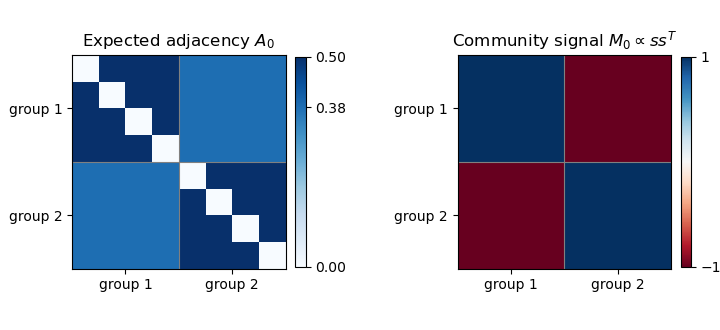
Write on and on , and put and . Because the two groups have equal size, are orthonormal. Let and . The expected value of the adjacency matrix of a graph is . ConsequentlyBoth displayed eigenvalues are positive under the stated range of , so the first matrix has matrix rank two. The other eigenvalues are zero. The figure shows the within-group and between-group blocks of this balanced stochastic block model; itself has zero diagonal.

For a symmetric matrix with simple largest eigenvalue and spectral gap , the Davis-Kahan curvature lemma says , where is its leading unit eigenvector. Applying this to a leading eigenvector of , the maximal Rayleigh quotient and duality of the operator norm and trace norm give ; the projector difference has matrix rank at most two. This is a rank-one eigenprojector perturbation bound.
Here has independent centered bounded upper-triangular entries, apart from symmetry. The spectral norm bound for a centered Bernoulli adjacency matrix gives . Taking and therefore gives, for the largest-eigenvalue estimator,The printed argmin selects the wrong end of the spectrum. For a minimizing unit eigenvector , compare its Rayleigh quotient with any unit vector orthogonal to . This yields , and hence . Its mean projector error is at least , using . Along with sufficiently large even , the printed parameter restriction holds and this lower bound tends to , contradicting an error of order . Replace argmin by argmax, or negate the entire matrix before minimizing.
For partitions, the appropriate Hamming distance between unlabelled bipartitions is . It counts vertices assigned to the wrong group after the better global exchange of the two group names. The printed signed-indicator formula does not implement this exchange: negating a zero-one indicator is not taking its complement. It must be read as this partition distance, or written with the membership vectors.
Use the corrected leading eigenvector estimator from 4(b), and orient its sign to minimize . At every wrongly signed coordinate, this difference has magnitude at least . Therefore the sign rounding bound for a unit eigenvector givesThe last inequality uses the projector distance bound . Taking the expected value of this Frobenius norm estimate proves . The assertion relies on the corrected estimator and partition-distance definition.
The Kullback-Leibler divergence of a product measure is the sum of the individual divergences, by expanding the logarithm of the likelihood ratio and taking its expected value. Put and define to be the unordered pairs lying within one group, while is the set of unordered pairs crossing between groups. ThenThus choosing the printed to mean gives its order of the summands. If denotes the usual graph cut , their two orders must be interchanged. Each unordered edge is counted once.
The inequality givesSince , each changed-edge divergence is at most . Summing over at most pairs gives . This is the information scale needed for Fano's inequality.
In natural logarithms, Fano's inequality for a uniform index among alternatives states . The mutual information is at most the average Kullback-Leibler divergence to any fixed reference law. With the supplied packing, nearest-neighbour decoding turns partition error below half the separation into correct decoding. Thus the packing alone proves a bound at radius , with the unavoidable term. It does not automatically prove the much larger printed radius.
A list-decoding Fano inequality supplies the intended near-half error threshold. Assume , since otherwise that threshold is nonpositive and its event is automatic. Take a uniform prior on all unlabelled balanced partitions, and let . A Hamming ball of radius less than around any estimated partition contains at most such partitions. This follows by selecting the representative closer to the estimated group; each unlabelled partition contributes at most one such representative because . The entropy bound for a Hamming ball gives , where is the binary entropy function measured in natural logarithms. Its curvature gives . Also , soUse the all- independent-edge law as a reference. Only the crossing pairs differ; the preceding Bernoulli distribution divergence estimate gives . Hence . Whenever the denominator is positive, the list-decoding Fano inequality proves the finite-sample answerFor , this is at least . If in addition , it implies the intended form with . This proves the claimed information-theoretic scale with its needed finite-sample qualifications.
As a uniform finite-sample assertion for every positive , the printed form is false. At every partition has the same data law, and a uniformly random balanced guess has a positive chance of being correct, giving error strictly below one. Such randomness can also be extracted from the finite graph sample: assign distinct graph outcomes to the finitely many balanced partitions; under the common law every selected outcome has positive probability. The worst error remains strictly below one for sufficiently small positive , by continuity. The printed lower bound tends to one as for any fixed universal , which contradicts this. The entropy correction cannot be dropped without an asymptotic or signal-size condition.
Articles by others on the same topic
There are currently no matching articles.