A transposition exchanges exactly two letters and fixes the rest. A permutation cycle sends each displayed letter to the next, sends to , and fixes all other letters.
After imposing , the remaining domain elements may be sent bijectively to the remaining values in arbitrary order. Hence the number is
There are even letters. The stated condition and injectivity force the even letters to permute among themselves, which can be done in ways. The remaining odd letters must then permute among themselves. Thus the number is
Choose the support of the four-cycle and then cyclically order it. A chosen set of four letters has distinct cycles, so the answer is
The product of two transpositions has three possible forms. Equal transpositions produce the identity, transpositions meeting in one letter produce a three-cycle, and disjoint transpositions produce two disjoint two-cycles. There are two three-cycles on each chosen triple and three pairings of each chosen four-set. Therefore the number of distinct permutations representable this way is
An equivalence relation is reflexive, symmetric, and transitive. HereThe relation is reflexive and symmetric, but it is not transitive. For example, takeThe real parts of and are positive, whereas that of is negative. Hence this is not an equivalence relation.
By the equality condition in the complex triangle inequality,for nonzero exactly when is a positive real number. Having the same complex argument is reflexive, symmetric, and transitive, so this is an equivalence relation. Its classes are the open rays from the origin.
This relation is reflexive because choosing gives . It need not be symmetric: take positive real numbers and . Then is rational, so . Butis transcendental, hence irrational, for every integer . Thus , and the relation is not an equivalence relation.
Set . The relation is exactlyIt is therefore the equivalence relation induced by a function: equality of the two function values is reflexive, symmetric, and transitive. Hence this is an equivalence relation.
For the parabola, , , , and . HenceThe difference from the straight-path value reflects that the one-form is not exact.
Green theorem states that for a positively oriented planar region ,Here and , soThe stated orientations make the positive boundary of the region inside the radius- circle and outside the radius- circle. Its area is regardless of the inner circle's center. Therefore
The central force conserves angular momentum. The initial impact parameter gives , while at closest approach the velocity is transverse and . Thus . Conservation of energy givesUnder , neglect the initial potential term and substitute :Consequently
Now , so the orbit is bound. Since , the initial energy isAt the farthest central-force radial turning point , the radial speed vanishes and the transverse speed is , givingEquating these expressions and multiplying by yieldsThus , , and .
Write the Möbius transformation asA finite fixed point of a Möbius transformation satisfiesIf three distinct points of the Riemann sphere are fixed, this quadratic is identically zero, with the usual interpretation when one point is infinity. Hence and , so . A nonidentity transformation's fixed-point equation is a nonzero polynomial of degree at most two on the sphere, and therefore it has one repeated fixed point or two distinct fixed points.
True. Conjugate the unique fixed point to infinity. The resulting map lies in the Affine subgroup of the Möbius group, so it has the form . A unique fixed point forces and ; otherwise would have a finite fixed point as well. Conjugation by the scaling changes into . Thus a nonidentity Möbius transformation with one fixed point is conjugate to a translation.
True. A Möbius transformation fixes infinity exactly when , so it has the affine formThis is the composition of the scaling and the translation .
False. Compositions of scalings and inversion reduce to one of the forms or ; they preserve the unordered pair . Butis a Möbius transformation fixing and sends infinity to , so it cannot be such a composition.
The singleton orbits are exactly . Every other orbit represented by has size by the orbit-stabilizer theorem. Partitioning into its orbits of a group action therefore gives
For the second identity, countin two ways. Holding fixed givesHolding fixed gives . Each orbit contributes points, each with stabilizer size , and hence contributes . Thus , proving Burnside lemma:
For the rotation group , the identity fixes all colorings. Because five is prime, each of the four nonidentity rotations is a single five-cycle and fixes exactly the constant colorings. Burnside lemma therefore gives the number of coloring necklaces
For the dihedral group , the five reflections each fix one vertex and interchange two pairs of vertices, so each fixes colorings. Adding these to the identity and rotation contributions gives the number of coloring bracelets
The Euler totient function is the number of residue classes modulo that are coprime to . The Chinese remainder theorem says that for pairwise coprime moduli , reduction induces a bijectionIt restricts to a bijection of unit groups. If is squarefree, thenEach of the primes is one more than a power of two, so every squarefree product of them has power-of-two totient. Ten odd examples are
The Fermat-Euler theorem states that if , thenLet be a reduced residue system modulo . Multiplication by permutes these classes, because implies . HenceEvery is invertible modulo , so cancellation gives .
In the RSA cryptosystem, choose distinct large primes , put , and choose coprime toThe decryption exponent is the modular multiplicative inverseThus . For a message with , the Fermat-Euler theorem givesFor , . The extended Euclidean algorithm givesso
A set is countable when it is finite or admits a bijection with a subset of ; equivalently, its elements can be listed in a sequence. The integers are countable, for example in the order . Enumerating pairs by diagonals, or applying the Cantor pairing function, then shows that is countable.
Suppose instead that the power set had an enumeration . The Cantor diagonal argument formsFor every , the set differs from at the element , so it is absent from the alleged enumeration. Therefore
If is a fixed point of , thenConversely, applying the same argument to transports every fixed point of back to one of . Thus the bijection restricts to a bijection between the two fixed-point sets, so conjugate functions have the same number of fixed points.
Choose a bijection , and conjugate the translation of the integers:Then is a bijection of . Its th iterate is , which has no fixed point for every . Hence .
The set is uncountable. Partition into countably many infinite sets , and choose bijections . For every subset , define a permutation separately on each block byEvery positive iterate translates each integer coordinate by a nonzero amount, so it has no fixed point and . Distinct subsets give distinct permutations, yielding an injection . Since the power set is uncountable,In fact its cardinality is the continuum, because it is a subset of all functions .
The surface is an annular band of the downward-opening paraboloid, bounded by the circles and . Choose the upward orientation.
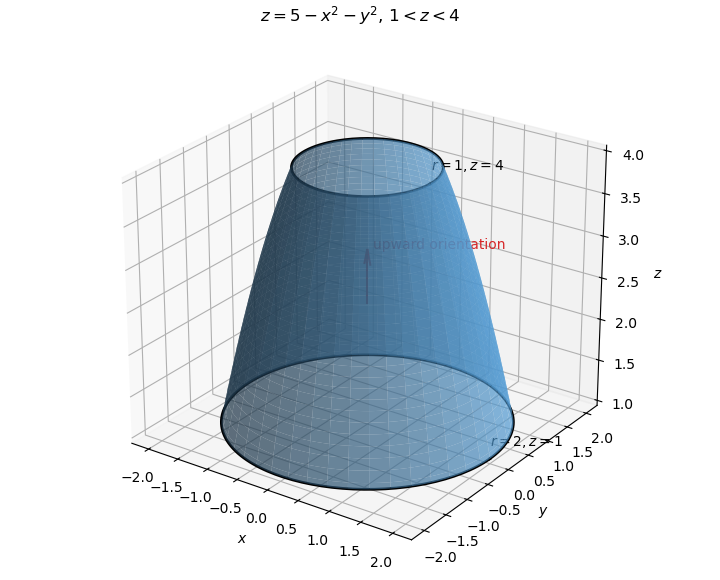
The curl of isFor the graph , the upward vector surface integral element isOver the annulus , the odd term integrates to zero. Therefore
Stokes theorem givesFor the upward orientation, the outer circle is counterclockwise from above and the inner circle is clockwise. On a counterclockwise circle of radius and height ,The outer circle contributes . The inner circle would contribute counterclockwise and hence contributes with its induced clockwise orientation. Thusagreeing with the direct calculation.
Writing and differentiating givesIts symmetric second-rank tensor part and antisymmetric second-rank tensor part areTaking the trace makes the two symmetric terms cancel, so the divergence isContracting the antisymmetric part with the Levi-Civita symbol gives the curl
Suppose are solutions and put . Then and satisfies the homogeneous Robin boundary conditionFor , Green's first identity givesThe left side is nonnegative, so both sides vanish and . For , the Dirichlet boundary condition on and the same identity again imply . The solution is therefore unique for every .
For a regular spherically symmetric solution, the Laplacian equation isRegularity at the origin gives , hence . Applying the boundary condition at yieldsAt the Neumann boundary condition would require , which is impossible for . Equivalently, its compatibility condition would require .
Let the heavier block move downward, so no slip gives linear acceleration . Newton's equations and the pulley torque equation areEliminating the tensions gives the first-order equationWith , its solution is
Let the photon energies be and their momentum angle be . Conservation of four-momentum and the null photon momenta giveUsing ,Thus the opening angle depends only on the parent rest energy and the two photon energies.
In the parent's rest frame, momentum conservation makes the massive daughter and photon momenta equal and opposite, of magnitude . The relativistic two-body decay formulas giveSince and ,The daughter's Lorentz factor isIf it decays after proper time , time dilation gives , while uniform motion gives . Therefore the event coordinates in the parent frame are
Articles by others on the same topic
There are currently no matching articles.