The factor theorem gives a factor . Polynomial division and then factorization giveConsequently all three roots of a polynomial are
Completing the square puts the equation of the circle in the formHence its centre is and its radius is .
The geometric series has first term and common ratio , whose absolute value is less than one. Therefore
On this parametric curve, permits or , but only also gives . The chain rule gives the slopeAt the required point, , so
The double-angle identity for the sine factors the equation as . The first factor gives in the specified interval; the second gives and hence . ThusKeeping the first factor avoids losing the solution where division by would be invalid.
Call the centre of the circle , the left endpoint on the diameter , the point of tangency , and the external intersection . Since are radii, the isosceles triangle has equal base angles: . Therefore , and, because and point in opposite directions, . The tangent to a circle is perpendicular to the radius , so in the right triangle ,
Rationalizing a denominator by multiplying by gives . Consequently the sum inside the parentheses is , and the entire expression is
The function is nonnegative and satisfies . Its derivative is , so it decreases from to its minimum and then increases to . These three points all have horizontal tangent lines.
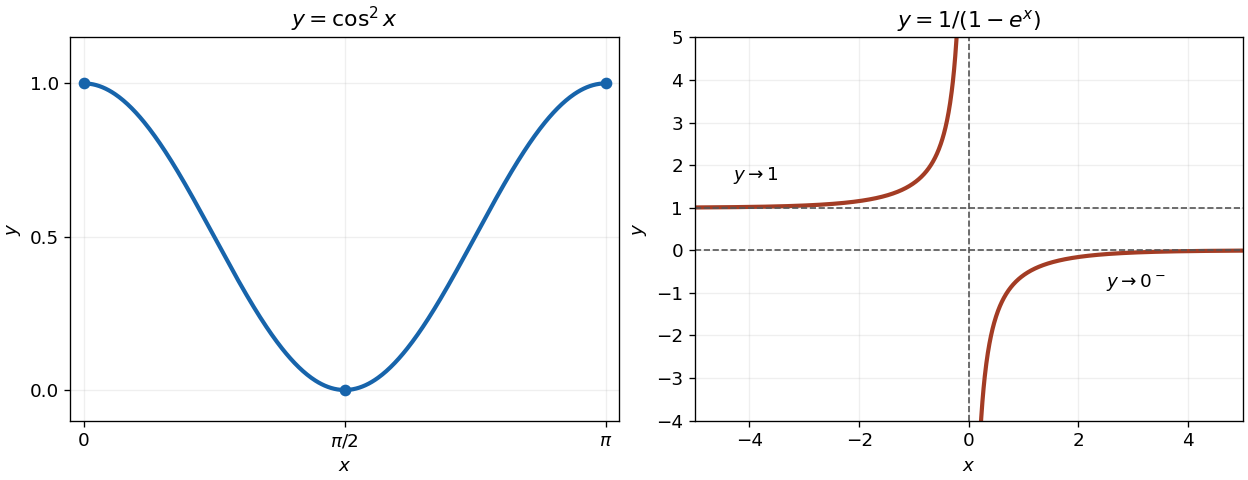

The denominator vanishes only at , giving a vertical asymptote. Since , the function tends to from the left and from the right. Its derivative isso each branch is increasing. The horizontal asymptotes are as and as . The left branch lies above ; the right branch lies below , as in the preceding figure.
If tangency occurs at , the slope must satisfy both and . Eliminating gives , so the tangent through the origin to an exponential curve has
Articles by others on the same topic
There are currently no matching articles.