The three coordinate basis vectors are the partial derivatives of the position vector with respect to the three coordinates. Direct differentiation givesThe multivariable chain rule then gives . These are coordinate tangent vectors, not necessarily unit vectors.
The azimuthal vector is automatically orthogonal to the other two. Their remaining dot product isThus orthogonal coordinates require , which integrates to . The initial value gives , and the smooth branch with isThe corresponding coordinate-vector norms are and , as in the hyperbolic parametrization of prolate spheroidal coordinates. Coordinate degeneracies on the axis and focal segment are understood.
Eliminating the angular coordinates on the requested surface givesIt is a prolate spheroid with long axis , equatorial radius , polar semiaxis , and foci .
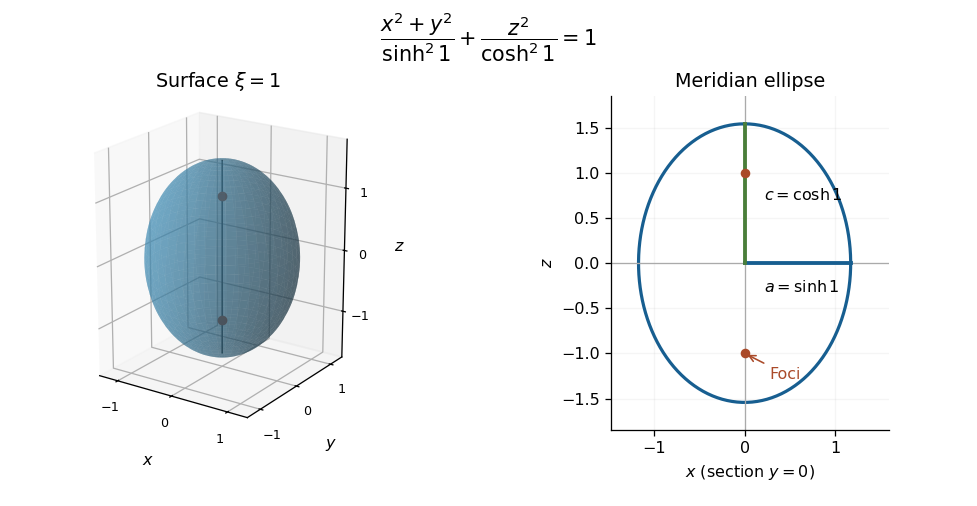

Let and . The region is the first-octant portion of the ellipsoid . In cylindrical coordinates, write and . Away from the axis, the divergence isThe field is singular on the axis, so applying the classical divergence theorem there without qualification would be invalid. Instead remove and apply it to the remaining region. On the added cylindrical boundary the unit normal is , andIts area element is , so its flux is . The axial component of the field has zero dot product with this normal. The volume integral of the divergence is locally integrable, because its factor cancels the cylindrical measure. Thus removing a singular axis in a flux integral gives the desired improper surface integral with no extra axial term.
The divergence theorem now reduces the calculation toThe integral over is the area of a quarter unit disk. All boundary fluxes are interpreted as convergent improper integrals at the axis.
Articles by others on the same topic
There are currently no matching articles.