The three coordinate basis vectors are the partial derivatives of the position vector with respect to the three coordinates. Direct differentiation givesThe multivariable chain rule then gives . These are coordinate tangent vectors, not necessarily unit vectors.
The azimuthal vector is automatically orthogonal to the other two. Their remaining dot product isThus orthogonal coordinates require , which integrates to . The initial value gives , and the smooth branch with isThe corresponding coordinate-vector norms are and , as in the hyperbolic parametrization of prolate spheroidal coordinates. Coordinate degeneracies on the axis and focal segment are understood.
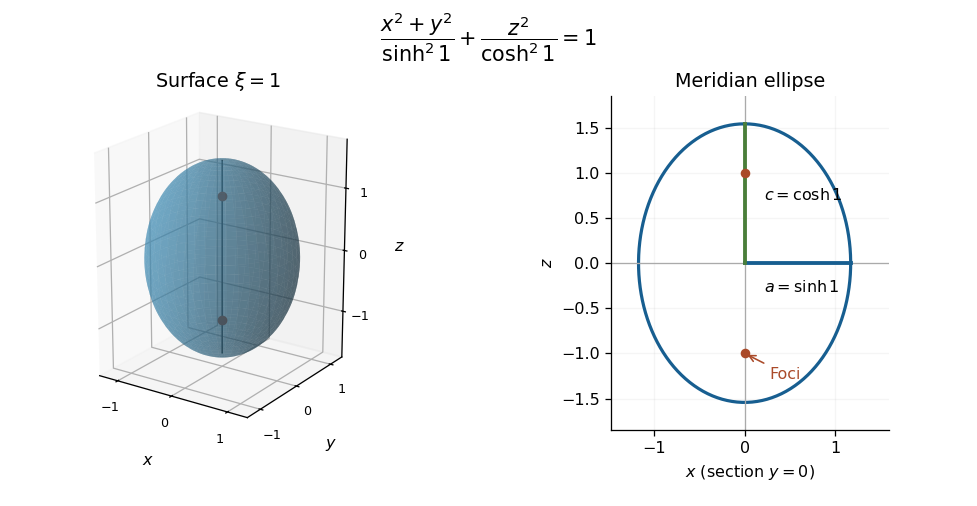
Eliminating the angular coordinates on the requested surface givesIt is a prolate spheroid with long axis , equatorial radius , polar semiaxis , and foci .

Let and . The region is the first-octant portion of the ellipsoid . In cylindrical coordinates, write and . Away from the axis, the divergence isThe field is singular on the axis, so applying the classical divergence theorem there without qualification would be invalid. Instead remove and apply it to the remaining region. On the added cylindrical boundary the unit normal is , andIts area element is , so its flux is . The axial component of the field has zero dot product with this normal. The volume integral of the divergence is locally integrable, because its factor cancels the cylindrical measure. Thus removing a singular axis in a flux integral gives the desired improper surface integral with no extra axial term.
The divergence theorem now reduces the calculation toThe integral over is the area of a quarter unit disk. All boundary fluxes are interpreted as convergent improper integrals at the axis.
Use separation of variables, , and divide by where nonzero. A real separation constant givesso and . Normalizing the second factor to one at zero givesThe spatial ordinary differential equation has three types of real solution:Products are the separated eigenfunctions. The negative, zero and positive separation constants give trigonometric, linear and hyperbolic function forms respectively. There is no discrete quantization until boundary conditions on are supplied. Since is bounded, the envelope of decays for , grows for , and is bounded and periodic for . The scalar prefactor can also be derived by removing a variable scalar reaction rate by an integrating factor.
The two homogeneous Dirichlet boundary conditions on force negative separation constants. The initial profile is an even function, so only the even sine-family eigenfunctions are needed:They obey and . Odd eigenfunctions have zero projection onto the even initial data. Hence the initial coefficients areThe desired eigenfunction expansion is thereforeAt this is the Fourier series of on the interval; its coefficients are absolutely summable. Each term satisfies the partial differential equation and side conditions. For the additional Gaussian decay in justifies termwise differentiation. Since and , the whole series decays uniformly as .
Set and choose , with the Green's function decaying at both ends. Away from the source, its homogeneous solutions are . Decay at each end and continuity at therefore give . Integrating its equation across the source gives a unit jump in its first derivative:ThusThe solution of the boundary value problem is the convolutionThere is no extra homogeneous term: no nonzero combination of decays at both infinities. The forcing must of course permit the imposed decay; integrable , including part (b), is sufficient. Literally arbitrary forcing need not do so: constant nonzero forcing admits no solution vanishing at both ends.
For , all forcing points satisfy , so the Green's function formula becomesAn integration by parts gives . ConsequentlyThe exponential has the required decay as .
For , every forcing point has . Hence the Green's function givesSince , the remaining integral is . ThereforeThis decays at positive infinity.
For , split the Green's function integral where the absolute value changes sign:The two terms inside the bracket are respectivelyAdding them yieldsThe affine term gives , while both exponential terms are homogeneous solutions. The values at the joins are and , agreeing with parts (i) and (ii). Their first derivatives also match: and . Thus the pieces introduce no unwanted Dirac delta distributions.
Let . Since , differentiation under the Fourier transform integral and integration by parts giveThus . The Gaussian integral gives , proving the Fourier transform of a Gaussian formulaFor the higher derivatives, start with . If , the product rule givesIf has degree and leading coefficient , the recurrence gives degree and leading coefficient . Induction proves the assertion for every . These polynomials are , where is the Probabilists' Hermite polynomial.
Assume the necessary derivatives decay enough for all boundary terms to vanish. One integration by parts givesRepeating proves the Fourier transform of a derivative rule . On the other hand, differentiation under the integral givesand therefore .
Write , with . Applying the second rule and part (a) giveswhereOnly the term can contribute degree . Its leading coefficient is , so has exactly the same degree , with no possible leading-term cancellation. The coefficients of this transformed polynomial can be complex even when those of are real.
By the two Fourier transform rules in part (b),Consequently transforming the differential equation givesorThe inverse Fourier transform gives the reverse implication under the same regularity hypotheses. This expresses the Fourier symmetry of the quantum harmonic oscillator operator.
Part (b) shows that the transform of is with of degree . Part (c) shows that it solves the same eigenvalue equation as , with the same . The assumed uniqueness of the polynomial solution of each degree therefore forces ; hence .
The constants can also be determined. Substituting into the equation gives the Hermite differential equationComparison of the leading coefficient yields . If the leading coefficient of is , part (b) gives leading coefficient for . ThusThus Hermite functions are Fourier eigenfunctions with the paper's unnormalized Fourier transform; dividing that transform by gives the unitary eigenvalues .
Since , , so is a real symmetric matrix. Moreover,proving that it is a negative semidefinite matrix.
For odd , determinant invariance under transpose givesso . Hence and have a zero eigenvalue. Finally, if , then , so . Thuswhere equality of these kernels includes the reverse implication, which is immediate.
Because commutes with ,Its squared Euclidean norm isA scalar equals its transpose, while , so . ConsequentlyThus each negative eigenvalue has at least this pair of orthonormal eigenvectors.
The plane spanned by is an invariant subspace for , sinceIts orthogonal complement is also invariant: for orthogonal to both, and . The restriction of the real symmetric matrix to this nonempty complement therefore has a unit eigenvector , by the spectral theorem for real symmetric matrices.
If its eigenvalue is , the argument in part (b) shows that is a unit eigenvector orthogonal to . It also lies in the same complement; explicitly,Repeating the construction decomposes every negative eigenspace into orthogonal pairs. The zero eigenspace has dimension for some number of pairs, and therefore has the same parity as . This is the paired eigenspaces of the square of a real skew-symmetric matrix property.
For , there can be distinct negative eigenvalues and no zero, or at most negative ones plus zero, because a nonempty zero eigenspace has dimension at least two. For , there are at most distinct negative ones plus the mandatory zero. HenceThe bound is attained by skew two-by-two blocks with distinct positive parameters, adding one zero direction when is odd.
The required actions have already been identified:In three dimensions choose a unit vector perpendicular to both. Its one-dimensional orthogonal complement to the pair is invariant under . On a one-dimensional real space, a skew-symmetric matrix must act as zero: would imply . Thus .
The columns of form an orthonormal basis, so is an orthogonal matrix. The displayed actions giveand thereforeIf , take and any orthogonal matrix . Otherwise its nonzero two-dimensional block supplies the pair used above.
For a real symmetric matrix , find its real eigenvalues from , then solve for the corresponding eigenspaces. Distinct eigenspaces are orthogonal. Within each repeated eigenspace, apply the Gram-Schmidt process and normalize to obtain an orthonormal basis of eigenvectors.
Put these vectors in the columns of . The spectral theorem for real symmetric matrices guarantees a full basis, so andThis is the orthogonal diagonalization of and the associated orthogonal change of coordinates.
The quadratic form has real symmetric matrixIts unit eigenvectors can be chosen as with eigenvalue , and , with eigenvalue . SetThe orthogonal diagonalization turns the surface equation intoIt is an ellipsoid, specifically a prolate spheroid centered at the origin. Its long principal axis is the line in direction , with semiaxis length . Each direction in the plane perpendicular to that line has semiaxis length ; the displayed give one orthonormal choice of the two short principal axes. Their nonuniqueness reflects the repeated eigenvalue and rotational symmetry about the long axis.
The orthogonal change of coordinates preserves the sphere equation, giving . Subtract it from the spheroid equation in part (b):Thus the intersection consists of the two circlesTheir common radius is . Transforming their centers back to the original coordinates givesTheir planes have equations , each with normal vector . The difference is parallel to this normal, proving that the line joining the centers is perpendicular to both planes. This is the intersection of a prolate spheroid and a concentric sphere in the regime between the short and long semiaxes.
For an analytic function, the complex differentiability limit is independent of the direction of approach. A real increment gives , whereas an imaginary increment givesEquality of real and imaginary parts proves the Cauchy-Riemann equations:Conversely, if have continuous first partial derivatives near a point and obey these equations, their real differentiability gives, for a complex increment ,Dividing by proves the complex differentiability there. Continuous first partial derivatives are a sufficient regularity hypothesis for this converse; agreement along the two coordinate directions alone is only a necessary condition.
Using the complex cosine identity,we findIts real part is exactly the prescribed function. Thus a harmonic conjugate is , and the general answer isTo check the only freedom, two analytic functions with this real part differ by a function with zero real part. The Cauchy-Riemann equations then force both partial derivatives of its imaginary part to vanish, so it is constant on the connected domain. No normalization was supplied to fix .
Multiply the exponential power series by the two prefactors:Collecting powers yields the Laurent seriesIts first terms are . Infinitely many negative-power coefficients are nonzero, so . The residue is the coefficient of :The phrase "power series" here refers to a Laurent series; no ordinary Taylor series about an essential singularity exists.
The denominator vanishes at , giving two simple poles. Their distances from the center are both . There are no nearer singularities, so the Taylor series has radius of convergence
Apply the Cauchy-Hadamard theorem to the power series coefficients for :For example, taking logarithms gives . ThereforeAny convention for the isolated coefficient has no effect on the radius of convergence.
Away from zeros of the leading coefficient, the normal-form differential equation isThe only finite singular points are . At zero, and are analytic, so zero is a regular singular point. At , the coefficient has a genuine double pole, so is not analytic; these are irregular singular points. ThusIf infinity is included, set and . The transformed coefficients are and . They satisfy the regular singular point at infinity criterion, so as well.
Seek a Frobenius solution with . Since , its lowest coefficient gives the indicial equationThus the repeated indicial root is . Equating the coefficient of before setting givesFor this becomes the linear recurrence relationEvery coefficient is fixed by , since the denominator never vanishes for . In particular and then every odd coefficient is zero. Therefore there is , not two merely because the indicial root repeats. If "power series" means an ordinary Taylor series with nonnegative integer powers, the only such solution is zero: its coefficient equation starts with and inductively forces all coefficients to vanish.
A second independent local solution is a logarithmic solution from a repeated Frobenius exponent. Indeed, Abel's identity gives . For the normalized first solution , reduction of order givesAfter choosing the harmless multiplicative constant in the numerator, its integrand is , so . The nonzero logarithmic coefficient proves that this second solution is not another pure Frobenius solution.
Normalize the free leading coefficient to . The linear recurrence relation from part (b) givesConsequently the first four nonzero coefficients areand the single pure Frobenius solution isFor clarity about the second independent solution, a choice with no added multiple of isThese companion coefficients follow by reduction of order with the normalized Wronskian . The logarithm requires a local branch; it does not supply a second ordinary power series solution.
The Fermat principle states that the actual path of a light ray makes its travel time stationary under small admissible variations with fixed endpoints. Equivalently, its optical path length is stationary:where is the local light speed, is the refractive index, and the two integrals differ by the constant vacuum light speed. In a uniform medium this reduces to stationarity of geometric path length. The principle is a stationarity statement; for the planar reflection considered next the stationary path is also the unique minimum.
Take the fixed source and receiver to be and on the same side of the mirror, with . In the uniform medium, the Fermat principle minimizes the length through a reflection point :Its stationary equation isThe two fractions are the signed tangential components of the ray directions. Equality of their magnitudes gives , where both angles are measured from the normal vector to the mirror and lie in . Hence the law of reflection isFor uniqueness, differentiate once more:Thus is a strictly convex function, its derivative increases from to , and it has exactly one stationary point, its global minimum. Explicitly,Substitution gives , verifying the reflection angles and the existence of that unique solution. Equivalently it is the point where the line from to the mirror image crosses the mirror.
First expand the variational integrand:Its needed partial derivatives are and . The Euler-Lagrange equation is thereforeThe general solution is . Subtracting the two endpoint equations gives ; adding them gives . HenceThis is the unique stationary solution. It is also the unique global minimizer: after discarding the fixed boundary terms, integration by parts rewrites as . For an endpoint-zero variation , the linear part vanishes at the displayed solution andwith equality only for .
The original PDF has a typographical omission: its displayed equation has rather than on the right. Taken literally, it is an inhomogeneous boundary value problem, not the stated Sturm-Liouville problem. The quotient and the later eigenfunction expansion identify the intended equation, which the following derivation produces explicitly.
Choose homogeneous Dirichlet boundary conditions and a nonzero real admissible . Then because . For an endpoint-zero variation , integration by parts givesThe first variation of the Rayleigh quotient is thusBy the fundamental lemma of the calculus of variations, stationarity is equivalent toConversely, multiply this corrected eigenvalue equation by and integrate. The same boundary cancellation gives , so the first variation vanishes. This proves the requested equivalence for the intended equation. Homogeneous Neumann boundary conditions, or a Dirichlet condition at one end and a Neumann condition at the other, also eliminate the boundary term. General Robin boundary conditions would require the corresponding boundary contribution in the numerator.
Use the normalized eigenfunctions with the stated weighted inner product. Orthogonality gives . The corrected Sturm-Liouville problem and the vanishing boundary term giveFor a complex trial the numerator means , agreeing with the given formula for real trials. ThereforeIt is a convex combination of the eigenvalues, with equality only for a trial proportional to the lowest eigenfunction. The Rayleigh-Ritz variational principle consequently estimates by choosing a nonzero admissible trial family and minimizing this quotient over its parameters:The result is an upper bound. A more flexible trial space can lower it, while equality requires that the exact lowest eigenfunction belong to the trial space. One need not know the expansion coefficients to calculate the quotient directly from the trial function.
Take and set . The Rayleigh quotient of the trial for the quantum harmonic oscillator isIts denominator is . The kinetic numerator is times that denominator. For the remaining integral, put and useobtained from and integration by parts. Thus the compact cosine trial bound for the quantum harmonic oscillator isDifferentiation gives , so the minimizing parameter satisfiesThe quotient tends to infinity at either end of , and the two positive terms are equal at this stationary point, proving it is the global minimum. ThereforeFor comparison, the exact ground state has value . The trial is admissible for the energy quadratic form: it is continuous, has compact support, and its weak derivative is square-integrable. Its first derivative jumps at the support endpoints, so it need not belong to the smaller twice-differentiable operator domain; this does not invalidate the Rayleigh-Ritz variational principle bound.
Articles by others on the same topic
There are currently no matching articles.