Use . Fix . For small, all triples , , lie in a fixed compact set up to null sets. The continuous derivatives are uniformly continuous there, with a modulus as . The integral form of the mean-value expansion gives a remainder bounded byThe proposed linear derivative is bounded because its coefficient functions are bounded on that compact set. The remainder is little-oh of the norm, proving Fréchet differentiability andThe derivative only needs to exist almost everywhere; the uniform compact-range bound handles its measurable representative.
Put into the differentiability expansion. The remainder is , so division by and passage to zero gives . For this is immediate as well.
For a zero-trace , the curve remains admissible. When is small it is within the weak-minimum neighborhood in , so its scalar energy has a minimum at zero. The preceding derivative therefore vanishes. Thus for every zero-trace variation.
The first variation isThe endpoint terms vanish. The fundamental lemma of the calculus of variations gives almost everywhere, hence on . A Lipschitz representative is then identically zero and cannot have terminal value one. Therefore there are no admissible solutions of the stationarity equation.
Stationarity says , or in distributions. Integrating gives . The endpoint values force and . Conversely this polynomial satisfies the first-variation identity for every zero-trace variation. Thus the only solution is .
Along the reference curve put , , . The second variation isStrict positivity means for every nonzero zero-trace variation. Under the given regular Legendre condition , the no-conjugate-point criterion also supplies a uniform coercive lower bound. The Jacobi equation is . A point is conjugate to when a nonzero solution vanishes at both and . In this regular setting, absence of conjugate points in is equivalent to existence of a Jacobi solution positive throughout .
Choose such a positive solution . The given square identity extends from smooth compactly supported variations to by density and boundedness of its coefficients. With it reads . The positive minima of bound this below by . A zero-trace function obeys , while and give . ConsequentlyIn particular the required second variation is positive for all nonzero Lipschitz zero-trace variations.
The Jacobi equation is . For the function is positive on the closed interval. The preceding square identity giveswith if . As in part (a), its positive minimum and bounded derivative provide a constant with . The second variation at zero is , so is positive, and zero is the unique global minimizer.
For a fixed zero-trace , positivity of for all gives, by letting ,This derivation did not assume the sharp inequality in advance. For equality, the nonnegative quadratic form has . Expanding for both signs of forces for every test. Thus , and the zero endpoint values give exactly , including . These functions do give equality.
Take . It is admissible andwhen . Hence the infimum is minus infinity. The roman label (iii) is retained exactly as printed.
A strong local minimizer of a variational integral has the same property for all admissible with ; its derivative need not be close. Since the supremum norm is bounded by the Sobolev norm, this neighborhood contains a sufficiently small weak neighborhood. Thus every strong local minimizer is a weak local minimizer of a variational integral.
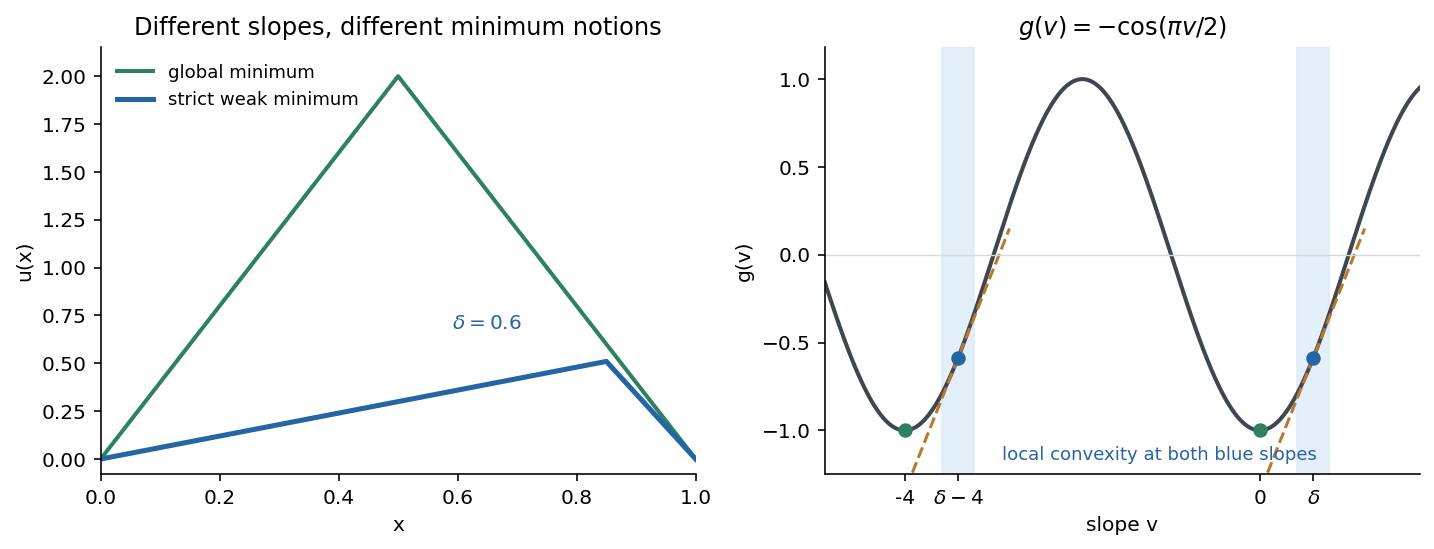
A point of convexity of a differentiable scalar function is one where its tangent supports the entire graph: for every . The Weierstrass necessary condition for strong minimality, under its differentiability assumptions in the slope variable, isfor almost every . In other words the reference slope is a point of convexity of the slope integrand. The later example is smooth, so these derivative-based conditions apply there.
Write . For the stipulated , the displayed tent is continuous at its junction, has zero endpoint values, and its slopes are and . At both slopes has the same value , and is strictly positive on common sufficiently small neighborhoods of them. Taylor's theorem gives, for small ,Thus is a strict weak local minimizer of a variational integral. It is not a strong local minimizer of a variational integral: the global supporting-tangent requirement at either slope has nonzero slope , whereas is bounded. Letting the trial slope tend to positive infinity violates that requirement. The Weierstrass necessary condition therefore fails.
The opening parameter range is essential. The subsequent phrase “for each ” must be read within it; taken literally beyond that range it is false. At the tent slopes are , where and , so this is not a weak minimum.
If is a strong local minimizer of a variational integral, the Weierstrass condition makes a point of convexity of the bounded function for almost every . A global supporting line to a bounded function must have zero slope, and its contact value must be a global minimum. Here that value is . Therefore almost everywhere and , while every admissible energy is at least . Hence every strong local minimizer is global.
For every positive integer , set . Its slopes are almost everywhere, both giving . Hence , the universal lower bound, and these tents are all distinct. Thus there are infinitely many global minimizers. Zero is another one.

Superlinearity and continuity make bounded below by a finite constant . Consequently for every admissible function. The affine endpoint interpolant has finite energy by continuity on its compact range, so the infimum is finite. Some other admissible energies can be infinite; this does not affect the bounded-below or minimizing-sequence argument.
The De la Vallée-Poussin criterion characterizes uniform integrability by existence of a nonnegative increasing convex function with and a uniform bound on . On a finite interval this gives a weakly convergent subsequence in by the Dunford-Pettis theorem.
After discarding a finite prefix of the minimizing sequence if needed, put . Its derivative sequence has . The superlinear bound directly gives uniform integrability: for outside ,If the convex version of the criterion is used, choose increasing so for , and set . This is locally a finite sum, convex and increasing. It is superlinear because for fixed and , . If exactly terms are active, for , so its integrals have the same bound. The criterion therefore supplies in .
Define . Interval-indicator tests give for every , including , so its endpoint values are correct and . The common derivative bound makes these functions uniformly bounded. Uniform integrability also gives common equicontinuity, since an increment is bounded by the derivative integral on the intervening interval. The Arzelà-Ascoli theorem yields uniform convergence to the same identified limit, and in particularHere the printed admissible space is , so this compactness argument gives precisely the needed membership.
Write . Since the limit is admissible, the assumed lower-semicontinuity inequality gives . Thus and is a global minimizer.
The extra integrand hypothesis in the Tonelli existence theorem for one dimension is convexity in the derivative variable for each fixed . Together with the stated continuity and coercive lower bound it gives the lower-semicontinuity property along the uniform-function/weak-derivative convergence just proved.
The assumed weak-star limit is the constant . Each integer rescaling has exactly full periods on , so a change of variables on those periods givesApply the asserted lower semicontinuity to this sequence. The integral of of its constant limit is , givingThis holds for every real and ; the endpoint values of give equality. Therefore is convex.
Articles by others on the same topic
There are currently no matching articles.