Set and use metric . In the rest frame of B, and . Since ,The denominator is because this is the B rest frame, not the C rest frame. In this frame C and have equal, parallel three-momenta.
The second decay has in the B rest frame. Using and givesThis is an ordinary two-body decay in its parent's rest frame.
Let and . In the B frame these are the energies of and . If is their relative angle,The minimum has parallel massless particles; the maximum has antiparallel ones. The isotropic decay allows both limiting directions. The bounds are Lorentz invariant even though the B frame makes their calculation simple.
Since , the same angle gives . ThereforeThe minimum now occurs when and are antiparallel. The eventwise identity independently checks the opposite ordering of the two endpoints.
Use and . In the first reaction a proton can join the incoming to form the component of the neutral pion, leaving . In the second, a pair can annihilate into a gluon which creates ; the remaining joins in the outgoing kaon, leaving . Thusbaryon number is one in both cases. Strong strangeness conservation provides a separate check: the first baryon has strangeness ; the second has strangeness because the outgoing carries . The Feynman diagrams show representative quark-line flavour rearrangement and pair-annihilation topologies. Bound hadrons require nonperturbative binding, so a single drawn gluon is not an exclusive cross-section calculation.
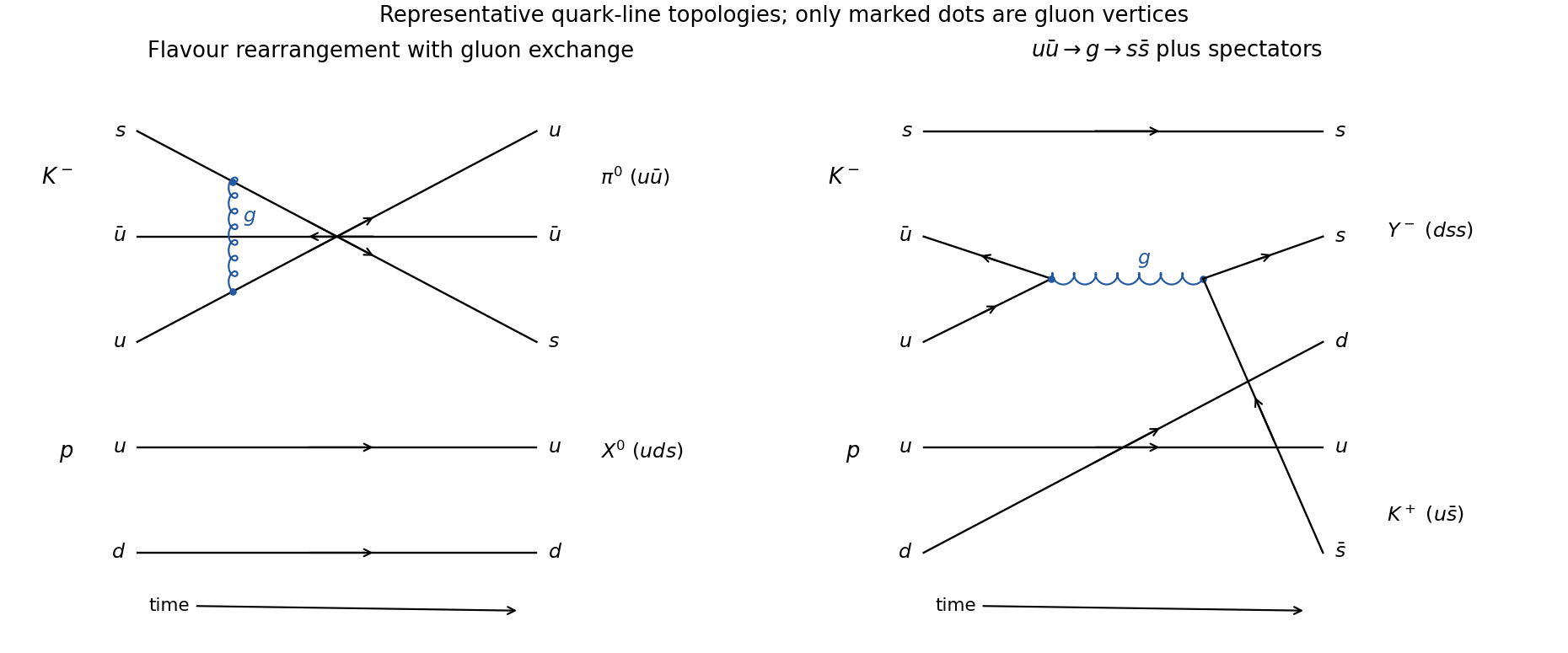
Original representative quark-line diagrams: flavour rearrangement and u-antiu annihilation into an s-antis pair
. Details. 
The radiative decay conserves strangeness and proceeds electromagnetically. A strong decay is closed because even the lighter neutral-pion threshold exceeds the supplied mass. The decay has about of available energy, but changes strangeness from to , so it requires the weak interaction. Its lifetime is therefore ordinarily much longer than the electromagnetic lifetime of ; no numerical lifetime follows from these masses alone.
Both particles are baryons with half-integer spin. A radiative transition to spin can couple through photon multipoles , giving . Electromagnetic parity is conserved, but without the electric/magnetic multipolarity neither nor its parity is fixed. In the weak decay, coupling orbital to the final spin gives ; parity conservation cannot be imposed on that weak amplitude. The supplied modes therefore do not determine unique spin-parity assignments.
The masses and flavours identify the familiar candidates as and . Their established ground-state assignments are both , consistent with the lowest-orbital quark model, but this is additional empirical/model information rather than a consequence of the two decay channels alone.[ref]
Review of Particle Physics by Particle Data Group (2022). Sigma-zero and Xi-minus listings, each p.1, established quantum numbers and decay information
Articles by others on the same topic
There are currently no matching articles.