What is measured. A monoenergetic Electron beam is directed at a thin target. A movable magnetic spectrometer selects the scattering angle and outgoing momentum, separating elastic scattering from nuclear excitation and other backgrounds. Incident beam current and target thickness supply the normalization of the differential scattering cross-section. The Hofstadter nuclear electron scattering experiment is a classic implementation of this electromagnetic probe.
For a heavy, approximately spin-zero atomic nucleus, neglecting recoil and treating the electron in the Born approximation, the point-charge result is multiplied by the nuclear charge form factor:Here is the magnitude of the spatial momentum transfer in natural units. The cosine factor includes the Electron spin. Dividing the elastic data by the point-charge factor isolates within these approximations. Recoil, magnetic terms for targets with spin, radiative corrections and particularly Coulomb distortion in electron scattering must be included when significant.
From scattering to size and shape. For a spherical nuclear charge distribution,Thus the nuclear charge form factor is a normalized Fourier transform. Its low- expansion,measures the nuclear charge radius . Larger momentum transfers resolve the density profile through diffraction maxima and minima. For a uniform sphere of sharp radius , the uniform-sphere nuclear charge form factor is ; its first zero is at , while .
A practical extraction fits a family of densities to all measured cross sections, rather than treating a few measured values of as a complete density reconstruction. Finite angular coverage, resolution and the missing sign information make this an inverse problem.
Observed pattern. Apart from the lightest nuclei, the central density is approximately constant; the size grows approximately as and there is a diffuse surface. The coefficient describes an equivalent sharp nuclear radius, rather than the root-mean-square radius itself. Heavy nuclear charge distributions are often described by the two-parameter Fermi nuclear charge distribution, , with half-density radius scaling roughly as and diffuseness around . The surface thickness is then about . Shell effects, deformation and the lightest systems give departures from this smooth pattern. These qualitative features are established by the electron scattering density measurements.[ref]
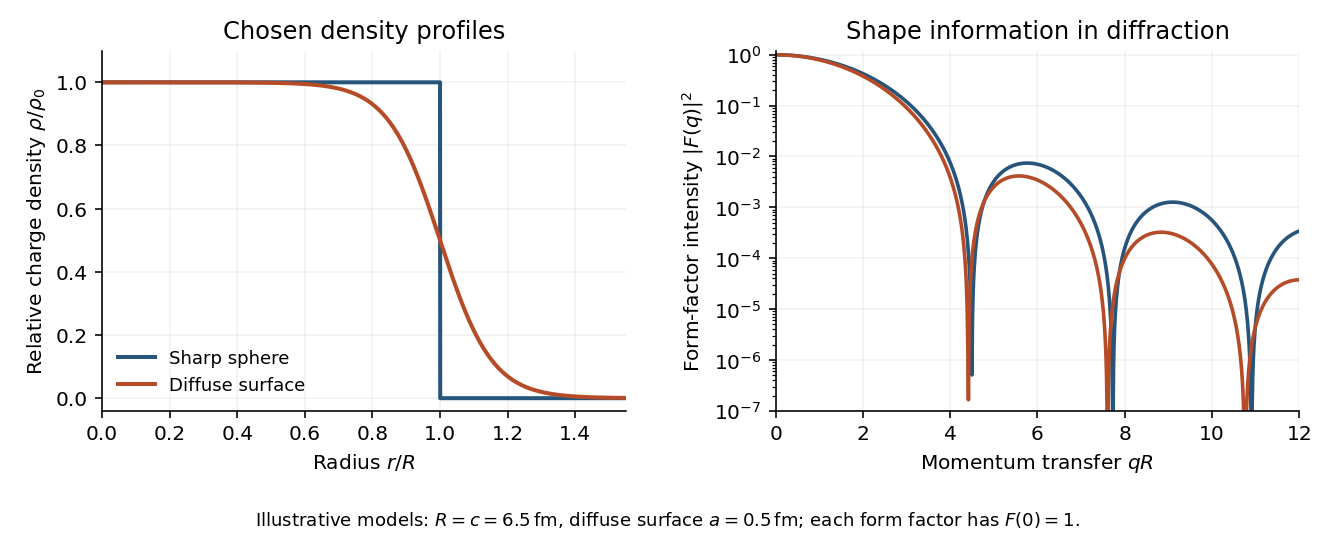
Original sharp-edge and diffuse nuclear charge models, showing how a surface profile changes the nuclear charge form factor
. Details. 
Complementary probes. Transition energies in a muonic atom are especially sensitive to nuclear size because the heavy negative muon orbits close to the charge. Electronic isotope shifts, after separating nuclear-mass and finite-size contributions, measure changes in . Both require atomic-structure calculations. Electromagnetic excitation and transition strengths constrain deformation and charge multipoles. Hadronic scattering can also constrain nuclear dimensions, but carries uncertainties from the strong interaction and probes matter rather than purely electric charge.
Theory. Quantum chromodynamics is a local, non-Abelian gauge theory with gauge group SU(3) acting on color charge. Its matter fields are spin-half quarks of six flavours, each in three colors; its eight massless spin-one gluons are the gauge fields. Unlike the neutral photon, gluons themselves carry gauge charge. Consequently there are three-gluon and four-gluon vertices as well as the quark-gluon vertex. A compact Lagrangian density iswhere is the gauge covariant derivative and the field strength contains the nonlinear term .
The running coupling is weak at high momentum scales. At one loop, for active flavours,The positive coefficient produces asymptotic freedom: short-distance, large- processes admit perturbation theory. The gluon self-interaction is crucial to its sign. At low scales the coupling grows and isolated colored particles are not observed; the physical spectrum consists of color-singlet hadrons, the phenomenon of confinement. A hard-produced quark or gluon radiates and undergoes hadronization, giving a collimated jet. The one-loop formula is not valid at and is not, by itself, a mathematical proof of confinement.
- Deep inelastic scattering resolves approximately pointlike spin-half constituents. Approximate Bjorken scaling supplies the starting parton picture, while the measured logarithmic departures from scaling agree with QCD evolution of parton distribution functions.
- The hadronic R ratio in electron-positron annihilation counts squared quark charges multiplied by three colors, with calculable strong corrections. It tests color multiplicity as well as the quark charge assignments.
- Two-jet events identify a quark-antiquark hard topology. Three-jet events test hard gluon radiation, ; their angular correlations support a spin-one gluon. Four-jet correlations and radiation patterns further probe the non-Abelian color factors and gluon self-interactions.
- Determinations of from processes at widely separated scales follow the same running coupling, rather than independent interaction strengths. Jet rates, event shapes, hadronic weak-boson decays and high-energy hadron collisions provide complementary tests.
- Lattice QCD calculations reproduce many hadronic masses and other low-energy quantities from the same underlying theory, connecting its strongly coupled regime to the observed spectrum.
The convincing evidence is the quantitative consistency across these probes, with a common color group and coupling evolution. A jet by itself is evidence for a hard parton; its rates and correlations supply the more specific tests of Quantum chromodynamics.[ref]
Production and identification. At a hadron collider, initial partons carry fractions of the proton momenta; observable production rates combine parton-level amplitudes with parton distribution functions.
- Top quark pairs are produced through and . Single top production uses the weak charged current, for example through a virtual W boson. The dominant decay is , and similarly for the antiquark. The subsequent W boson decays produce dilepton, lepton-plus-jets and all-hadronic channels. Reconstructing the W and b systems constrains the top mass. The top decays before forming an ordinary long-lived top hadron.
- An on-shell W boson is produced by quark-antiquark annihilation, for example . Other sources include top decay and boson-pair production; at a lepton collider, provides a clean pair channel. The W boson decays to or to a kinematically accessible quark pair. Neglecting masses and strong corrections, the three lepton channels and two up-type quarks with three colors give approximately one-third leptonic and two-thirds hadronic branching. The leptonic modes combine a charged lepton with missing transverse momentum; the transverse-mass distribution constrains .
- Higgs boson production includes gluon fusion through a heavy-quark loop, vector-boson fusion , associated , and production. At a lepton collider, is another example. For a Higgs mass near , important decays include , , , and . The less frequent mode and mode give especially clean reconstructed mass peaks. The asterisk denotes an off-shell daughter boson; two on-shell W or Z bosons are inaccessible at that Higgs mass.
Why the three masses form a test. At tree level, electroweak symmetry breaking gives and . The Higgs mechanism relates masses to the vacuum field, but it does not by itself predict the top Yukawa coupling or the Higgs self-coupling, so the three masses are not fixed independently of measured parameters.
The stronger test comes from radiative corrections. With accurately measured , and , the electroweak precision test with the W, top and Higgs masses usesThe top-bottom loop contributes approximately , while the Higgs contribution has a characteristic logarithmic mass dependence. Hence direct measurements of and turn the precision calculation into a prediction for . Comparing that prediction with the direct W-mass measurement overconstrains the Standard Model; disagreement beyond experimental and theoretical uncertainties could indicate additional particles or interactions in the loops. The test concerns the relation among independently measured quantities, rather than merely the existence of the three particles.
Articles by others on the same topic
There are currently no matching articles.