Equation and boundary conditions. The delta potential has strength with units of energy times length, because the Dirac delta function has units of inverse length. The Time-independent Schrödinger equation isThe wavefunction is continuous at the origin. A finite jump in would produce a derivative of a Dirac delta function in , with no corresponding term in this potential. A jump in does produce a delta contribution and is allowed. Integrate through a symmetric interval:For continuous finite , the right-hand side vanishes as . ConsequentlyThis derivative jump is the boundary condition associated with the attractive delta potential.
Unique bound state. For , write . Away from the origin, . Normalizability excludes exponentials growing at either infinity, leavingContinuity gives . The derivative jump then becomes . For a nonzero state,There is exactly one positive value of , so exactly one negative-energy bound state. An odd solution would have ; the allowed decaying exponentials would then both vanish identically. Normalize the even solution usingChoosing the overall phase real and positive gives the bound state in a delta potential:It peaks at the origin, has a downward cusp there, and decays exponentially on both sides. Its value, but not its slope, is continuous.
Scattering amplitudes and fluxes. For , put and retain as a strength parameter. A unit-amplitude wave incident from the left hasContinuity gives . The jump condition givesSolving,The probability current of a plane wave of amplitude is in its propagation direction. Since the asymptotic wavenumber is the same on both sides, reflection probability and transmission probability are just and :They satisfy , expressing conserved probability current in this real potential.
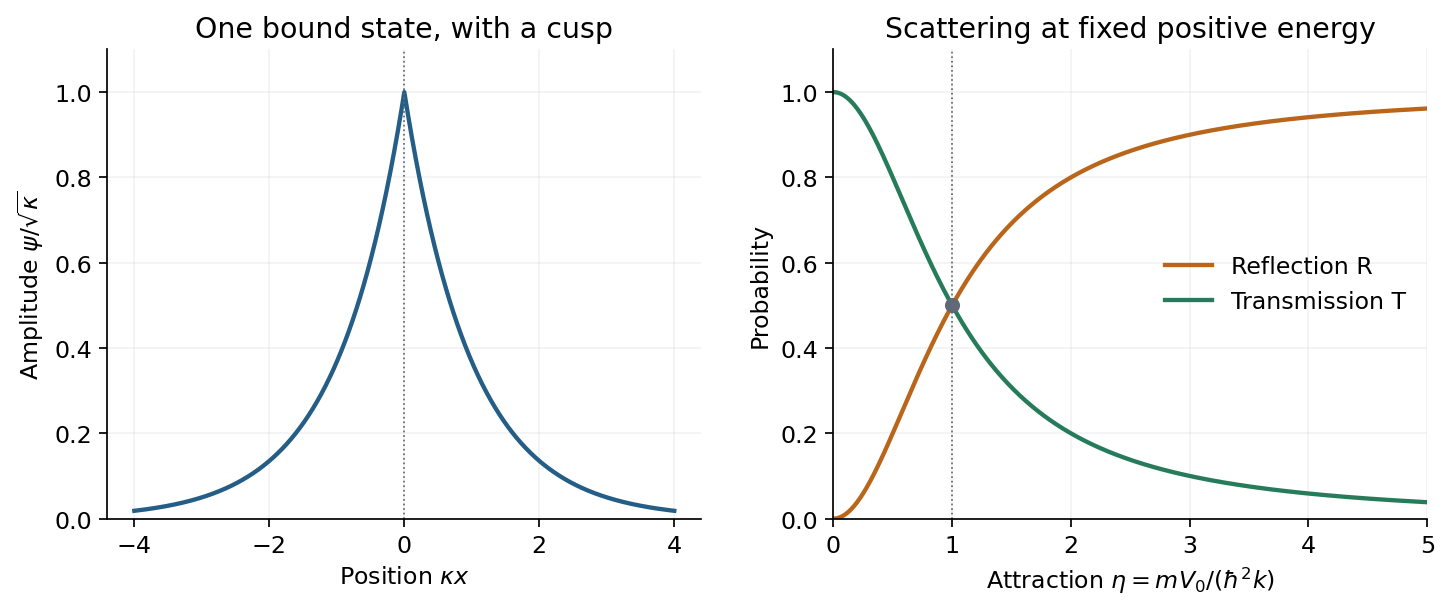
The normalized delta-well bound state and reflection/transmission probabilities as attraction increases
. Details. 
The right-hand plot uses , proportional to at fixed incident energy. Then rises monotonically from zero to one, while falls from one to zero; they are equal at . Despite the absence of a classical forbidden barrier, an abrupt attractive interaction reflects a quantum wave. Increasing attraction strengthens the derivative mismatch and can approach complete reflection at fixed positive energy. At fixed , increasing incident energy instead makes the well increasingly transparent. The negative-energy bound state and the positive-energy scattering states are different stationary solutions, not an absorptive loss channel.
Hamiltonian and commutators. Use the canonical commutation relation and define . Expanding the product of the given creation and annihilation operators,Therefore the quantum harmonic oscillator Hamiltonian operator isSimilarly,Using gives
Lowering a normalized energy eigenstate. The commutator impliesFor , nondegeneracy of this one-dimensional energy level means . Its norm is fixed by the number operator:Choosing successive eigenstate phases in the conventional way makes , soFor , the same norm is zero, hence . A nonzero lowered ground state would have energy below the lowest allowed level, and positivity of forbids that possibility.
Coherent-state eigenvalue. Applying the annihilation operator term by term, with the contribution zero, givesThusThe coherent state is normalized because . Its annihilation operator is not Hermitian, so the eigenvalue may be complex.
Time evolution. Under the time-independent Hamiltonian operator, each energy component acquires its own phase:Since , the normalization prefactor is unchanged. HenceThe state remains a coherent state, with its complex parameter rotating at the oscillator's angular frequency; the displayed extra factor is a global phase from the zero-point energy.
Reduced radial equation. A spherical harmonic satisfies . Substitute into the Time-independent Schrödinger equation, divide out the angular function, and put . Direct differentiation givesMultiplication by then gives the Radial Schrodinger equationHere is the reduced mass, and the extra positive term is the centrifugal potential.
Boundary conditions. At the origin this finite central potential has no point interaction. The physical radial solution is regular there, requiring ; for , a nonzero constant would give and a point-source singularity of the three-dimensional Laplacian. Mere square integrability alone would not remove that singular solution. For a bound state, the radial probability integral is , so the exterior solution must decay and as .
Solutions for zero orbital angular momentum. For and , defineThe interior equation is ; excludes the cosine. The exterior equation is ; normalizability excludes the growing exponential. ThusThe constants cannot remain independent once the interface is matched. Since the potential step is finite, both and are continuous at :Dividing the equations yields
Existence and number of s-wave bound states. Put , , and . ThenThe lowest branch lies on . Along it, and increases continuously from to infinity. Therefore a first negative-energy solution exists precisely when , orFurther branches begin at as . Hence the bound-state thresholds of a spherical square well give exactly one negative-energy state whenThe upper equality is included: the second branch is then only at , with constant exterior , and is not normalizable. If threshold cases are excluded by convention, the commonly quoted open interval has a strict upper inequality; the physical negative-energy state count at equality is still one.
Deuteron estimate. Using , and gives . At ,The threshold for a second state is , far above the stipulated depth . Thus this model has no radially excited s-wave bound state.
Checking other orbital angular momentum sectors matters before ruling out every excitation. At the first -wave threshold, the regular interior reduced radial function is and the zero-energy exterior function is proportional to . Matching their logarithmic derivatives requires , whose first root is . HenceLarger only increases the centrifugal potential. Therefore no bound orbital excited states are expected in the specified central square-well model. Its spin dependence and tensor nuclear forces have not been specified; the calculation does not resolve the real deuteron's internal spin structure.
Distinguishable noninteracting particles. Interpret as the same external one-particle potential for each particle; the total potential is . The Time-dependent Schrödinger equation isLet and , where . Applying to the product multiplies it by . The time derivative of multiplies it by . Thus the proposed stationary product is a solution providedThe tensor product separates the two independent one-particle dynamics.
Identical spin-one-half particles. Identical fermions require antisymmetry under exchange of the complete position-and-spin labels. First take to be distinct orthonormal spatial orbitals, and defineThe symmetric spatial state must multiply the antisymmetric spin-one-half singlet state; the antisymmetric spatial state must multiply one of the three symmetric spin-one-half triplet states. The four normalized possibilities, each with the common time factor , areThese are the required product states under fermionic exchange symmetry. If , the antisymmetric spatial combination vanishes. Only the product times the singlet remains, as required by the Pauli exclusion principle. A nonorthogonal pair would require different normalization factors; the displayed assumes an orthonormal stationary-state basis.
Weak repulsive Coulomb interaction. For fixed orbitals , first-order perturbation theory gives spatial energy shifts . Here is the direct interaction energy, while the exchange integral for repulsion strength isThe positivity follows from the positive Fourier transform of the Coulomb kernel. Consequently Coulomb exchange splitting of two orbitals givesAll three triplet spin components remain degenerate for a spin-independent Coulomb interaction. Their antisymmetric spatial factor vanishes at coincidence and reduces close encounters. The inequality is strict when ; for negligible orbital overlap, the splitting may vanish. This comparison fixes one particle in each of the specified orbitals and does not rank singlets with a different orbital occupation.
Spin-zero bosons. For one particle in each of the same distinct orthonormal orbitals, the spin factor is symmetric and bosonic exchange symmetry requires . At coincident positions,Thus the bosonic coincidence enhancement in two orthogonal orbitals isThese are joint probability densities, or small-detector-volume limits; an exactly specified point has zero probability in a continuous distribution. If both particles occupy the same orbital, the properly normalized product is already symmetric and the corresponding enhancement relative to distinguishable particles in that same orbital is one. The paper's usual factor-two answer presumes distinct orthogonal input orbitals.
Articles by others on the same topic
There are currently no matching articles.