The Debye model treats a solid's low-frequency lattice vibrations as acoustic phonons in an elastic continuum. There are three polarizations per wavevector, one longitudinal and two transverse, with approximately linear dispersion relations. A cutoff is chosen to preserve the total vibrational modes of atoms. The phonon number itself is not fixed; mode occupations follow the Bose-Einstein distribution with zero chemical potential.
For one polarization of speed , counting wavevector states in a spherical shell gives . Define an average Debye speed by . The total density of states can then be writtenThe Debye wavevector is , the Debye frequency is , and the Debye temperature is .
Omitting the temperature-independent zero-point energy, the vibrational energy and resulting Debye heat capacity areAt low temperature the upper limit can be extended to infinity. The integral is , givingOnly the long-wavelength acoustic modes are appreciably populated, explaining the Debye T-cubed test. At high temperature every mode contributes by equipartition theorem, so , the Dulong-Petit law.
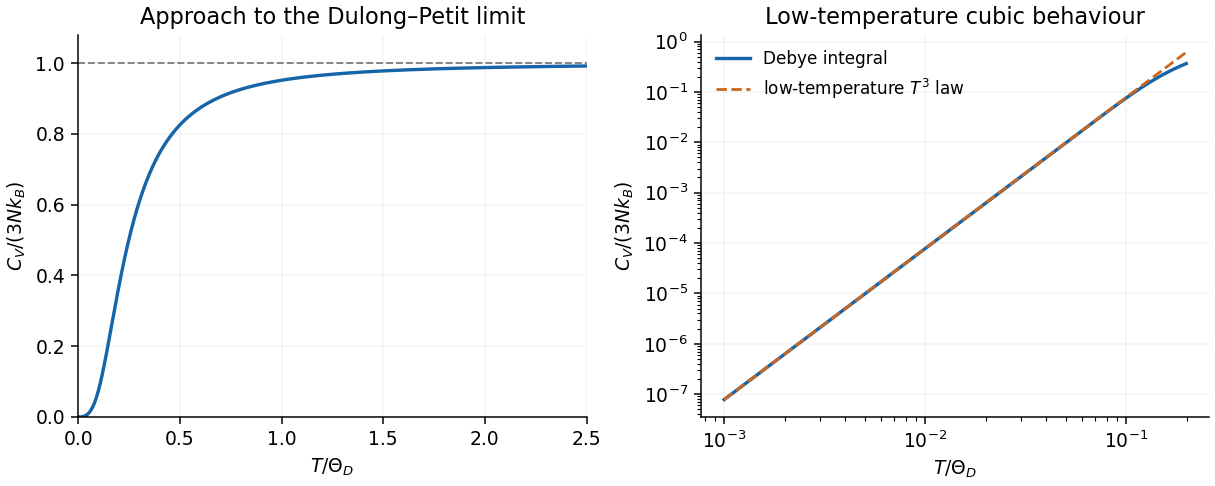
The model succeeds especially at low temperature, where long-wavelength elasticity is reliable. It replaces real anisotropic branches by a simple continuum and cannot reproduce detailed optical phonon branches or every intermediate-temperature feature. Metals also have an electronic heat capacity approximately proportional to ; defects, magnetic excitations or a phase transition can add other terms. Experiments often measure heat capacity at constant pressure, which need not equal the harmonic model's exactly.
A band effective mass describes the acceleration of an electronic wavepacket in a periodic lattice through the local band curvature. It incorporates the periodic lattice potential into a useful transport parameter without changing the bare Electron mass. For a Bloch state in an isolated band,Differentiation givesIn one dimension this becomes . A locally parabolic isotropic band minimum has with positive . A flatter band has a larger effective mass. At a band maximum the Electron curvature is negative, so the Electron accelerates oppositely to the applied force. Describing the missing Electron as a positive-charge electron hole with positive mass is often simpler.
In the scalar relaxation-time approximation, a conduction Electron in an electric field reaches . ThusFor a crystal with different directional curvatures, conductivity is a tensor and involves the occupied states and their scattering. Contributions from Electrons and holes add: in an isotropic two-carrier description. A filled band contributes no ordinary longitudinal current because opposite group velocities cancel; a partially filled band or holes permit a current response.
Effective mass therefore connects measured electrical transport to electronic band structure, but carrier density and momentum relaxation time matter as much as curvature. Ionised impurities and phonons alter . A smaller mass does not guarantee a higher conductivity if carrier population or scattering changes. Nor are all reported masses identical: density-of-states, cyclotron and conductivity masses weight anisotropic bands differently. The simple semiclassical formula assumes an isolated band, slowly varying weak fields and negligible interband transitions; near degeneracies or strong fields a single constant scalar mass is inadequate.
For a Bravais lattice with primitive translation vectors , define the reciprocal lattice by vectors satisfying for every direct-lattice translation . A convenient basis iswith cyclic formulas for . Then and for integers . The reciprocal primitive volume is .
These vectors are the spatial Fourier series frequencies of a periodic lattice potential or density. Elastic coherent crystal diffraction occurs when the scattering wavevector transfer equals a reciprocal lattice vector, with intensities additionally controlled by the basis crystal lattice structure factor. This is the reciprocal-space version of Bragg's law. A lattice of points and its basis should not be confused: a basis can make allowed reciprocal-lattice diffraction intensities vanish.
The first Brillouin zone is the Wigner-Seitz cell around the reciprocal origin: it consists of points closer to than to any other reciprocal point. Its faces lie on the perpendicular bisectorsTo see the condition, equate and . These are also free-electron Bragg-degeneracy planes, where a periodic potential can open a band gap. Higher zones classify regions beyond successive Bragg planes; the reduced-zone description folds them into the first zone while retaining a band label.
In one dimension with spacing , reciprocal points occur at , and the first zone is . A square lattice of spacing has reciprocal basis , and a square first zone with edges at .
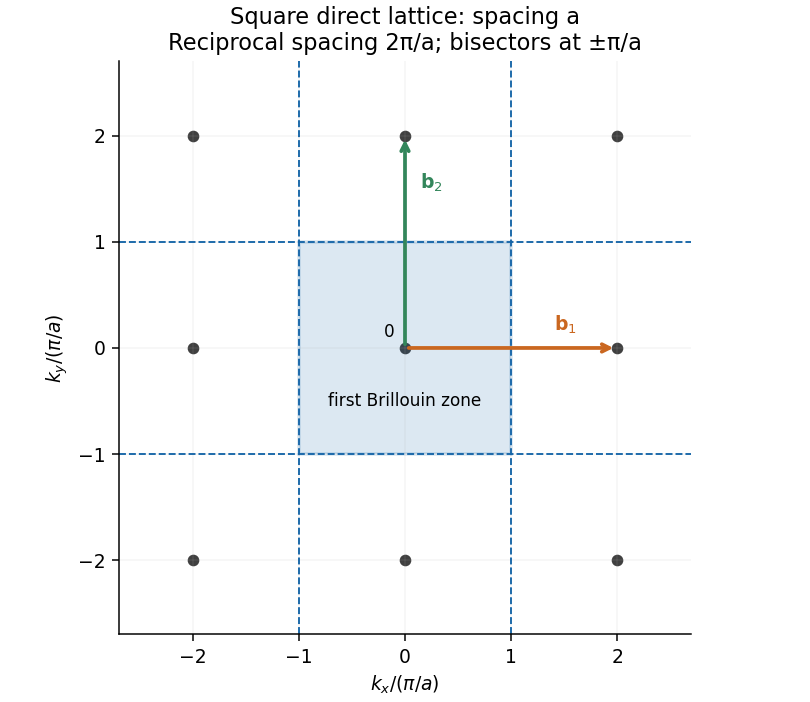


The reciprocal of a face-centered cubic lattice is a body-centered cubic lattice and vice versa, with the scale fixed by the primitive-vector definition. In a Bloch state, wavevectors differing by describe equivalent crystal momenta modulo the lattice periodicity. A crystal with primitive cells has allowed wavevectors in one Brillouin zone, hence states in each band per spin. This state count links reciprocal geometry to band filling, metallic conduction and band insulating behaviour. Reciprocal space also labels phonons and makes conservation of crystal momentum modulo transparent.
Articles by others on the same topic
There are currently no matching articles.