Circular apertures and circular obstructions illustrate both the usefulness and the limits of geometric shadow arguments. In scalar diffraction theory, each point of a transmitted wavefront contributes a complex secondary field. Their coherent sum, described by the Huygens-Fresnel principle, determines the intensity. Circular symmetry simplifies the integral, but the answer depends on whether propagation is in the Fraunhofer diffraction or Fresnel diffraction regime.
For aperture radius and axial propagation distance , the Fresnel number measures the importance of quadratic phase across the aperture. The far-field condition is ; a lens can produce the same angular spectrum in its back focal plane. Fresnel propagation retains that quadratic phase. For an axial point source a distance before the object and an observer a distance after it, the phase uses the effective distance , because both incident and outgoing spherical paths contribute curvature. Scalar, paraxial propagation and an opening large compared with wavelength are assumed throughout.
A circular hole in the far field gives an Airy pattern. For uniform plane illumination the field is the two-dimensional Fourier transform of the aperture. In polar coordinates, let ; the angular integral gives the Bessel function :ThusThe limiting central value is one because near zero. A bright central Airy disk is surrounded by progressively weaker concentric rings. The first dark ring has , or with diameter . This scale gives the Rayleigh criterion for a circular optical instrument. Larger apertures narrow the angular pattern; a lens of focal length maps the first dark ring to radius in its focal plane.
In the Fresnel regime, the axial intensity oscillates as aperture size or distance changes. Fresnel half-period zones have boundaries at path excesses and approximately opposite phases in successive zones. For a plane wave, their radii obey . A circular opening can therefore expose alternating constructive and cancelling zone contributions. More precisely, Fresnel diffraction by a circular aperture gives, normalized by the unobstructed field,An odd integer number of zones gives a bright axial point with ideal intensity ; an even number gives an axial zero. Intensity can locally exceed the unobstructed value because interference redistributes energy; total transmitted power still obeys conservation of energy. The relative normalisation here differs from the Airy expression, which normalises each far-field pattern by its own central intensity.
Off axis, the circular Fresnel field isIts concentric structure evolves with and includes fringes near the geometrical edge. The axial zone argument does not determine the complete off-axis pattern.
Complementary holes and opaque disks are related at the field level. Babinet's principle states for complementary aperture and disk transmissions under the same illumination. In the Fraunhofer region away from the direct transmitted beam, the background field is absent and the diffracted fields are opposite in sign. Their scattered intensity profiles therefore have the same Airy angular dependence. Exactly in the forward direction the unobstructed field must be retained; subtracting intensities is incorrect. Finite incident beams also give a finite-width direct beam rather than an ideal angular delta function.
For Fresnel diffraction by an opaque disk, the axial complement is particularly striking:The ideal circular disk has an Arago spot at the centre of its geometric shadow. Circular edge contributions reach the axial point with the same phase. This does not mean the whole shadow is illuminated: off-axis cancellation produces the surrounding shadow and rings, and the axial spot becomes narrower for larger obstruction or shorter propagation distance. An aperture's axial intensity oscillates, while its complementary disk's axial intensity stays constant in this ideal paraxial model.
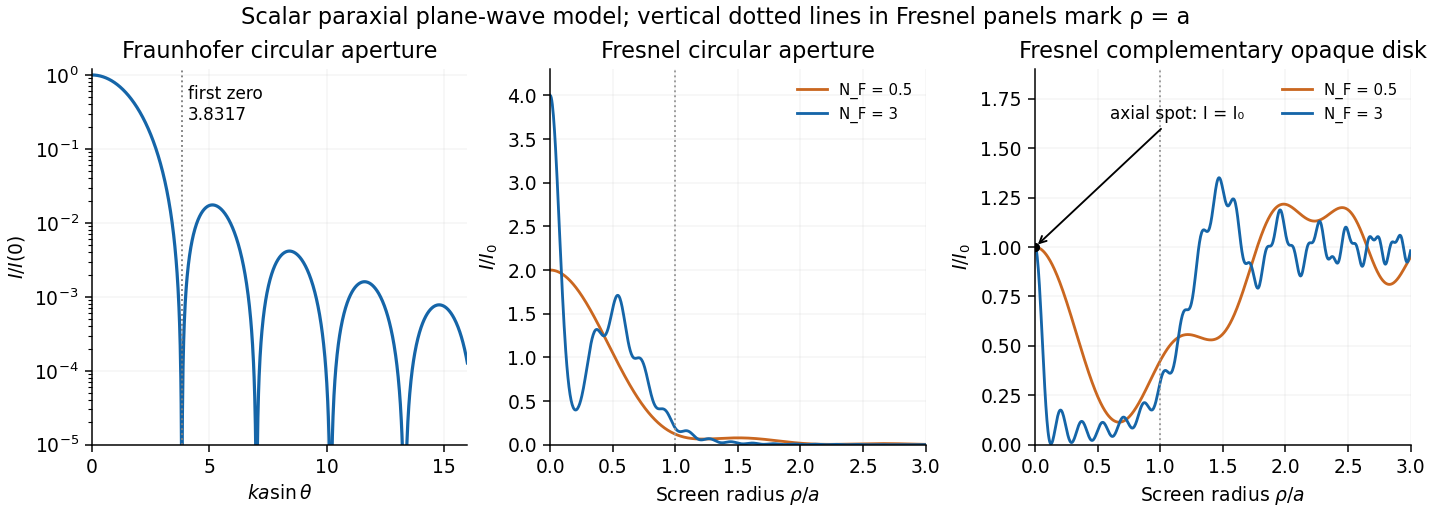
Original computed circular diffraction profiles: Airy far field and Fresnel aperture and complementary-disk intensities
. Details. A practical observation uses a compact coherent source, an accurately circular hole or disk, and an aligned screen or camera. Varying the propagation distance or aperture radius reveals the transition between regimes. A point source, or spatial filtering, prevents different source positions from washing out the fine structure. Finite source size, incomplete coherence, edge roughness, misalignment, vector effects for wavelength-sized objects and lens aberrations reduce the ideal contrast. These experimental limitations explain why a geometrically unexpected axial bright point requires a suitable setup even though its scalar derivation is simple.
The Debye model treats a solid's low-frequency lattice vibrations as acoustic phonons in an elastic continuum. There are three polarizations per wavevector, one longitudinal and two transverse, with approximately linear dispersion relations. A cutoff is chosen to preserve the total vibrational modes of atoms. The phonon number itself is not fixed; mode occupations follow the Bose-Einstein distribution with zero chemical potential.
For one polarization of speed , counting wavevector states in a spherical shell gives . Define an average Debye speed by . The total density of states can then be writtenThe Debye wavevector is , the Debye frequency is , and the Debye temperature is .
Omitting the temperature-independent zero-point energy, the vibrational energy and resulting Debye heat capacity areAt low temperature the upper limit can be extended to infinity. The integral is , givingOnly the long-wavelength acoustic modes are appreciably populated, explaining the Debye T-cubed test. At high temperature every mode contributes by equipartition theorem, so , the Dulong-Petit law.
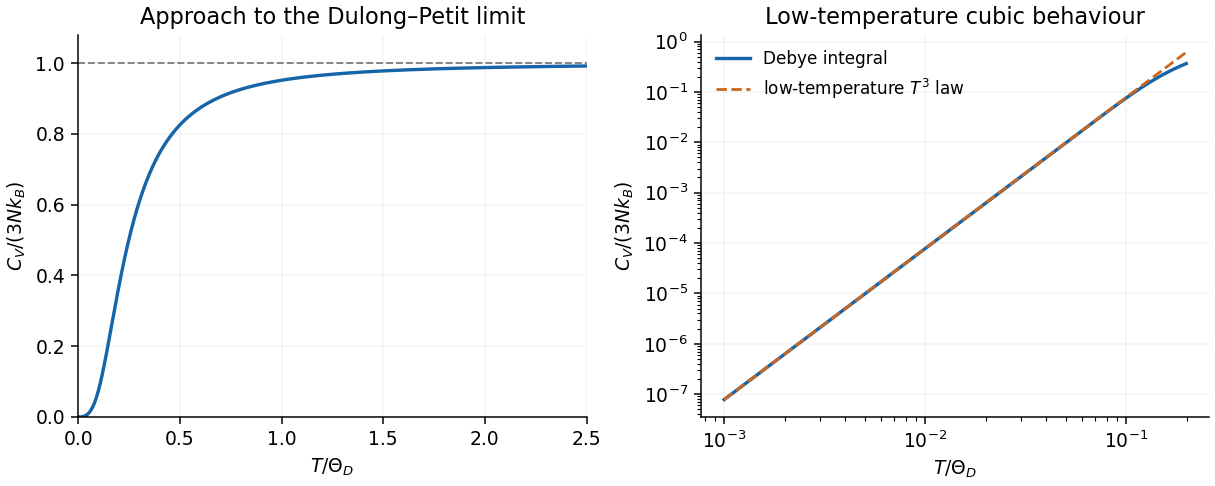
The model succeeds especially at low temperature, where long-wavelength elasticity is reliable. It replaces real anisotropic branches by a simple continuum and cannot reproduce detailed optical phonon branches or every intermediate-temperature feature. Metals also have an electronic heat capacity approximately proportional to ; defects, magnetic excitations or a phase transition can add other terms. Experiments often measure heat capacity at constant pressure, which need not equal the harmonic model's exactly.
A band effective mass describes the acceleration of an electronic wavepacket in a periodic lattice through the local band curvature. It incorporates the periodic lattice potential into a useful transport parameter without changing the bare Electron mass. For a Bloch state in an isolated band,Differentiation givesIn one dimension this becomes . A locally parabolic isotropic band minimum has with positive . A flatter band has a larger effective mass. At a band maximum the Electron curvature is negative, so the Electron accelerates oppositely to the applied force. Describing the missing Electron as a positive-charge electron hole with positive mass is often simpler.
In the scalar relaxation-time approximation, a conduction Electron in an electric field reaches . ThusFor a crystal with different directional curvatures, conductivity is a tensor and involves the occupied states and their scattering. Contributions from Electrons and holes add: in an isotropic two-carrier description. A filled band contributes no ordinary longitudinal current because opposite group velocities cancel; a partially filled band or holes permit a current response.
Effective mass therefore connects measured electrical transport to electronic band structure, but carrier density and momentum relaxation time matter as much as curvature. Ionised impurities and phonons alter . A smaller mass does not guarantee a higher conductivity if carrier population or scattering changes. Nor are all reported masses identical: density-of-states, cyclotron and conductivity masses weight anisotropic bands differently. The simple semiclassical formula assumes an isolated band, slowly varying weak fields and negligible interband transitions; near degeneracies or strong fields a single constant scalar mass is inadequate.
For a Bravais lattice with primitive translation vectors , define the reciprocal lattice by vectors satisfying for every direct-lattice translation . A convenient basis iswith cyclic formulas for . Then and for integers . The reciprocal primitive volume is .
These vectors are the spatial Fourier series frequencies of a periodic lattice potential or density. Elastic coherent crystal diffraction occurs when the scattering wavevector transfer equals a reciprocal lattice vector, with intensities additionally controlled by the basis crystal lattice structure factor. This is the reciprocal-space version of Bragg's law. A lattice of points and its basis should not be confused: a basis can make allowed reciprocal-lattice diffraction intensities vanish.
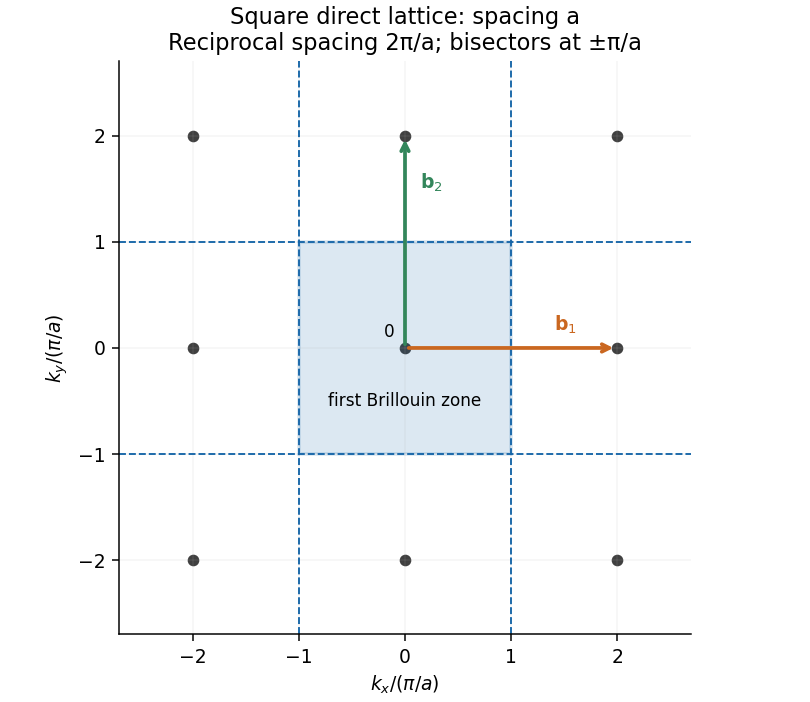
The first Brillouin zone is the Wigner-Seitz cell around the reciprocal origin: it consists of points closer to than to any other reciprocal point. Its faces lie on the perpendicular bisectorsTo see the condition, equate and . These are also free-electron Bragg-degeneracy planes, where a periodic potential can open a band gap. Higher zones classify regions beyond successive Bragg planes; the reduced-zone description folds them into the first zone while retaining a band label.
In one dimension with spacing , reciprocal points occur at , and the first zone is . A square lattice of spacing has reciprocal basis , and a square first zone with edges at .


The reciprocal of a face-centered cubic lattice is a body-centered cubic lattice and vice versa, with the scale fixed by the primitive-vector definition. In a Bloch state, wavevectors differing by describe equivalent crystal momenta modulo the lattice periodicity. A crystal with primitive cells has allowed wavevectors in one Brillouin zone, hence states in each band per spin. This state count links reciprocal geometry to band filling, metallic conduction and band insulating behaviour. Reciprocal space also labels phonons and makes conservation of crystal momentum modulo transparent.
Articles by others on the same topic
There are currently no matching articles.