The infinite walls impose , and the interior time-independent Schrödinger equation is with . Its general solution is . The first boundary condition gives , and the second gives . A nonzero normalizable state needs ; would give the zero function.
Wavefunction normalization, , gives the infinite square well states and their energy eigenvalues:The wavefunctions vanish outside the well, and their full time dependence is .
The first two probability densities areBoth vanish at the walls. The ground state has one maximum at and no interior node. The first excited state has a node at and equal maxima at and .
For a finite square well whose exterior potential is , the exterior wavefunction decays as , where and is distance from the relevant edge. Wavefunction matching at a finite potential step makes the wavefunction and, for constant mass, its first derivative continuous. Thus the probability density is nonzero at the edges and has evanescent tails outside, the interior wavelength increases, and the energy levels are lower than for infinite walls at the same positions. Reflection symmetry still gives an even ground state and odd first excited state about the center, when both are bound. A shallow well may not support that excited bound state at all.
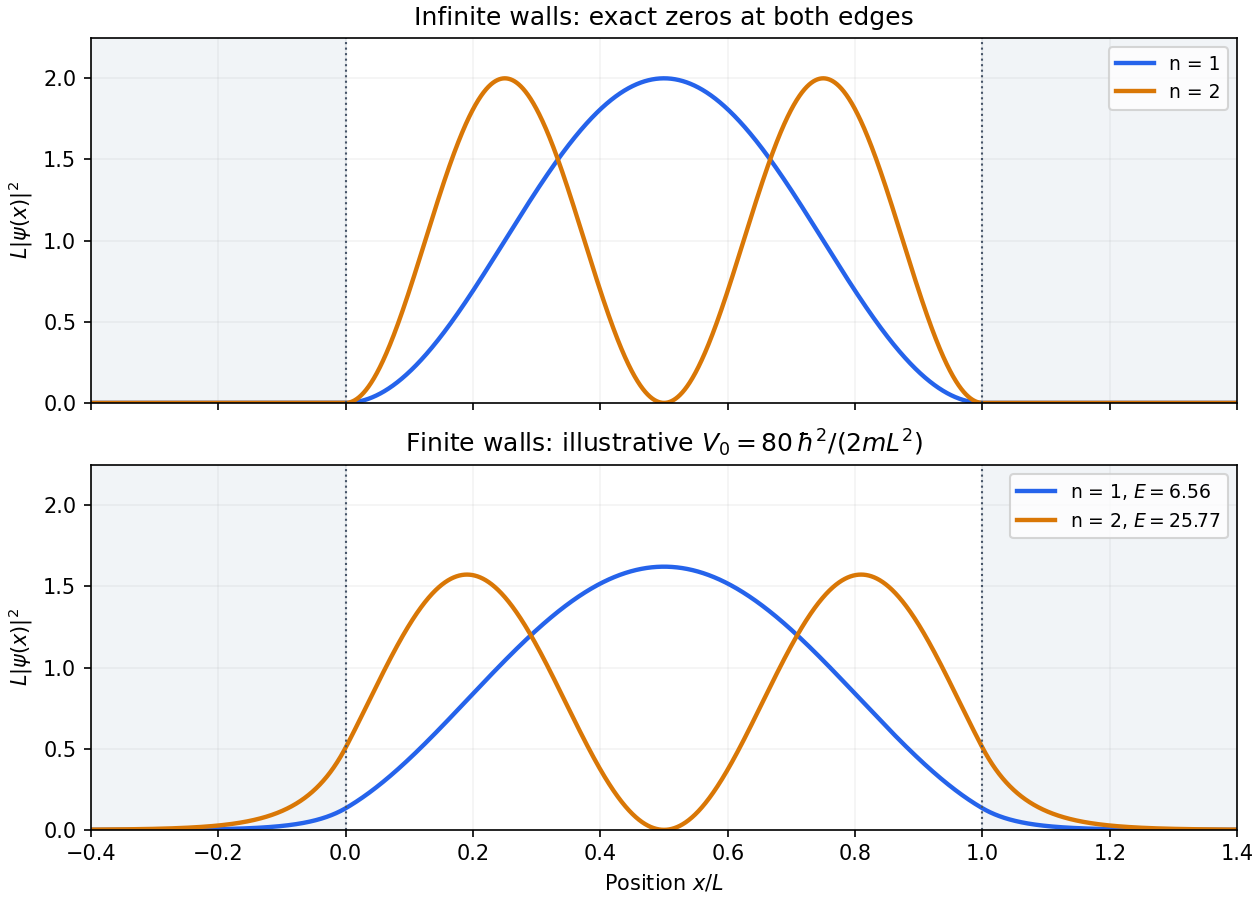
Lowest box-state densities and their evanescent tails for one finite-depth example
. Details. 
Choose the two real energy eigenstates in part (a) and take their coefficients to be in phase initially. A different initial relative phase only shifts the oscillation in time. The normalized quantum superposition isOrthogonality removes the cross terms in the energy expectation value, soFor position, the diagonal matrix elements equal by reflection symmetry, but the off-diagonal element is nonzero. Using the product-to-sum identity and givesTherefore the equal superposition of the first two box states hasThe amplitude is , and the ordinary frequency is . The motion of the mean position is an interference effect between distinct energies, while their populations, and hence the mean energy, remain fixed.
The boundary force in an infinite square well is obtained from the kinetic momentum flux at each wall. With , the derivatives of the state in part (c) areThe outward force magnitudes are . Taking positive force to mean rightwards, the forces exerted by the particle on the walls areBoth point outwards at all times, but their magnitudes oscillate out of phase. This force formula follows directly by differentiating the mean particle momentum and integrating the interior Schrödinger equation by parts: . As a check, the net force on the particle is , the opposite of the net force on the two walls.
A classical particle of energy transfers momentum in each collision with a particular wall, and returns to that wall after . Its mean outward force on that wall isThus the time averages agree separately at each wall, although the classical force consists of collision impulses and the quantum expectation varies continuously. Constant mean energy alone does not make the instantaneous quantum wall forces constant; their unequal instantaneous values supply the oscillation of .
Articles by others on the same topic
There are currently no matching articles.