Here is displacement from equilibrium, in metres; is the oscillating mass, in kilograms; is the coefficient of linear viscous damping, in ; and is the spring constant, in . The terms , and are respectively the inertial term, the opposing velocity-dependent damping term and the opposing displacement-dependent restoring term when moved to the force side of Newton's second law.
is a possibly complex driving-force complex amplitude, measured in newtons. is the driving angular frequency in , and taking the real part of gives the physical sinusoidal force. Its frequency in hertz is . The natural undamped angular frequency and damping rate areThis damped harmonic oscillator model assumes a linear restoring force and a linear, instantaneous viscous damping law.
Set the drive to zero and try . The characteristic equation isFor underdamping, , the roots are , with . The displacement oscillates with an exponentially decaying envelope:For critical damping, , there is a repeated root , giving . The motion is nonoscillatory and is the limiting case between oscillatory and overdamped response.
For overdamping, , the roots are distinct negative real numbers and . Both components decay without sustained oscillation; strong damping gives a particularly slow late-time relaxation. Constants depend on the initial conditions. A nonoscillatory solution can cross equilibrium once for some initial data, so “nonoscillatory” does not mean monotone for every possible initial condition.
Let the initial conditions be and . The velocity-impulse response of a damped oscillator isAll curves start at the origin with the same positive slope . Underdamping gives a decaying sequence of positive and negative lobes. Critical damping gives one positive lobe followed by return to zero. Overdamping also remains positive for these initial data, but has a longer tail. The initial impulse changes velocity abruptly, not displacement.
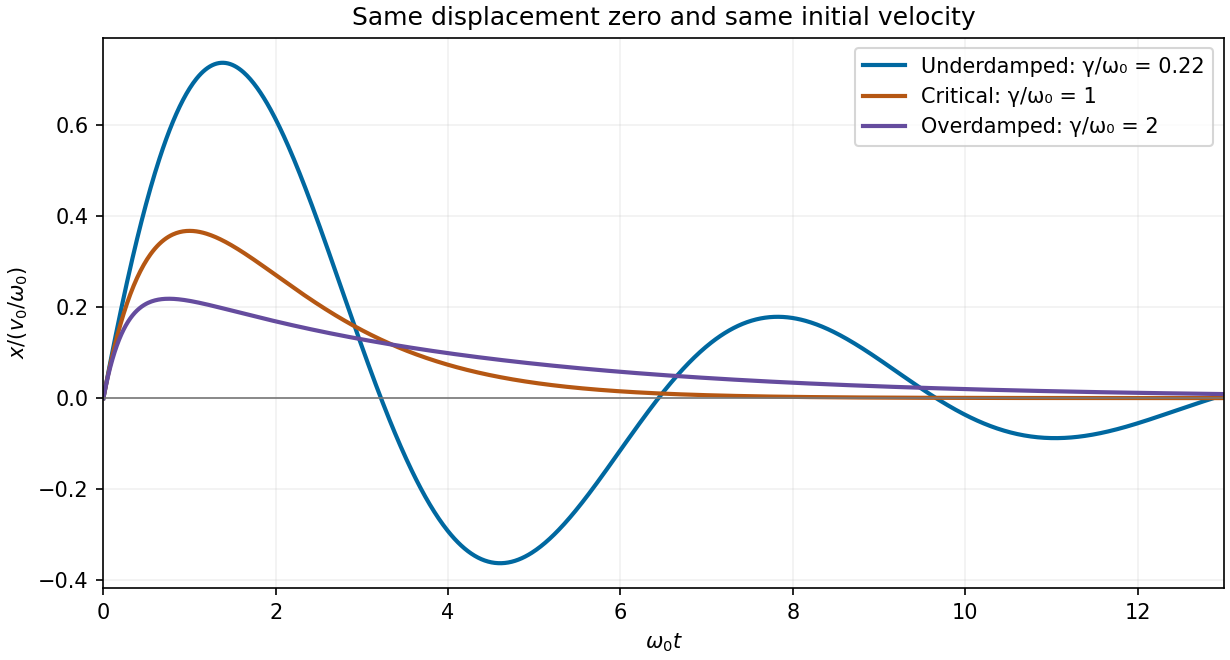
Calculated displacement after the same initial velocity impulse for underdamped, critically damped and overdamped oscillators
. Details. 
For underdamping, the general response is a free transient plus a particular driven response. Use the paper's convention. The steady displacement complex amplitude isThusHere , and the real constants enforce the initial conditions. For a real positive , the steady term is , whereFor light damping, and the transient decays slowly compared with an oscillation. The two-argument phase convention makes the displacement lag evolve from approximately zero below resonance through near to approximately far above it.
The response is quasistatic at low frequency, resonantly enhanced when the spring and inertia nearly cancel, and suppressed as at high frequency. The original graph gives approximate readings , and . These are graph estimates, not exact supplied measurements.
Use oscillator parameters from static and resonant displacement. The static spring constant isFor light damping, , givingNear resonance, , soIndependently, the resonance enhancement estimates the same quality factor. The half-power displacement level is ; its intersections are approximately and , giving bandwidth and .
The exact displacement-peak frequency is . At its difference from is only about , well below the precision justified by this printed curve. Greater numerical precision for the inferred parameters would be misleading.
Articles by others on the same topic
There are currently no matching articles.