The Born rule gives the required probability by integrating the probability density over the central interval. Put . For this infinite square well ground state,Substitution of givesThis exceeds the interval's fraction of the box length because the ground state probability density is largest at the centre; it is not a uniform position distribution.
Inside the rectangular potential barrier, the electron's wavefunction is evanescent, with decay constantFor width , the squared exponential suppression in the quantum tunnelling probability isThis is the usual leading-exponential estimate. The rectangular-barrier tunnelling probability, retaining the interface-matching prefactor for equal potentials on the two sides, isHere that prefactor is , so the more accurate result is . Both estimates show that transmission is of order one part in a million. A classical particle with this kinetic energy cannot cross the barrier at all.
A Stern-Gerlach experiment sends a collimated beam through an inhomogeneous magnetic field and then measures its transverse position after a drift region. The neutron is electrically neutral but has a nonzero magnetic moment proportional to its spin, . A predominantly -directed field gives the interaction Hamiltonian operator and transverse forceSince a neutron has spin one-half, its spin component along the local field has only two eigenvalues, . Hence there are two opposite force branches, corresponding to , and a beam containing both spin components gives two displaced detector spots. This is neutron Stern-Gerlach splitting, not an electric-charge Lorentz force. A uniform magnetic field can cause Larmor precession but does not provide the required separating magnetic field gradient.
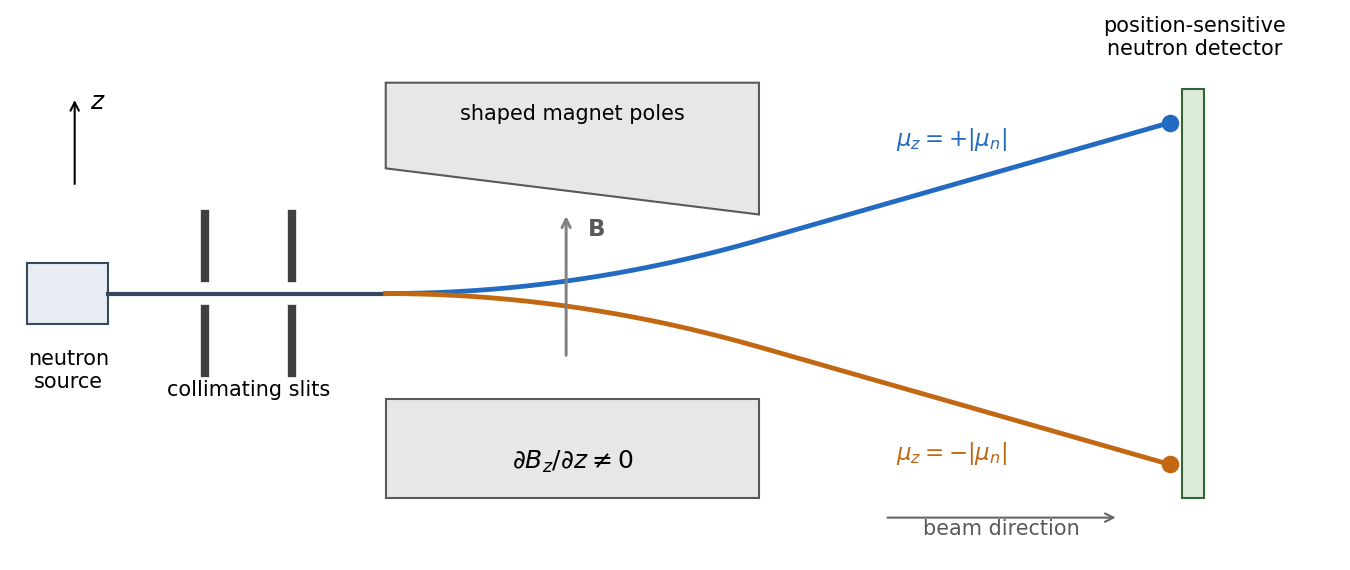

The neutron's gyromagnetic ratio is negative, so its magnetic moment points opposite to its spin; this reverses which spin label goes to which spot without changing the two-way splitting. Equal populations occur for an initially unpolarized beam. A beam prepared entirely in one field-axis spin eigenstate gives only its corresponding branch, explaining the qualification “in general”.
Assume independent background events at a known constant rate, so the background count follows a Poisson distribution. In five months its mean is . The null hypothesis of background alone assigns the observed upward fluctuation the P-valueThusThe tail includes counts above eight because they would be at least as discrepant with the background-only prediction. Even the probability of exactly eight, , exceeds the specified threshold, though it is not the appropriate tail test. The Poisson tail discovery probability is a probability of data under a background model; it is not a posterior probability that the background model is true. This interprets the question's discovery rule in its usual statistical significance sense.
For a real signal with highest frequency , the Nyquist–Shannon sampling theorem gives the nominal Nyquist sampling rateTo cover an arbitrary component exactly at the band edge, choose : a sine sampled at exactly can have every sample equal to zero for an unfortunate phase. Practical aliasing suppression also calls for a margin above the nominal limiting rate.
With rounding to the nearest digitizer level, quantization with step has the uniform-quantization error boundThus the stated digitizer meets the requested nominal amplitude precision per sample, assuming no clipping or other errors. The bandwidth sets the nominal minimum sampling rate; the level spacing sets the rounding precision. Strictly, the sampling theorem reconstructs exactly from exact samples. A uniform error bound on the entire reconstructed continuous waveform is not guaranteed by the level spacing and sampling rate alone; that stronger requirement needs a specified reconstruction and noise model.
Articles by others on the same topic
There are currently no matching articles.