A heat pump delivers : electrical work moves heat from a source as well as contributing energy itself. Its heating coefficient of performance can therefore exceed one, whereas direct resistance heating supplies at most its electrical input as useful room heat. For an ideal reversible pump,with absolute temperatures and . This is an ideal limit; actual costs also depend on compressor performance and tariffs.
For the annual ground-temperature wave, model the soil as a homogeneous semi-infinite conductor, with depth positive downward and a prescribed surface temperature. Here is thermal conductivity and is heat capacity per unit volume, so the thermal diffusivity is . Conservation of energy gives . After transients decay, put . Substitution gives ; the solution bounded at depth uses . Matching the surface then givesThis approximation identifies the ground surface with air temperature and neglects the pump's perturbation of the ground, as required by the model. The attenuation and phase delay arise from heat diffusion, not propagation at one fixed wave speed.
The graph below covers a full annual cycle. At , the amplitude is K and the minimum lags January by a quarter-year. At , the amplitude is only K and the minimum lags by half a year: the ground is slightly warmer than its annual mean in January.
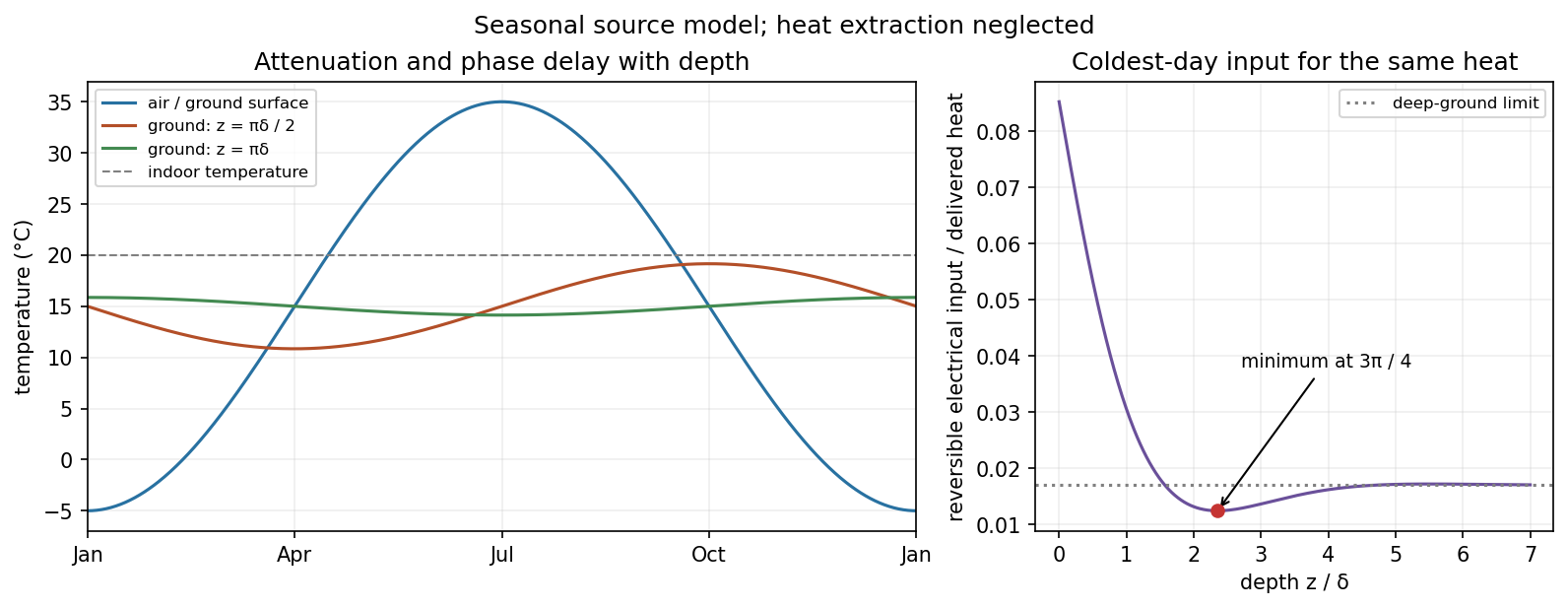
Annual air and ground temperatures, with attenuation and depth-dependent phase delay
. Details. 
The seasonal source depth for a reversible heat pump has a subtle limit: a deep source approaches and avoids severe winter cooling, but infinite depth is not the thermal optimum of this single-frequency model. In January, with , maximize . The first and largest maximum is at , where , giving and . It is also the optimum of the ideal annually integrated heating work: the heating load is even about January, so its weighted sine term integrates to zero and the depth dependence is again proportional to . Installation cost, finite tube spacing, heat extraction, weather and real pump performance alter this result. The supplied model therefore supports a finite seasonal thermal optimum, while not fixing a practical burial depth in metres.
Articles by others on the same topic
There are currently no matching articles.