An equation of state relates thermodynamic variables within a material model; a phase diagram records which equilibrium phase or phases are stable under specified controls. For a pure substance at fixed temperature and pressure, stability means minimizing Gibbs free energy. Two phases coexist when their molar chemical potentials agree. The equation of state and the free-energy stability condition must therefore be used together: an algebraic relation between alone need not identify the stable branch.
A pressure-temperature phase diagram contains single-phase regions separated by phase coexistence curves. For a one-component system the Gibbs phase rule gives : a single phase has two independent controls, two-phase coexistence lies on a curve, and three phases coexist at a triple point. The liquid-gas coexistence curve ends at a liquid-gas critical point; beyond it a continuous path connects liquidlike and gaslike states without crossing a first-order coexistence boundary. A fixed point on a coexistence curve does not specify the proportions of the two phases: an additional extensive constraint, such as total volume, fixes the phase fraction.
At a first-order phase transition, first derivatives of Gibbs free energy, such as molar entropy or volume, are discontinuous. The conversion has latent heat . At a continuous transition the first derivatives match, while response functions associated with higher derivatives can be singular or discontinuous. At an ordinary liquid-gas critical endpoint, the two coexisting densities approach one another and the latent heat tends to zero; the material does not retain a sharp liquid-gas boundary above it.
The coexistence slope follows directly from equality of the two molar chemical potentials. Since , differentiating along the boundary givesThis is the exact Clapeyron equation, also commonly called the Clausius-Clapeyron relation. For vaporization, both and are positive, so the saturation pressure rises with temperature. For ordinary ice melting into liquid water, but the molar volume decreases, giving the familiar negative melting-curve slope. The sign follows from the volume change, not from a different law.
For a dilute ideal vapour with , . The ideal-vapor Clausius-Clapeyron approximation becomesIf molar latent heat is approximately constant over the interval,These approximations deteriorate close to the critical point, where liquid and gas volumes become comparable, or over a range in which latent heat changes appreciably.[ref]
Statistical Physics by David Tong. §5.1.2, coexistence slope and ideal-vapour approximation; surrounding discussion of the liquid-gas critical point and solid-liquid boundary
The ideal gas law is an equation of state for a dilute gas, but it has no liquid branch and cannot predict condensation. A simple model including repulsion and attraction is the Van der Waals molar equation,where represents excluded molar volume and represents attraction. At its critical point, , givingBelow , the homogeneous isotherm has an interval with . That would have negative isothermal compressibility and is mechanically unstable. Equilibrium liquid-gas coexistence replaces the loop by a constant-pressure segment. Equality of chemical potentials gives the Maxwell construction:The equal-area condition enforces the common tangent to the appropriate free energy; it is a stability construction rather than permission to follow the unstable loop physically. The average molar volume between and varies by changing the phase fraction.
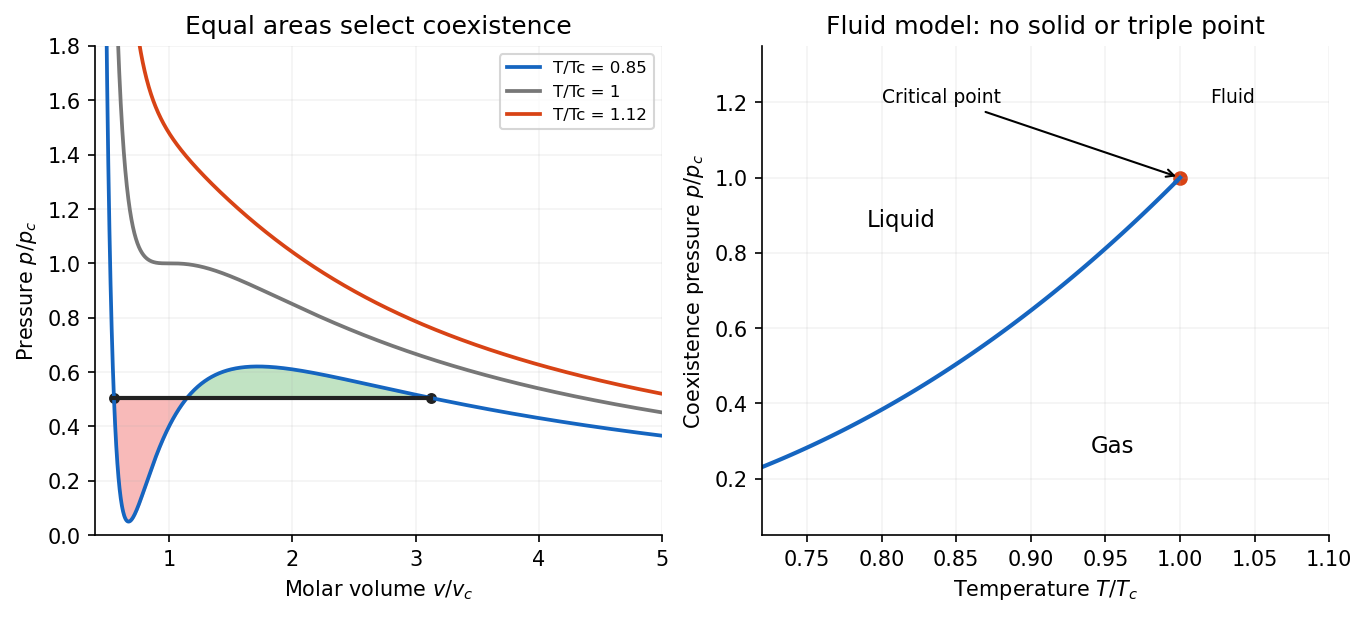

The model captures a liquid-gas critical point and qualitative coexistence, but its simple constants are not a complete quantitative description of real fluids and it has no solid phase. A full phase diagram needs additional solid free energies and can contain several crystal phases. Conversely, an experimentally determined coexistence curve and latent heat constrain equations of state through the Clapeyron equation. This is the useful connection: local thermodynamic response, global free-energy stability and the geometry of phase boundaries describe the same material at different levels.
Articles by others on the same topic
There are currently no matching articles.