A Carnot cycle consists of two reversible isothermal branches joined by two reversible adiabatic branches. Let the hot isothermal expansion run from volume to , and the cold isothermal compression from to . For moles of an ideal gas, their absorbed and rejected heat magnitudes areOn a reversible ideal-gas adiabat, is constant. Applying this to the two joining branches gives . ThereforeThe result is independent of the gas's heat-capacity ratio. This derivation presumes the usual constant-heat-capacity ideal-gas model; more generally the equal entropy changes on the two isotherms give the same heat ratio without that restriction.
To establish the upper bound, suppose an engine were more efficient between these same two reservoirs. Use its output work to drive a reversed Carnot cycle, scaled so that the work magnitudes match. For fixed work , the hypothetical engine would take from the hot bath, whereas the reversed Carnot cycle would return to it. The combined device would transfer heat from the cold bath to the hot bath without any net external work. That contradicts the Clausius statement of the second law. Hence no such two-reservoir engine can exceed .
For the triangular cycle, call the three successive vertices , and measure energies in units of . For one mole of a monatomic ideal gas, , and positive work done by the gas is . The net values on the three complete branches areThus the net work is , equal to the triangle's enclosed area.
There is a small but important distinction between the net heat on a branch and its total positive heat input to a cycle. On the sloping branch put , so , with . ThenThere is a heat-flow reversal along a thermodynamic path at . The first part absorbs heat; the final part rejects it. Integrating the two signed contributions separately givesThe true total absorbed and rejected heats and thermal efficiency are thereforeFor clarity, the positive heat input on is , on it is , and on it is zero. Using just the positive net heats of the complete branches would give and ; that shortcut misses the short heat-rejection interval on .
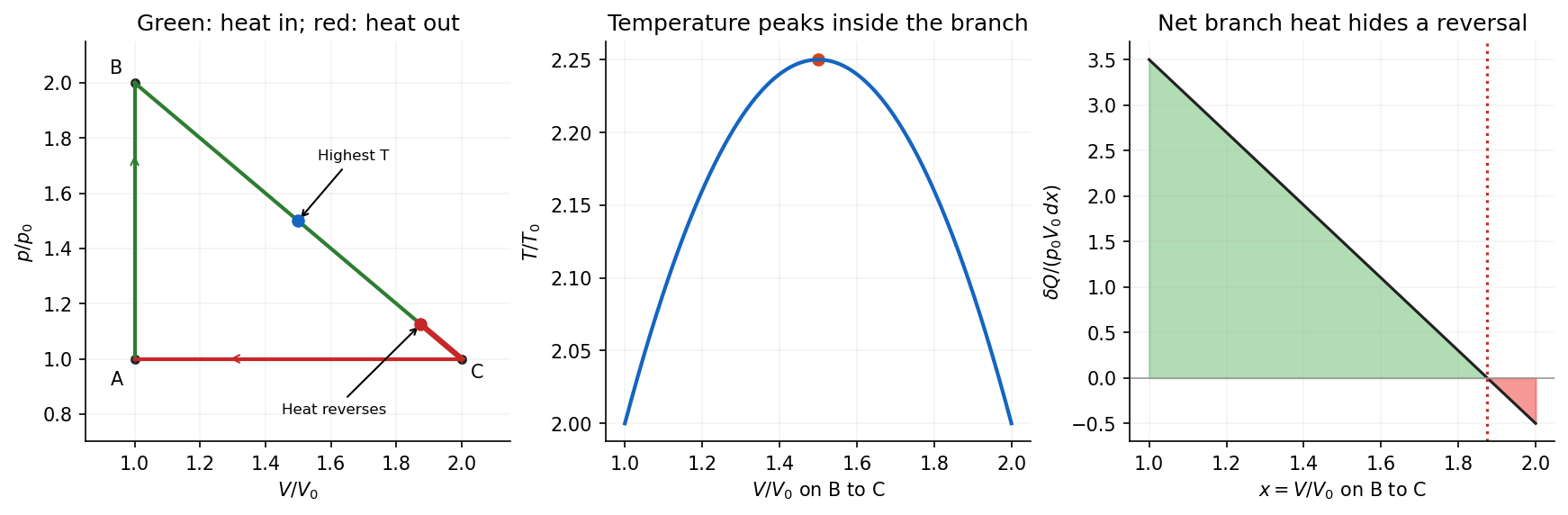
Original pressure-volume cycle with the interior temperature maximum and the late reversal of heat flow
. Details. Finally, put . The minimum temperature is at . Along ,which has its maximum at , not at either endpoint. Thus the corresponding two-reservoir Carnot efficiency isThe triangular cycle receives heat at a range of temperatures below and rejects it at temperatures above . It therefore makes less work per unit input heat than a Carnot cycle using only those extrema. The geometric path alone does not prove irreversibility: it could in principle exchange heat reversibly with a continuum of matched-temperature reservoirs, while still having this lower efficiency. Restricting it to only the two extreme-temperature reservoirs would introduce additional irreversible heat transfers.
The classical equipartition theorem assigns mean energy to each independent quadratic term in the Hamiltonian, provided the canonical distribution and its relevant boundary integrals exist. For a quadratic term , the Boltzmann distribution is proportional to , with . Integrating a total derivative givesAfter dividing by the normalization,The same argument applies to quadratic momentum terms. Other independent canonical coordinates factor out of the ratio. It is a classical statement: widely spaced quantum energy levels can freeze out a contribution at low temperature.
The confining quartic potential energy , with , is not quadratic, so the rule cannot be assigned to it. This does not invalidate the canonical Boltzmann distribution or its generalized integration-by-parts identity. Indeed,Hence equipartition for a homogeneous potential givesEquivalently, and . This is the potential contribution only; an additional standard kinetic term would contribute a further to energy and to heat capacity.
For an intact diatomic molecule, the classical degrees of freedom comprise three translational quadratic terms, two rotational quadratic terms, and two terms for its one bond-stretching vibration: one kinetic and one potential. Thus complete classical equipartition predictsThe heat capacity of a diatomic gas has lower-temperature regimes because rotational and vibrational levels are quantized. In a dilute molecular gas, the expected progression isThe rotational energy scale is normally much smaller than the vibrational scale, so these steps are separated. The high-temperature value treats the vibration as harmonic and excludes dissociation and electronic excitation; the lowest-temperature gas regime is meaningful only while the sample remains dilute and gaseous.[ref]
Statistical Physics by David Tong. §2.4, molecular rotation and vibration, and §3.4, quantum heat capacity of a diatomic gas
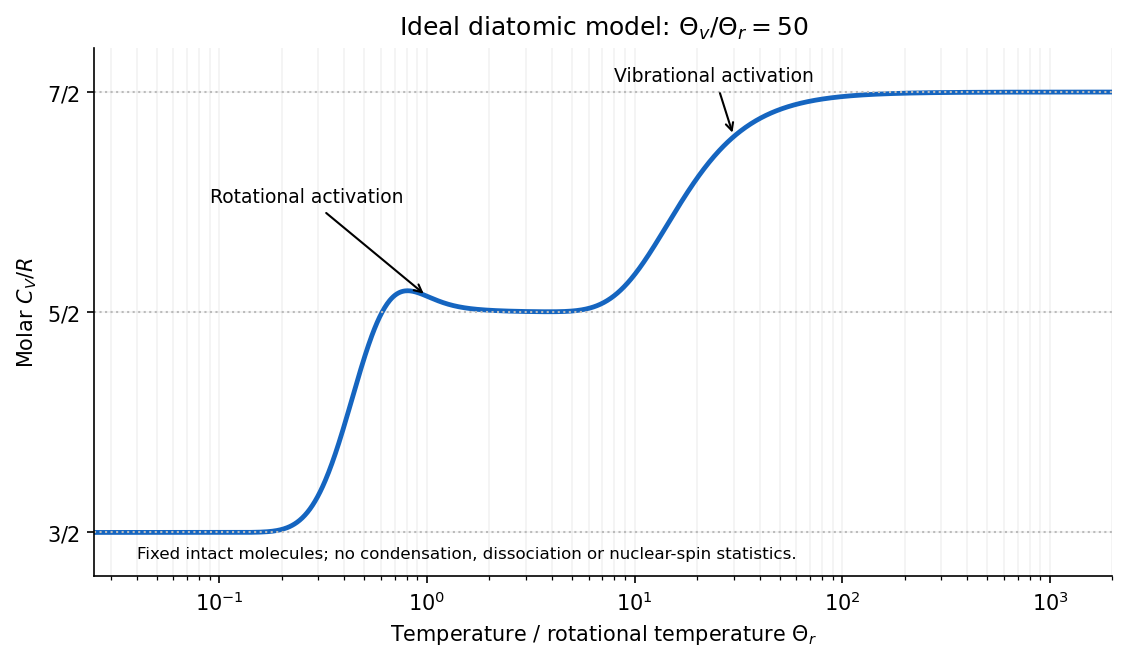
Original ideal diatomic heat-capacity model showing rotational and vibrational activation, without dissociation
. Details. The plotted example uses a quantum rigid rotor and harmonic vibration, with an illustrative ratio of characteristic temperatures. It is a model calculation, not measured data for a particular molecular species. For the vibrational part,which tends to zero on freezing out and to one when many vibrational levels are accessible. The classical equipartition theorem is recovered when the relevant level spacings are small compared with .
For the two unlabelled follow-up requests, distinguish re-equilibrating effusion from collisionless effusion. The calculations below show that escaping atoms carry mean kinetic energy , whereas a bulk atom has mean kinetic energy . If the aperture is small and interatomic collisions maintain near-equilibrium conditions, faster atoms escape preferentially, and the remaining gas relaxes toward a lower-temperature Maxwell-Boltzmann distribution. No heat supplied by the walls is available to replace the lost energy.
For a monatomic gas at fixed container volume, conservation of energy gives a quantitative check on this effusive cooling picture:Since , the temperature falls. Under these idealizations ; the gas is not left with a permanently truncated velocity tail when collisions rapidly restore equilibrium.
If interatomic collisions are absent, the individual surviving atoms do not rethermalize to a new common temperature. Their speed distribution becomes selectively depleted, generally favouring slower survivors, and their angular and spatial distribution can also develop structure determined by which trajectories reach the hole. A single lower temperature does not describe the full nonequilibrium distribution. With a direction-randomizing but energy-preserving wall model, an illustrative survival law is ; specular walls can give more detailed directional selection and even persistent nonescaping trajectories. The question supplies no wall-scattering or container-geometry model from which a unique collisionless loss law could be inferred.
For the labelled wall integrals, choose the polar axis toward the wall so that incoming atoms have , and putThe needed radial integrals are , and . They are related to the supplied integrals by rescaling the speed.
The collision flux contains an extra normal velocity : a faster atom sweeps out a longer approach cylinder per unit time. Integrating the Maxwell-Boltzmann distribution over the incoming hemisphere givesThereforeHere is the number striking unit area per unit time and is the bulk mean speed. A simple factor of one half would count the incoming hemisphere but miss the projection factor and velocity weighting.
An elastic reflection transfers normal momentum to the wall. Multiplying this impulse by the collision flux and integrating givesUsing the radial integral and yieldsThis agrees with the ideal-gas equation of state. The calculation assumes a stationary wall and elastic normal momentum reversal, appropriate to a gas in equilibrium with it.
The energy average must be taken over the atoms that actually arrive, not over the bulk population. Weighting the collision flux by givesThe wall-impact speed distribution is proportional to rather than the bulk . Faster atoms are overrepresented among arrivals. Equivalently, the mean normal kinetic energy of the arriving flux is , while each tangential component still contributes .
An equation of state relates thermodynamic variables within a material model; a phase diagram records which equilibrium phase or phases are stable under specified controls. For a pure substance at fixed temperature and pressure, stability means minimizing Gibbs free energy. Two phases coexist when their molar chemical potentials agree. The equation of state and the free-energy stability condition must therefore be used together: an algebraic relation between alone need not identify the stable branch.
A pressure-temperature phase diagram contains single-phase regions separated by phase coexistence curves. For a one-component system the Gibbs phase rule gives : a single phase has two independent controls, two-phase coexistence lies on a curve, and three phases coexist at a triple point. The liquid-gas coexistence curve ends at a liquid-gas critical point; beyond it a continuous path connects liquidlike and gaslike states without crossing a first-order coexistence boundary. A fixed point on a coexistence curve does not specify the proportions of the two phases: an additional extensive constraint, such as total volume, fixes the phase fraction.
At a first-order phase transition, first derivatives of Gibbs free energy, such as molar entropy or volume, are discontinuous. The conversion has latent heat . At a continuous transition the first derivatives match, while response functions associated with higher derivatives can be singular or discontinuous. At an ordinary liquid-gas critical endpoint, the two coexisting densities approach one another and the latent heat tends to zero; the material does not retain a sharp liquid-gas boundary above it.
The coexistence slope follows directly from equality of the two molar chemical potentials. Since , differentiating along the boundary givesThis is the exact Clapeyron equation, also commonly called the Clausius-Clapeyron relation. For vaporization, both and are positive, so the saturation pressure rises with temperature. For ordinary ice melting into liquid water, but the molar volume decreases, giving the familiar negative melting-curve slope. The sign follows from the volume change, not from a different law.
For a dilute ideal vapour with , . The ideal-vapor Clausius-Clapeyron approximation becomesIf molar latent heat is approximately constant over the interval,These approximations deteriorate close to the critical point, where liquid and gas volumes become comparable, or over a range in which latent heat changes appreciably.[ref]
Statistical Physics by David Tong. §5.1.2, coexistence slope and ideal-vapour approximation; surrounding discussion of the liquid-gas critical point and solid-liquid boundary
The ideal gas law is an equation of state for a dilute gas, but it has no liquid branch and cannot predict condensation. A simple model including repulsion and attraction is the Van der Waals molar equation,where represents excluded molar volume and represents attraction. At its critical point, , givingBelow , the homogeneous isotherm has an interval with . That would have negative isothermal compressibility and is mechanically unstable. Equilibrium liquid-gas coexistence replaces the loop by a constant-pressure segment. Equality of chemical potentials gives the Maxwell construction:The equal-area condition enforces the common tangent to the appropriate free energy; it is a stability construction rather than permission to follow the unstable loop physically. The average molar volume between and varies by changing the phase fraction.
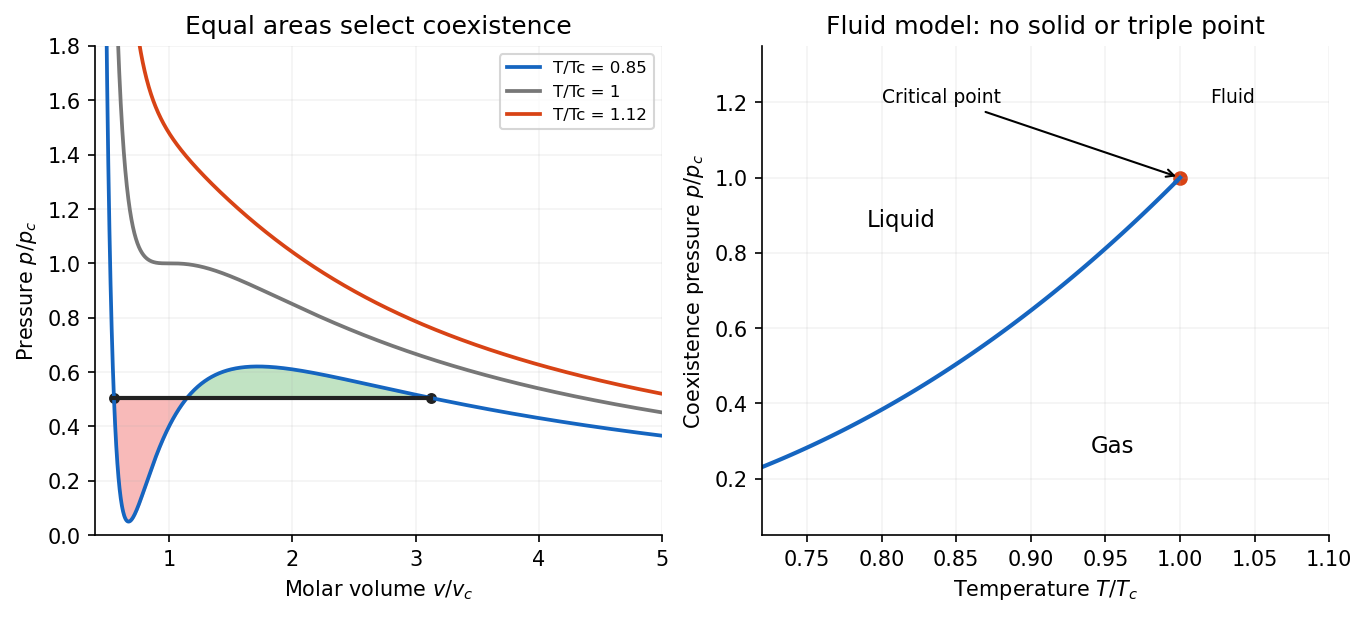


The model captures a liquid-gas critical point and qualitative coexistence, but its simple constants are not a complete quantitative description of real fluids and it has no solid phase. A full phase diagram needs additional solid free energies and can contain several crystal phases. Conversely, an experimentally determined coexistence curve and latent heat constrain equations of state through the Clapeyron equation. This is the useful connection: local thermodynamic response, global free-energy stability and the geometry of phase boundaries describe the same material at different levels.
Articles by others on the same topic
There are currently no matching articles.