Axial moment of inertia. In the original diagram is the outer radius and the inner radius. For uniform mass density , a coaxial annulus of thickness has . Therefore the axial moment of inertia of a hollow cylinder isSince , factorizing the fourth-power difference givesFor a solid cylinder , giving . For a thin cylindrical shell with fixed mass and , . The latter limit agrees with every mass element being at radius .
Undamped rolling oscillations. Let be axle displacement from the spring equilibrium. Rolling without slipping imposes . The sum of translational and rotational kinetic energy isThe potential energy is . Differentiating in the absence of damping, or applying the force and torque equations below, givesFor the thin shell , the effective inertia is , and the angular frequency of the simple harmonic motion isStatic contact friction supplies the required torque but does no work when the contact point is instantaneously stationary.
Damped force balance. Take rightward force as positive and counterclockwise rotation as positive. Write for the signed static friction at the bottom contact. ThenEliminate and use :Here has units , so has units and units . The stated drag force is interpreted as acting through the axle, with no additional viscous torque. An oil bath could also exert such a torque physically, but its magnitude is not specified by this force-only model.
Light damping. Substitution of into the differential equation gives . In the underdamped regime ,Taking real linear combinations gives the general damped harmonic oscillator displacementThe constants are fixed by the initial displacement and velocity. For example, release from rest at gives and . Light damping means , in which case and the envelope decays slowly compared with an oscillation.
Complex impedance. In sinusoidal steady state write physical voltage and electric current as real parts of and . The electrical impedance is a ratio of phasors; its magnitude gives the voltage-to-current amplitude ratio and its argument gives their phase difference. It is measured in ohms.
For an ideal capacitor, and . Consequently , givingWith this time convention the voltage lags the electric current by .
Bridge output. The original diagram has and in parallel in the upper-left arm, and and in series in the lower-left arm. The point labelled is connected to the upper supply node. Set the lower supply node to zero, so . Assuming the measured output draws negligible electric current, the two voltage dividers giveTheir difference is thereforeThe reactive-arm electrical impedances are
Balance. Setting and cross-multiplying gives . For this Wien bridge,The right-hand side must be the real number . Equating imaginary and real parts givesPositive capacitances require . In the equal-component case and , this reduces to
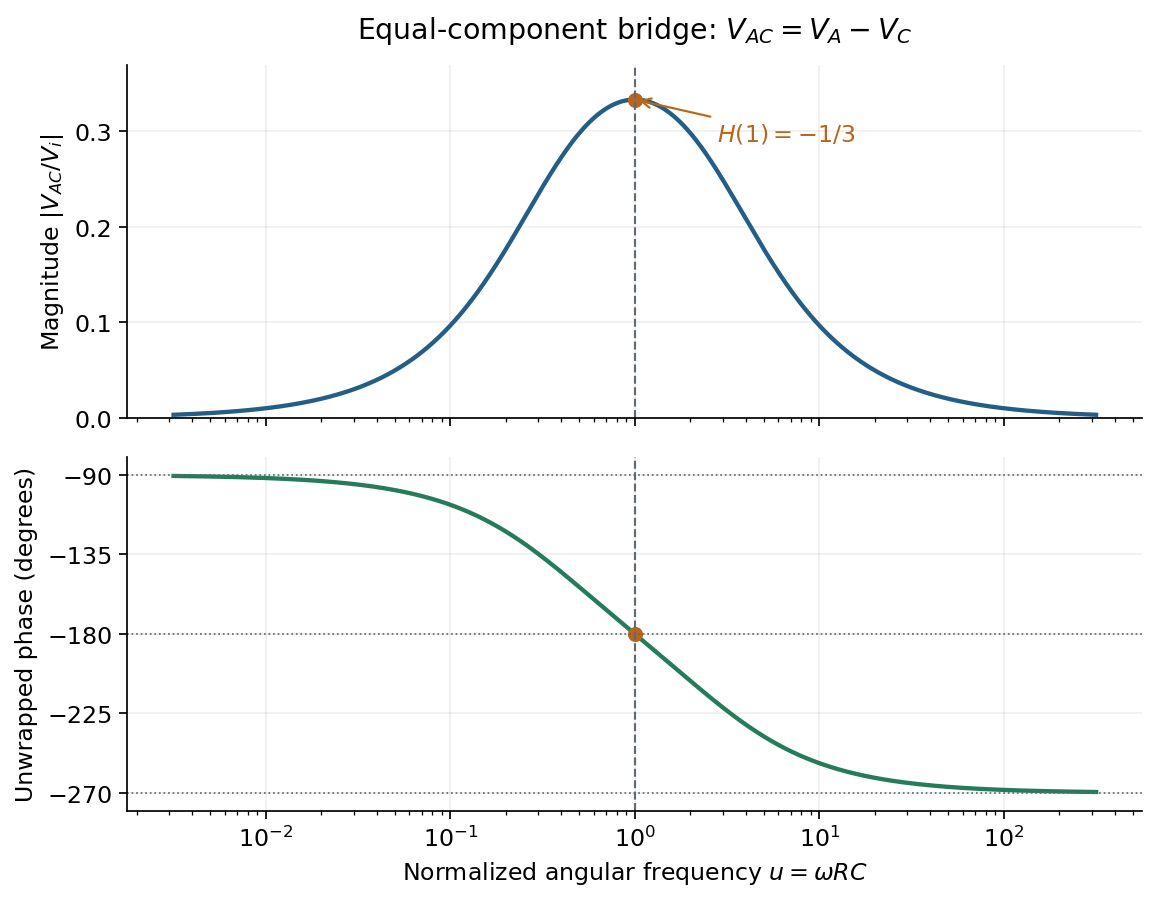
Band-pass output and phase. Preserve the requested voltage polarity: . Since ,Put . The equal-component ratio is , so the Wien bridge band-pass response isAt finite positive frequency, its imaginary part vanishes exactly when . ThusThe magnitude is maximal there and tends to zero at both frequency extremes, as expected for a band-pass filter.
A convenient continuous, unwrapped wave phase isIt decreases from as , passes through at , and tends to as . A principal-value plot instead jumps from to at resonance; both represent the same phasor. Reversing the output to would shift the phase by and make the resonant ratio , but that is a different output polarity from the one printed.

Articles by others on the same topic
There are currently no matching articles.