Rearrange the supplied form of Kepler's third law to make the gravitational constant the subject:Convert the semi-major axis and orbital period to SI units before substitution:The central value is thereforeFor monomial uncertainty propagation, logarithmic differentiation givesIf the quoted errors are independent standard uncertainties, the variances of these contributions add:Thus , and the measured result under that statistical convention isThe semi-major axis measurement supplies the largest individual contribution to the relative uncertainty.
The paper does not specify whether its errors are statistical uncertainties or bounds. If they are maximum input errors, the first-order worst-case error propagation estimate adds magnitudes:Correlation between input errors would instead require the covariance terms in the general propagation of uncertainty formula; they are not specified.
The original diagram places the output across the resistor, in series with an ideal inductor. Treat the voltages as phasors with time dependence . The electrical impedances are and , so the same electric current flows through both:This is an RL low-pass filter, with corner angular frequencyThe frequency response tends to one for , has magnitude at the corner, and tends to for . The requested sketch uses a logarithmic horizontal axis and a linear voltage-gain axis:
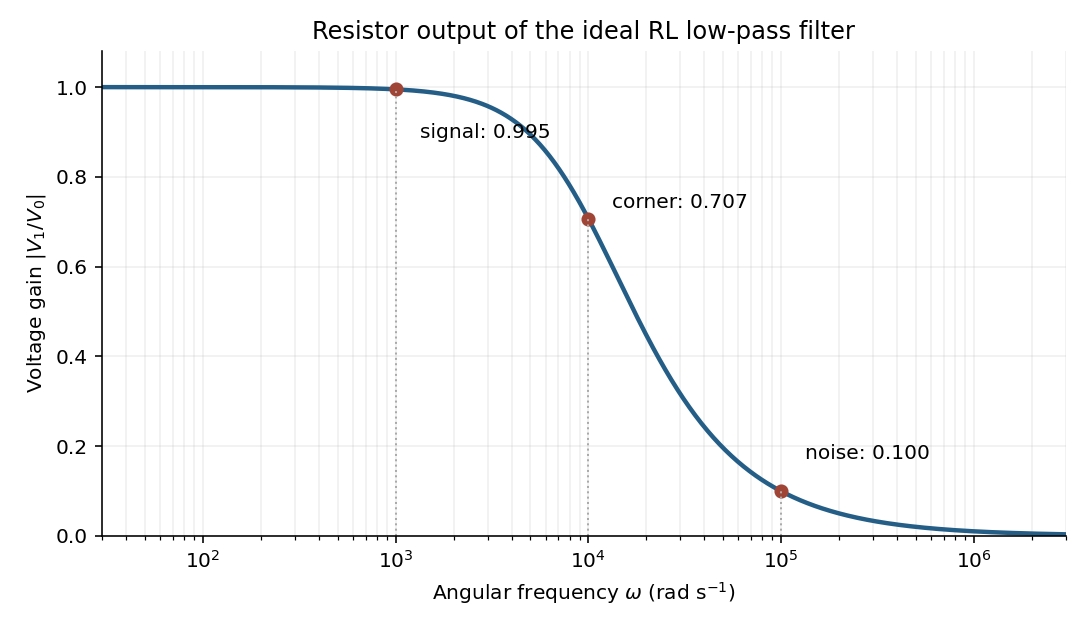
At the two specified angular frequencies,The relative attenuation by a linear filter is the ratio of these gains:Thus the noise amplitude is attenuated by a factor of 10 relative to the signal. A squared-voltage ratio would decrease by a factor of ; the question's voltage transfer function gives the amplitude comparison.
The Huygens-Fresnel principle constructs a new wavefront as the envelope of secondary wavelets emitted by points on an earlier wavefront. Let the phase velocities in the two media be and , with refractive indices evaluated at the light's fixed frequency.
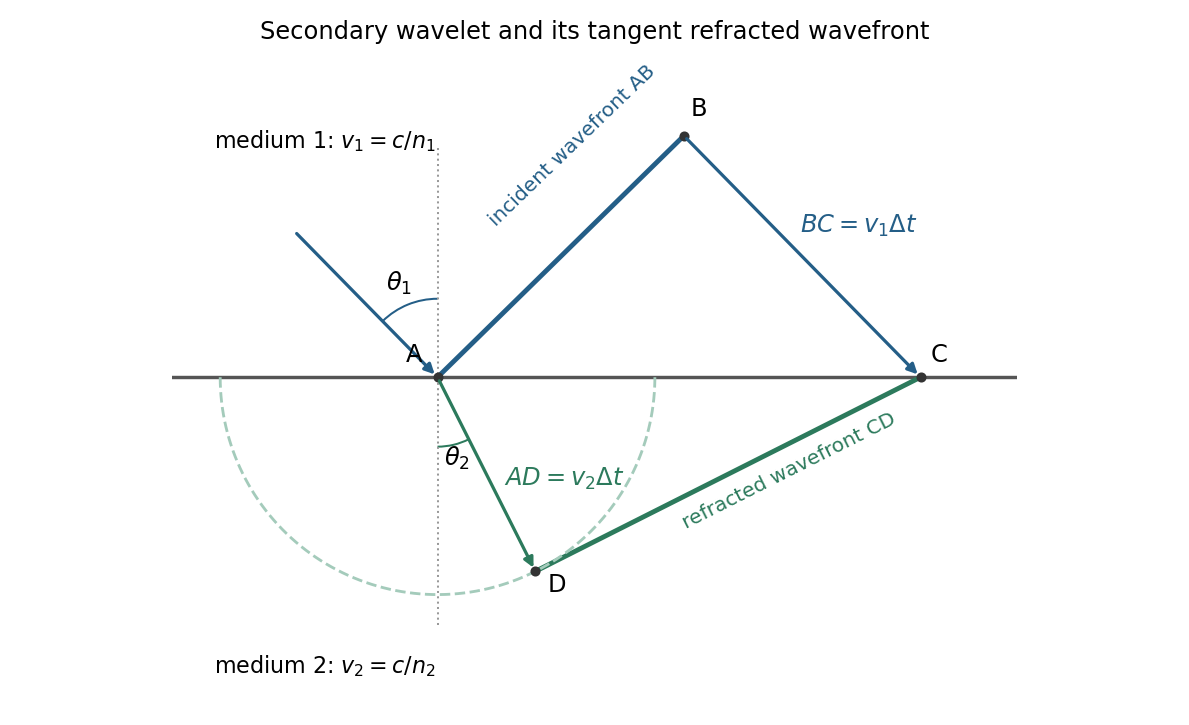


For refraction from secondary wavelets, let point of the incident wavefront reach the interface first. A second point reaches the interface at after time , so . During the same interval, the secondary wavelet centered on advances radius into the second medium. The refracted wavefront is tangent to this wavelet, hence ; also because a ray is normal to its wavefront in these isotropic media.
Let be the incident and refracted ray angles from the interface normal. They also equal the corresponding acute angles between the wavefronts and the interface. The two right triangles have common hypotenuse , givingTheir ratio eliminates both and :This is Snell's law. In particular, entering a medium of larger refractive index reduces the ray's angle to the normal. The construction assumes a stationary interface and homogeneous isotropic media with a propagating refracted wave.
Use base dimensions for mass, length and time. The proposed dimensional analysis givessoEquating the independent dimensional powers requiresConsequentlyThe mass density drops out because there is no other mass-bearing quantity with which to combine it under the stated assumptions.
Dimensional analysis fixes the powers but leaves a dimensionless coefficient undetermined. For a linear deep-water gravity wave, the dispersion relation is , giving phase velocity and group velocity . Both obey the inferred scaling. The phrase wave speed alone does not distinguish these two velocities or fix the coefficient.
Choose a positive unit normal to the loop and choose positive circulation by the right-hand rule. Write the applied magnetic field as , where . Because the field is uniform, the external magnetic flux isFaraday's law of induction gives the induced electromotive force, and Ohm's law gives the current through the loop's electrical resistance:This is the induced current in a tilted resistive loop with the self-generated magnetic-flux contribution neglected as requested. The factor has units . A field parallel to the loop plane has and induces no current in this uniform-field model.
For , the initial normal flux is positive. At , the external magnetic field is instantaneously zero but its normal component is decreasing, so and . The current is counterclockwise when viewed from the positive-normal side. Its own magnetic field points along through the loop, preserving the initial normal flux in accordance with Lenz's law.
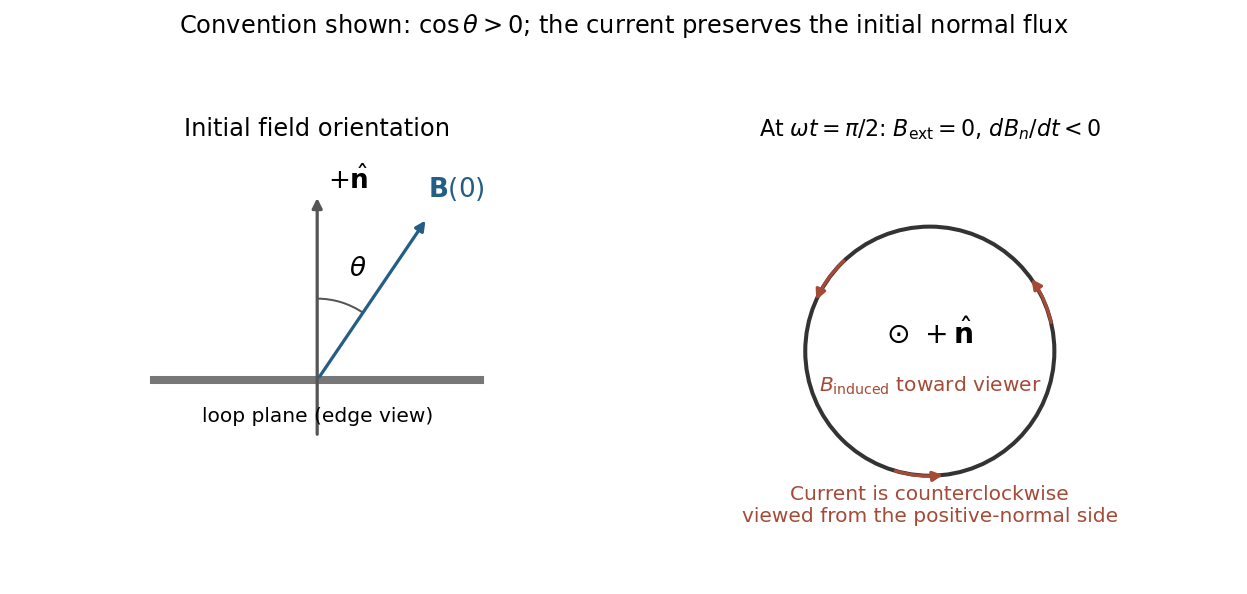
Initial oblique field and the induced current a quarter-cycle later, for a positive initial normal flux
. Details. 
For , both circulation and the induced normal-field direction reverse. The current follows the rate of change of magnetic flux; the quarter-cycle current is nonzero even though the external field itself vanishes then.
Articles by others on the same topic
There are currently no matching articles.