Use as a spectroscopic wavenumber, in the same units throughout. Write the mass absorption coefficient of the absorbing species asHere is the spectral line strength, the integrated mass absorption coefficient; it is not the line-centre coefficient. If has units and is in , then has units . For absorber mass density , the volume coefficient in Beer-Lambert law is .
Lifetime broadening. Finite lifetimes of the upper and lower states destroy optical coherence, even for an isolated molecule. Exponential coherence decay gives a Lorentzian line shape. For population decay rates and no extra dephasing, its wavenumber half-width is , with expressed in the length unit reciprocal to . This sets a natural linewidth and can matter at extremely low collision rates; it is generally much smaller than atmospheric collisional or thermal widths.
Thermal Doppler broadening. A Maxwell-Boltzmann distribution of molecular line-of-sight velocities givesThis Gaussian distribution has a half-width , determined by absorber molecular mass and temperature. It is especially relevant in the rarefied upper atmosphere, where collisions are infrequent.
Pressure broadening. Collisions perturb transition frequencies and phases. In the impact regime, exponential phase decorrelation givesHere is the half-width at half maximum, proportional to the coherence-destroying collision rate. It depends on perturber density, molecular collision properties, and temperature; it is often parameterized by for a specified broadener. It dominates much of the dense lower atmosphere. The Lorentzian line shape has algebraic wings, whereas the Doppler profile has rapidly decreasing Gaussian wings. Where both mechanisms matter, their convolution is a Voigt profile. A pure pressure-broadened profile should not be extrapolated to arbitrarily low pressure while discarding the finite Doppler core.
Let be the absorber mass path along a ray. If the spectral line profile is independent of position, Beer-Lambert law gives . A finite-band mean and the line's equivalent width are respectivelyWhen the band contains all significant absorption, . An unqualified integral of transmission over the entire infinite line domain diverges because transmission tends to one far from line centre; is the finite and physically useful line deficit.
This is nonexponential band transmission: each monochromatic transmission is exponential, but their average generally is not. Differentiating with respect to mass path givesMore decisively, define the absorption coefficient averaged over the transmitted spectrum byThen . The core saturates first and the surviving radiation increasingly samples weakly absorbing wings. The effective attenuation per additional mass therefore decreases. Jensen's inequality also gives , with equality for a spectrally constant coefficient. Thus the band transmission decays more slowly than the exponential with its initial mean attenuation.
The corresponding curve of growth has for an optically weak line, and sublinear growth after saturation. For the Gaussian profile, with , absorption extends to , so . For a strongly saturated pure Lorentz profile the wings instead give . These asymptotes apply while the line remains isolated and its important wings remain within the range where the assumed profile and nearly constant Planck function are appropriate. The integrated absorption is not an exponential either: and .
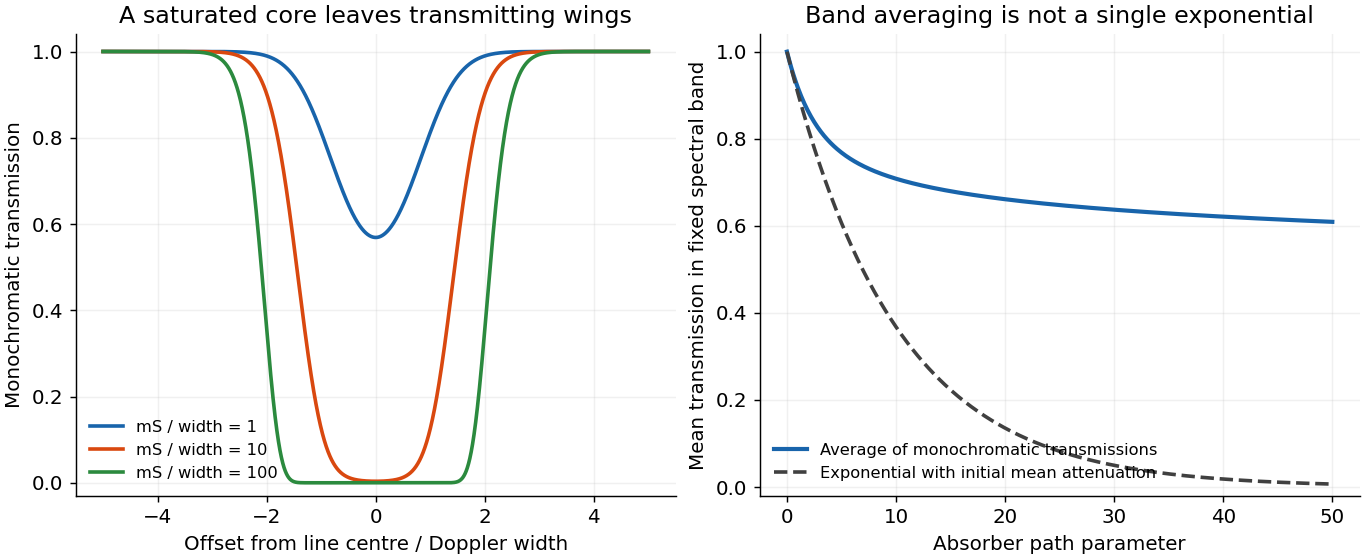
Line saturation produces nonexponential band transmission
. An original fixed Gaussian line example shows its opaque core expanding with absorber path. The mean transmission across a fixed band remains above the single exponential determined by its initial mean attenuation. Details.
For the single-line greenhouse deficit, use hydrostatic balance, fixed surface pressure , constant gravity , and the dry adiabatThe gas constant and specific heat refer to the background gas. Let be the supplied effective ray cosine. The vertical optical depth and slant transmittance from level to space areThis permits pressure-dependent line widths. With local thermodynamic equilibrium, negligible infrared scattering, a black thermal surface, and no incident thermal radiation from space, the formal radiative transfer solution isThe weights add to one. Subtract the transparent-surface radiance and put , using the narrow-line approximation only in the line deficit. Define its pressure-dependent equivalent widthApproximating each hemispheric flux by times the effective-ray radiance preserves the black-surface flux. The outgoing longwave flux is thereforeIntegration by parts gives the particularly transparent formBoth boundary terms vanish: and . The dry adiabat and monotonic Planck function give . Atmospheric emission replaces part of the warm surface radiation by emission from cooler levels, reducing emission to space for a specified . The inequality is strict when opacity occurs over a nonzero range with temperature contrast; an isothermal absorbing layer at the surface temperature would not produce such a contrast.
For a spherical planet the mean absorbed instellation is . The required global energy balance isConsequently every equilibrium of this model has , with strict warming when . At fixed temperature profile, increasing increases and hence . This argument does not assume that the greenhouse gas changes the stellar-band albedo, surface pressure, or background thermodynamics; those are held fixed. For sufficiently broad or overlapping saturated wings the full frequency-dependent Planck function must replace the narrow-line approximation.
Take a weak line in the radiative sense: the integrated slant optical depth is small wherever absorption materially contributes, not merely a small greenhouse-gas mass mixing ratio. Normalize every local spectral line profile so that , with the line strength independent of pressure and, as stipulated, temperature. Keep a finite Doppler or natural core, or a Voigt profile, so that a pressure-only zero-width core at the top does not invalidate a uniform optical-depth expansion. The line must also be narrow enough to use across it.
To first order,Thus the detailed normalized line shape drops out, even if its width varies with pressure. Substituting in the deficit in c givesThe neglected term is second order when the relevant squared optical depths are integrable and uniformly small. A very narrow saturated line need not be weak simply because . More generally the displayed first-order integrated limit follows from the finite integrated opacity even if an idealized line centre makes a pointwise expansion nonuniform; a finite physical core is the straightforward sufficient assumption.
For an explicitly perturbative temperature estimate, evaluate the bracket at :At fixed and radiative conditions, increasing makes every level cooler relative to the surface, enlarging the bracket and the warming. Increasing at fixed has the opposite effect. The limit is isothermal and gives zero line-induced deficit. A change of background molecular mass alone need not change this leading result: for ideal gases with the same active degrees of freedom, and scale together and their ratio is unchanged. Comparing only the height-coordinate lapse rate would miss that the absorber column is naturally a pressure-coordinate quantity.
Articles by others on the same topic
There are currently no matching articles.