A periodic harmonic chain with masses , spacing and nearest-neighbour spring constant hasHamilton's equations give . The discrete Fourier transform , , with in one Brillouin zone, diagonalizes the quadratic form:The harmonic-chain normal-mode reality condition means , not that and are independent real coordinates. For canonical quantization, impose , equivalently . For setThen the quantum harmonic chain is a set of independent phonon oscillators:The centre-of-mass zero mode of a harmonic chain is the free coordinate , with ; it cannot be normalized by dividing by . Retaining it giveswith the corresponding momentum expansion and uniform term . The nonzero modes alone give the site commutator ; the uniform term supplies the missing . Each oscillator occupation is a nonnegative integer, and adding one phonon costs and crystal momentum modulo a reciprocal-lattice vector. [ref]
Applications of Quantum Mechanics by David Tong. §4.1.1, printed pp.103–105, monatomic-chain normal modes and quantization
In the continuum limit of a harmonic chain, , andThe wave equation and linear low- dispersion relation follow. The lattice gives an ultraviolet cutoff; the acoustic approximation does not reproduce the zone-edge flattening.
With the centre of mass fixed, the oscillator partition function and Bose-Einstein distribution areFor a long chain, above its finite-size level spacing and below the zone-edge scale, integrating the two acoustic propagation directions gives . At high temperature each retained oscillator instead contributes to the heat capacity.
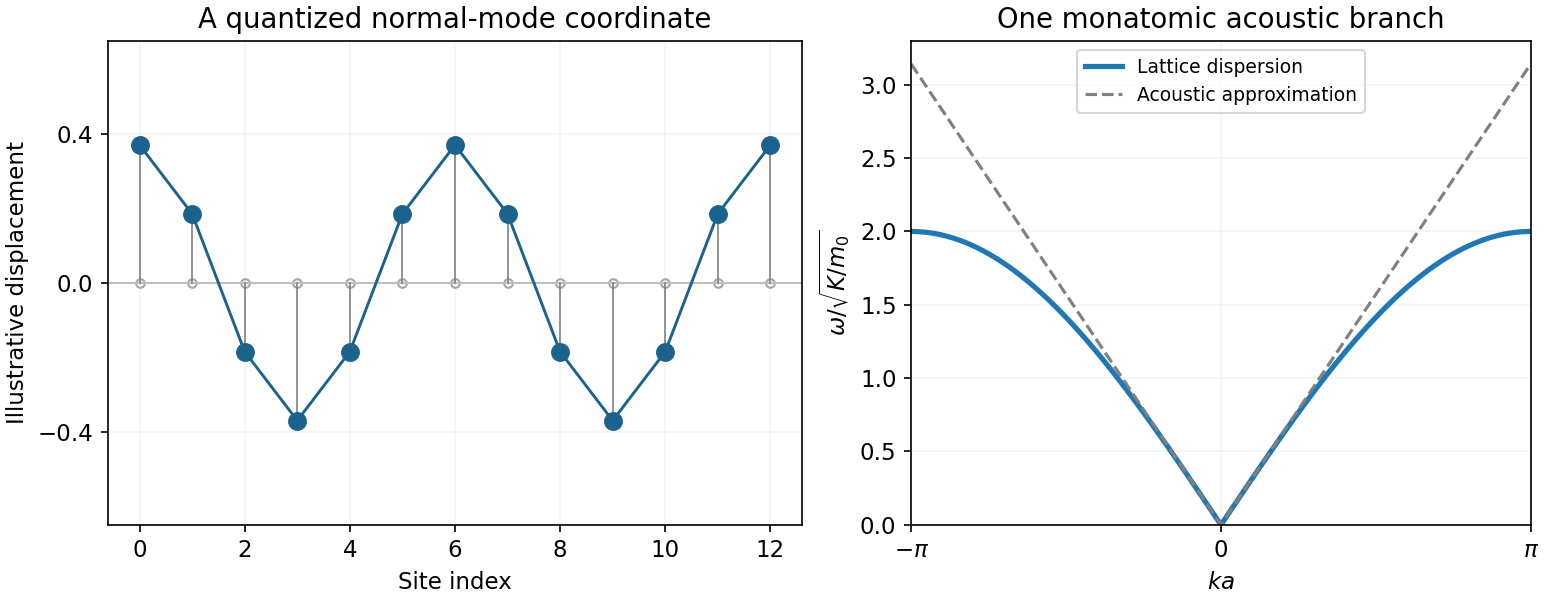
Original monatomic-chain mode sketch and its acoustic lattice dispersion
. Source. Details. For , divide elapsed time into slices and apply the Trotter product formula. Inserting complete position and momentum bases gives the regulated phase-space path integralThe endpoint values are , . Each Gaussian momentum integration in a phase-space path integral can be performed explicitly, leaving the configuration-space path integralIts measure is the time-sliced limit of , with the usual infinitesimal convergence prescription. The integral sums amplitudes, not positive classical probabilities. Operator ordering remains part of the time-slice definition. Expanding a short-time kernel recovers the Schrödinger equation; composing kernels reproduces the time-evolution operator.
In the classical limit, rapid phase cancellation suppresses paths away from stationary action. Varying with fixed endpoints gives . The semiclassical result sums the classical-path phases multiplied by fluctuation functional determinants; for a quadratic Hamiltonian the fluctuation integral is Gaussian and this expansion is exact.
For quantum statistical mechanics, continue by a Wick rotation. The Euclidean action and thermal trace giveThe trace closes position-space paths. In a many-particle trace one also sums over endpoint permutations with the appropriate exchange signs. In a coherent state field formulation, bosonic fields are periodic and fermionic coherent states instead give antiperiodic Grassmann fields, hence bosonic and fermionic Matsubara frequencies and . [ref]
Physics 215C: Quantum Field Theory, Part 3 by John McGreevy. §§3.1–3.2, coherent-state time slicing and trace boundary conditions
The quantum-to-classical imaginary-time mapping views a local -dimensional quantum problem as a classical-looking field theory in dimensions, with imaginary-time extent . A genuine classical probability interpretation additionally requires a nonnegative weight; fermion signs and Berry terms can obstruct it.
For a smooth potential in the high-temperature or small- limit, imaginary-time paths fluctuate only over the thermal de Broglie wavelength . If this is short compared with the potential's variation scale, the diagonal free kernel givesThis classical phase-space limit of the thermal kernel is the classical phase space partition function for one degree of freedom. A dilute identical-particle gas also needs its factor; when exchange is appreciable, classical statistics fails. As a check, a single quantum harmonic oscillator gives , precisely the classical phase-space integral.
For conventional superconductivity, an attractive interaction pairs opposite-spin fermions. A complex pairing Hubbard–Stratonovich transformation introduces a Cooper pair field . The fermionic fields then appear quadratically, giving the pair-field effective action of a superconductorThe trace convention counts each independent spin-pair block once. The uniform saddle is the BCS gap equation; the fermionic excitations have in the fully gapped case. A slow-field expansion near the transition yields Ginzburg-Landau theory of superconductivity. Normalize its pair field so is an effective pair density, with pair mass and signed charge :For , the uniform minimum has , with arbitrary constant phase. Writing separates the amplitude mode from the phase. The local potential has curvature term and coherence scale . A neutral condensate has a gapless phase Goldstone mode when suitable dynamics is included.
The charged theory is invariant underThe gauge-invariant condensate momentum is . Only and enter physical phase dynamics. At nearly constant amplitude, varying givesFor a smooth phase, taking the curl and using Ampère's law gives : the Meissner effect screens a static bulk magnetic field over the London penetration depth . In a gauge with , the phase stiffness is a quadratic term in , the superconducting version of the Higgs mechanism.
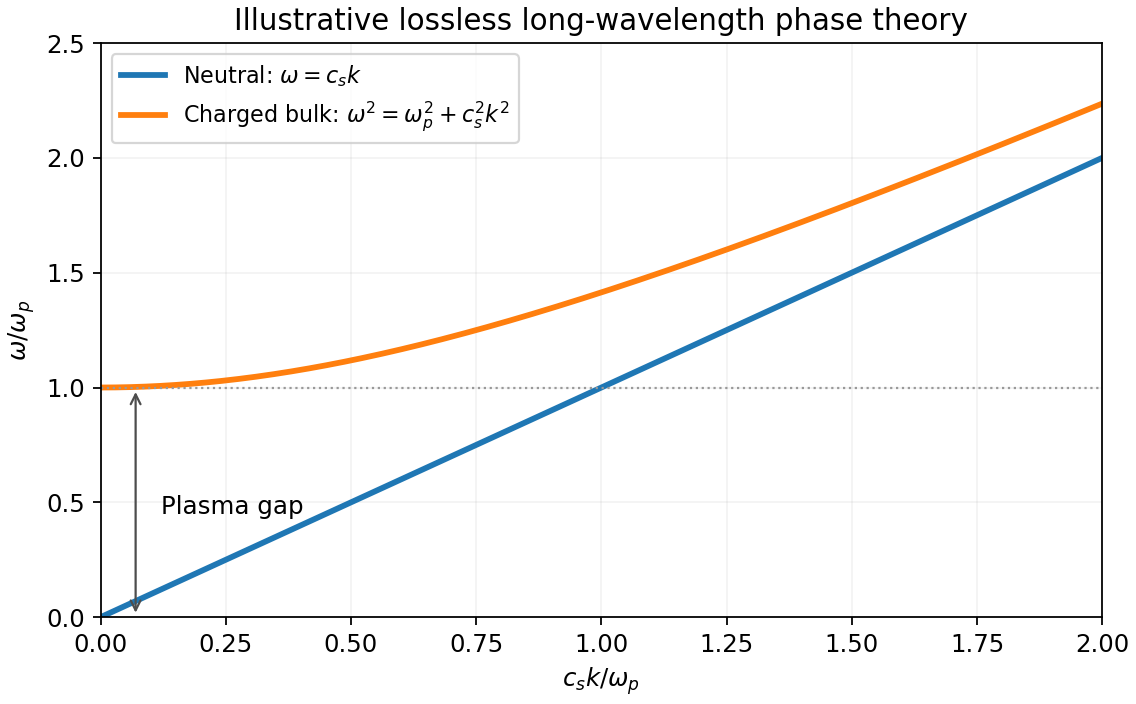
To identify the dynamical mode, a simple lossless long-wave superconducting phase-density action isHere is the pair compressibility coefficient. Eliminating the longitudinal electric potential givesThus the neutral sound mode becomes a gapped longitudinal plasma oscillation; transverse electromagnetic waves acquire in this simple bulk model. This redistribution of the phase degree of freedom into electromagnetic collective modes is the Anderson-Higgs mechanism in a superconductor. Local gauge symmetry is a redundancy, not an independently observable symmetry whose breaking creates another massless particle. [ref]
Physics 215C: Quantum Field Theory, Part 3 by John McGreevy. §2.3, superconductors, superfluids and gauged phase dynamics
The static functional alone does not determine a frequency or damping rate. The displayed mode dispersions require the added dynamical assumptions; real screening, normal carriers, boundaries and dissipation modify them. The amplitude fluctuation is distinct from the phase mode and is not removed by the gauge choice.


Articles by others on the same topic
There are currently no matching articles.