For a normal-ordered bosonic Hamiltonian, insert coherent-state resolutions between short imaginary-time evolution factors. The overlaps generate and the Hamiltonian symbol is obtained by replacing creation and annihilation operators by and . Including the chemical potential gives, in the stated convention,The trace imposes periodic imaginary-time boundary conditions,so bosonic Matsubara frequencies are . The two complex coherent-state integration variables are treated independently before imposing the physical saddle contour. There is no extra zero-point ordering term: the supplied interaction is already normal ordered.
The spatial confinement is not specified beyond the volume. The uniform bulk results below use a homogeneous box with periodic spatial boundaries, or the interior of a large vessel where boundary effects can be neglected. A hard wall instead requires a vanishing field at that wall and an inhomogeneous saddle near it. Temporal periodicity follows from the thermal trace and does not by itself impose periodic spatial boundaries.
For a uniform time-independent saddle, extremizing the action gives . Its grand-potential density is , with . Since , the minimum at positive density for isFor the uniform mean-field minimum is the vacuum, rather than a positive-density condensate. At fixed nonzero density in the weakly interacting condensed regime, the saddle relation sets . The mean-field one-body density matrix factorizes as , giving macroscopic occupation of the uniform mode. Depletion corrections are omitted at this stage.
The action has the global particle-number symmetry , . Choosing one saddle phase breaks this symmetry; the degenerate mean-field minima form the circle . There is no energetic preference for a uniform value of , but spatially varying phase costs gradient energy. Consequently a neutral condensate has a gapless Goldstone mode and a nonzero phase stiffness. The mode becomes sound once density dynamics is included. With the superfluid velocity is , so a single-valued field allows circulation in units around a closed loop that avoids zeros of the amplitude. This phase coherence and rigidity are the physical content of the broken-symmetry description.
The claim is a mean-field saddle statement, not an assertion that every and temperature in the question supports true long-range order. In a finite number-conserving system ; the symmetry-breaking order parameter is defined with the thermodynamic limit taken before an infinitesimal source is removed. In a homogeneous infinite short-range gas at nonzero temperature, infrared phase fluctuations prohibit true condensation in . In one dimension they also destroy true condensate long-range order at zero temperature. A two-dimensional gas can nevertheless have superfluidity and algebraically decaying correlations below a Berezinskii–Kosterlitz–Thouless transition. A finite trap can have substantial coherence without contradicting these thermodynamic statements.[ref]
Existence of Long-Range Order in One and Two Dimensions by Pierre Hohenberg. abstract and pp.383–386; finite-temperature restriction
On the physical density-phase contour put . Direct differentiation givesIntegrating the Laplacian by parts with the stated bulk boundary convention, and dropping the periodic total derivative of , produces the density-phase action of a Bose gas,Write and , where is constant. To quadratic order,The uniform static density fluctuation has positive curvature . Its inverse static susceptibility at wavevector is , which remains nonzero at . This is the sense in which the amplitude or density fluctuation is massive. The phase has no term proportional to without derivatives; a uniform phase rotation costs no action. It is the massless direction required by global symmetry.
The term shows density-phase conjugacy. It is important to distinguish static density stiffness versus an excitation gap: the density and phase do not form two independent normal-mode branches with one gapped and one gapless particle. In this nonrelativistic first-order theory they supply the conjugate variables of one positive Bogoliubov branch, derived below. The omitted cubic terms include and corrections from the density-gradient denominator.
There is also a background term . It vanishes for smooth fluctuations with zero temporal winding. Periodicity of , however, permits . The compact phase winding term must be retained when such sectors are included; it is not generally the same constant in all sectors. The local Gaussian phonon calculation concerns the smooth zero-winding sector and does not describe vortices or points where the density vanishes.
At wavelengths with , neglect the density-gradient term in the quadratic density-phase action. Complete the square in its remaining density terms:The convergent Gaussian integral can be performed by a contour shift or by its Fourier-transform identity. Its determinant is independent of at this order. Combining that normalization with the saddle action into a constant givesThe saddle contribution to is ; the additional measure-dependent constant need not be assigned an invented numerical value. The density Gaussian extends the fluctuation integration beyond its exact positivity domain, which is justified only while fluctuations around are small. The smooth zero-winding assumption is also required as discussed above. A constant global phase zero mode gives a finite compact-group volume, handled separately from nonzero phonon modes.
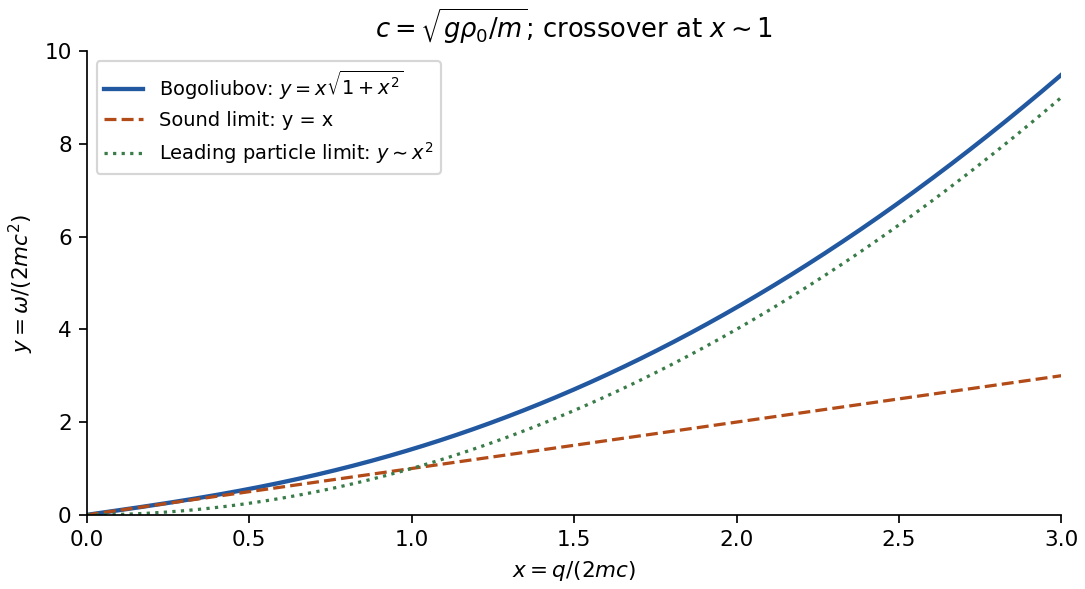
Fourier transforming the Bose-gas phase-only action gives a kernel . Analytically continuing gives its real-frequency poles,In the present units the excitation energy equals . Each real Fourier coordinate is a harmonic oscillator with inertia coefficient and spring coefficient , hence frequency equal to the square root of their ratio. This is the direct relation to a quantum harmonic chain. The mode is a gapless sound phonon; its finite speed reflects both the compressibility and the phase stiffness .
Retaining the density-gradient term provides a useful check. Its integration instead gives a temporal coefficient , soThis is the Bogoliubov spectrum. Its small- limit is the derived sound branch; at large within the contact model it crosses towards particle-like behaviour. The crossover in the squared dispersion is , precisely the scale beyond which the discarded density gradient is not small.
The same action checks the dimensional restriction in the saddle analysis. At nonzero temperature its zero Matsubara mode gives phase fluctuations proportional to ; at zero temperature integrating the frequency gives . Their infrared divergences invalidate uniform true long-range order for at nonzero temperature and for at zero temperature. The long-wave collective description can remain useful for correlations even where a global condensate saddle is not a literal symmetry-broken state. The contact coupling here is an effective low-energy parameter; this calculation does not determine ultraviolet renormalization or trap-specific surface modes.

Articles by others on the same topic
There are currently no matching articles.