In general relativity, light follows null geodesics. A weak gravitational field outside an isolated spherical mass gives the Schwarzschild light deflectionfor impact parameter . At the solar limb this is approximately arcseconds. A Newtonian corpuscular calculation gives half this value; the full result depends on spatial curvature as well as the gravitational time dilation. The parametrized post-Newtonian formalism predicts , with in general relativity.
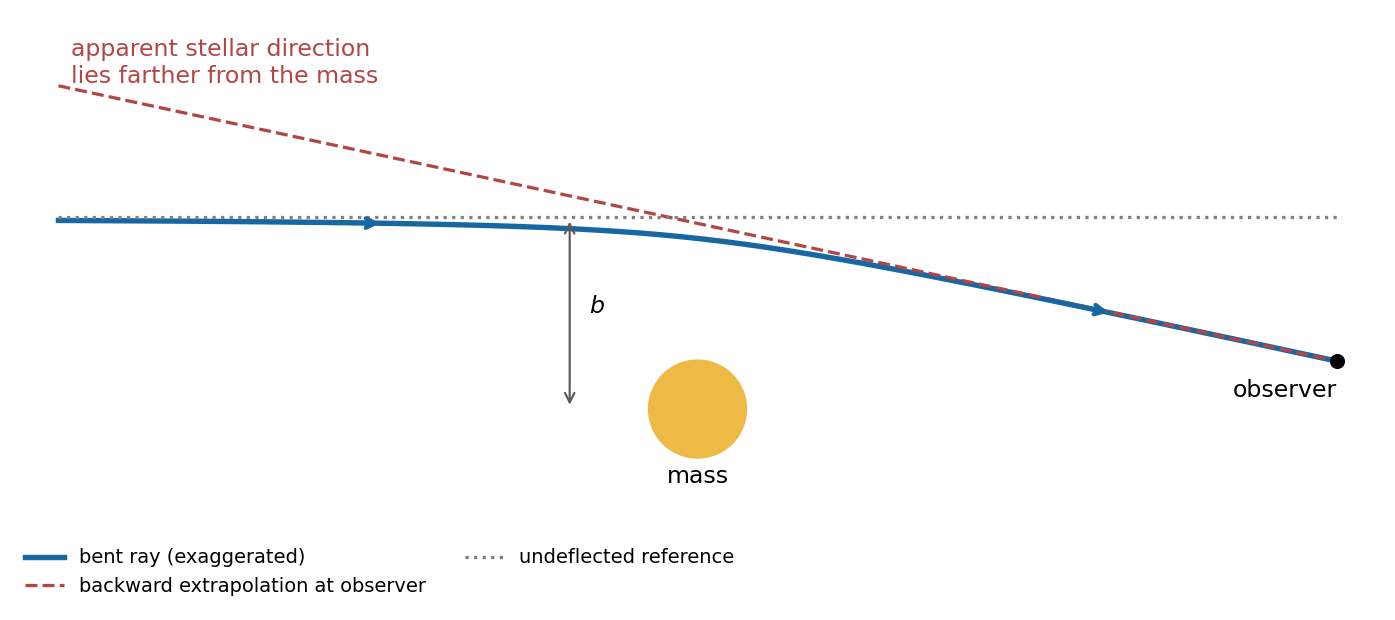

The Eddington experiment compared photographic star positions near the eclipsed Sun with reference exposures taken without the Sun in that field. Rays bend toward the Sun, but their backward extrapolations place the apparent stellar images farther from it. Plate scale, focus changes, atmospheric refraction and comparison-field alignment must be separated from a radial displacement proportional to . The original report discusses the instruments, plate reductions and competing predicted deflections; the test is a quantitative comparison with uncertainty, not a unique proof of a gravitational theory.[ref]
a determination of the deflection of light by the Sun's gravitational field by Frank Watson Dyson and others. 1920, pp. 291–333: eclipse observations, instruments and plate reductions
radio interferometry permits an independent test without an eclipse. A 2005 Very Long Baseline Array experiment observed four compact sources at 43, 23 and 15 GHz. Differential astrometry suppressed common antenna errors, while a fit separated refraction in the solar corona from achromatic gravitational deflection. Tropospheric errors and radio-source structure also required calibration. The reported was consistent with general relativity.[ref]
Progress in Measurements of the Gravitational Bending of Radio Waves Using the VLBA by Edward Fomalont and others. 2009, §§II–III on observations, calibration and coronal subtraction; §V on the reported result
tidal forces measure differences in gravitational acceleration across an extended region. Neighboring freely falling particles each have zero four-acceleration, but their separation need not accelerate uniformly. Let be the tangent to a reference timelike geodesic and its infinitesimal separation from a neighboring one, chosen from an affinely parametrized geodesic congruence. Using the Riemann curvature tensor convention specified in Solution 3,Changing the overall curvature convention changes this displayed sign. The covariant derivatives compare vectors by parallel transport, avoiding a coordinate-dependent subtraction of accelerations.
In the Newtonian limit, expand the force field at two nearby points:For , a local orthonormal frame aligned with the radius givesThere is radial stretching and transverse compression; the trace vanishes outside the mass. Two freely falling test masses and a measurement of their changing separation implement gravity gradiometry. Their common acceleration drops out, while a relative acceleration proportional to separation remains. A local inertial frame removes Christoffel symbols at a point, but cannot remove nonzero curvature over a finite region.
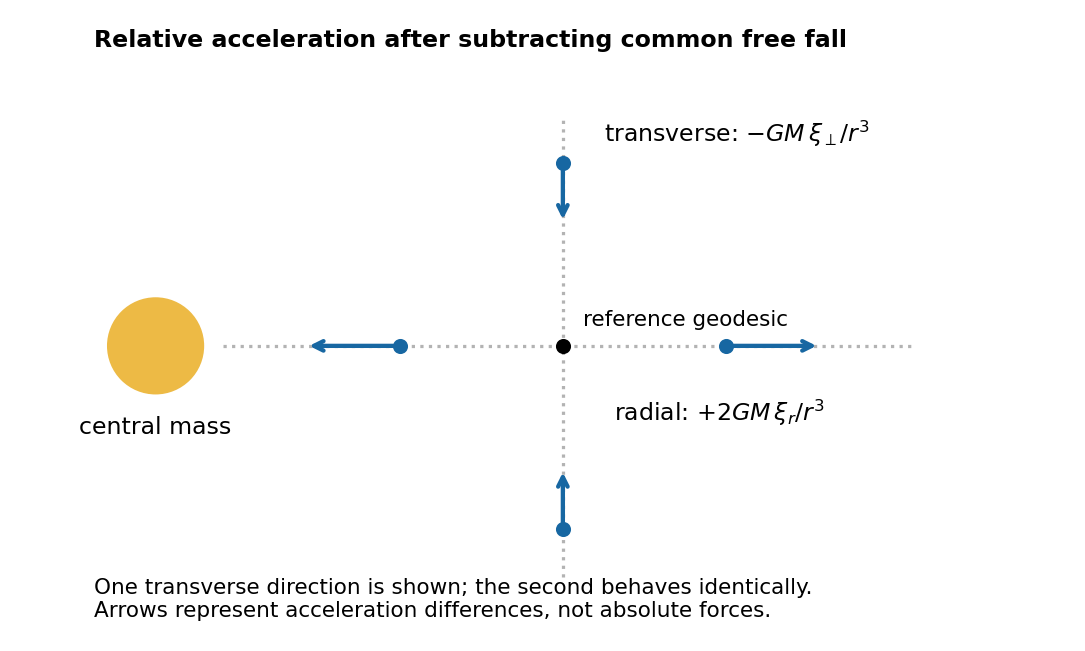
Point-mass tidal deviation
. Details. 
With Cartesian Minkowski spacetime coordinates , introduce the four-current and electromagnetic four-potential . The antisymmetric electromagnetic field tensor has components and . Maxwell equations becomeThe time and space components reproduce Gauss's law and the Ampère-Maxwell equation; the dual equation gives absence of magnetic monopoles and Faraday's law of induction. Antisymmetry gives charge conservation . The relativistic Lorentz force is . Every displayed equation transforms tensorially under a Lorentz transformation; the electric field and magnetic field are different components of the same object.
Two independent algebraic electromagnetic field invariants areThe second is a pseudoscalar: it is invariant under proper Lorentz transformations but changes sign under spatial reflection. For perpendicular fields, the sign of the first distinguishes a frame with purely magnetic field from one with purely electric field. Both invariants vanish for a plane electromagnetic wave with and , although the field itself is nonzero.
Articles by others on the same topic
There are currently no matching articles.