Let U(x) be the static potential and γ the drag coefficient, so terminal Genetic drift under force −U′ is v=−U′/γ. The probability current is J=−DU′p/(kBT) only after imposing the desired relation; instead start independently from J=−Dp′−U′p/γ. At thermal equilibrium p∝e−U/(kBT) and detailed balance requires J=0. Substitution yieldsAt 298 K with a=0.5 μm, this gives approximately 4.37×10⁻¹³ m2 s−1. The argument assumes an overdamped particle in an equilibrium thermal bath, rather than arbitrary driven diffusion.
D=γkBT=6πηakBT.
Write the displacement after m independent isotropic zero-mean steps as R=∑jsj. Cross terms vanish, giving ⟨R2⟩=mΔ when Δ=⟨∣s∣2⟩. Isotropy makes each Cartesian variance one third of this. Since m≃kt and ⟨R2⟩=6Dt, D=kΔ/6. If “step size” were instead defined as a single-coordinate mean square, the corresponding expression would be kΔ/2; the factor of three is purely the stated three-dimensional convention.
The stationary occupation ratio is p1/p2=2. Balance of the two probability currents gives p1k12=p2k21, and Boltzmann occupation of the trapped macrostates gives p2/p1=e−(G2−G1)/(kBT). ThereforeThe sketch has two wells separated by 1 micrometre, with the second free-energy level higher by kBTlog2 and an intervening escape barrier. Free energy includes the volume of each trapped basin; equal minimum potential heights alone would not ensure equal occupations if basin shapes differed.
k21k12=21,G2−G1=kBTlog2.
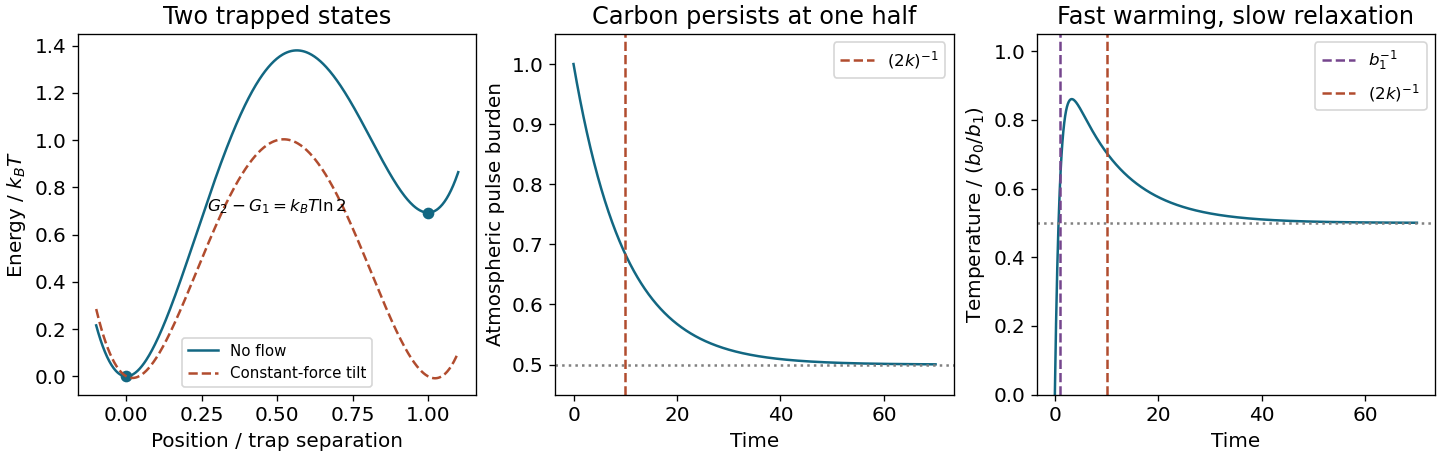

In a sufficiently uniform flow the Stokes force is F=γv toward trap 2. Its work over separation d lowers the second effective well by Fd. Equal effective free energies require γvd=kBTlog2. Henceat 298 K. The temperature was not specified, so the numerical result scales as T/298 K. This approximation treats a weak uniform drag as a constant tilt and neglects changes in barrier shape and hydrodynamic interactions with boundaries.
v=6πηadkBTlog2≃3.0×10⁻⁷ ms−1
Ancestors (10)
- S12
- 2017
- Past exam of the short options paper shared by Prelims and Parts A and B of the physics course of the University of Oxford
- Short options paper shared by Prelims and Parts A and B of the physics course of the University of Oxford
- Physics course of the University of Oxford
- Undergraduate course of the University of Oxford
- Course of the University of Oxford
- University of Oxford
- List of universities
- Home
Discussion (0)
New discussionThere are no discussions about this article yet.
Articles by others on the same topic (0)
There are currently no matching articles.