DNA is a directional polymer with a sugar-phosphate backbone linked by phosphodiester bonds. Its deoxyribose sugars carry adenine, thymine, guanine or cytosine. In the usual cellular duplex, antiparallel strands form a double helix with complementary A–T and G–C pairing, stabilized by base stacking as well as hydrogen bonding. The sequence can vary without changing the basic backbone, allowing a large information capacity. Complementarity provides a template for copying and repair; the two strands are not merely two redundant lists stored without a copying mechanism. Major and minor grooves permit proteins to recognize sequence-dependent chemical patterns. Eukaryotic chromosomes package DNA around histones, while bacterial chromosomes are usually supercoiled and associated with other proteins; not all cellular DNA is nuclear or linear.
RNA uses ribose with a reactive 2-prime hydroxyl and usually uracil in place of thymine. It is often a single chain, but intramolecular complementary segments form stems, loops and elaborate three-dimensional folds. Messenger RNA conveys coding information to ribosomes; transfer RNA combines an anticodon with an amino-acid attachment site; ribosomal RNA has structural and catalytic roles in translation. Regulatory and catalytic RNAs show why it is inadequate to describe RNA solely as a transient DNA copy. RNA's local pairing and folding let sequence encode both information and molecular machinery. DNA's chemical stability and duplex repair make it especially suitable for long-term inheritance.
Replication is highly faithful but imperfect. Heritable sequence changes, recombination and gene duplication create variation, and selection, Genetic drift and population history determine its spread. Thus the same chemistry explains both continuity of lineages and their divergence; mutation is not directed toward what an organism needs. Conserved genes, homologous sequences and the widely shared genetic code support common ancestry. RNA catalysis makes an early RNA-based stage of evolution a plausible hypothesis, not a direct historical observation or a deduction that all modern RNA preceded DNA in a demonstrated sequence. Structure constrains function and evolutionary possibilities without uniquely determining a species' history.[ref]
Molecular Biology of the Cell, 4th edition by Bruce Alberts and others. Chapter 4, The Structure and Function of DNA; Chapter 6, RNA structure and translation
Let U(x) be the static potential and γ the drag coefficient, so terminal Genetic drift under force −U′ is v=−U′/γ. The probability current is J=−DU′p/(kBT) only after imposing the desired relation; instead start independently from J=−Dp′−U′p/γ. At thermal equilibrium p∝e−U/(kBT) and detailed balance requires J=0. Substitution yieldsAt 298 K with a=0.5 μm, this gives approximately 4.37×10⁻¹³ m2 s−1. The argument assumes an overdamped particle in an equilibrium thermal bath, rather than arbitrary driven diffusion.
D=γkBT=6πηakBT.
Write the displacement after m independent isotropic zero-mean steps as R=∑jsj. Cross terms vanish, giving ⟨R2⟩=mΔ when Δ=⟨∣s∣2⟩. Isotropy makes each Cartesian variance one third of this. Since m≃kt and ⟨R2⟩=6Dt, D=kΔ/6. If “step size” were instead defined as a single-coordinate mean square, the corresponding expression would be kΔ/2; the factor of three is purely the stated three-dimensional convention.
The stationary occupation ratio is p1/p2=2. Balance of the two probability currents gives p1k12=p2k21, and Boltzmann occupation of the trapped macrostates gives p2/p1=e−(G2−G1)/(kBT). ThereforeThe sketch has two wells separated by 1 micrometre, with the second free-energy level higher by kBTlog2 and an intervening escape barrier. Free energy includes the volume of each trapped basin; equal minimum potential heights alone would not ensure equal occupations if basin shapes differed.
k21k12=21,G2−G1=kBTlog2.
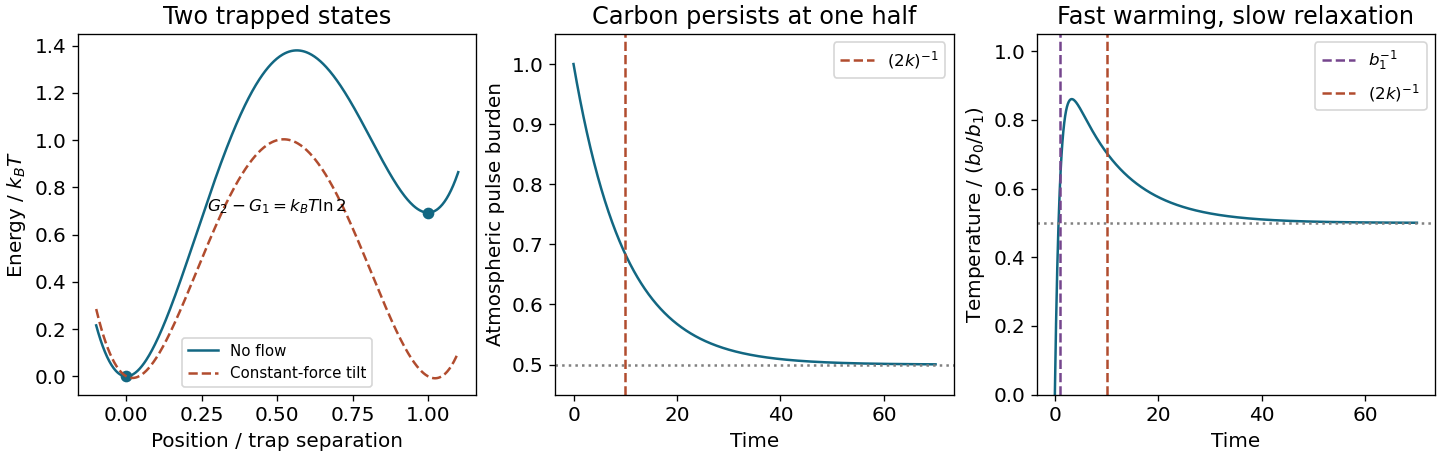

In a sufficiently uniform flow the Stokes force is F=γv toward trap 2. Its work over separation d lowers the second effective well by Fd. Equal effective free energies require γvd=kBTlog2. Henceat 298 K. The temperature was not specified, so the numerical result scales as T/298 K. This approximation treats a weak uniform drag as a constant tilt and neglects changes in barrier shape and hydrodynamic interactions with boundaries.
v=6πηadkBTlog2≃3.0×10⁻⁷ ms−1
Cells store usable free energy in chemical disequilibria: reduced carbon compounds, redox carriers such as NADH, ATP relative to ADP and inorganic phosphate, ion concentration gradients and membrane voltage. These reservoirs are maintained away from equilibrium; the useful quantity is the chemical or electrochemical potential difference, not simply a bond's isolated energy. Some ATP-consuming reactions can be driven because a coupled overall reaction decreases Gibbs free energy, even when the uncoupled synthesis would not.
Oxidation of nutrients transfers reducing equivalents to electron carriers and then to an electron-transport chain. Coupled proton pumping converts part of the redox free-energy drop into a protonmotive force. ATP synthase can convert that force into ATP chemical potential, and ATP hydrolysis drives biosynthesis, transport and mechanical motion. Substrate-level phosphorylation is another ATP source; photosynthetic cells can initially supply the disequilibrium with absorbed light. These are flows with unavoidable dissipation and heat release, not independent energy-creation processes. A reservoir is depleted unless metabolism replenishes it.
The cylindrical part has length 2 micrometres and radius 0.5 micrometres. Including both hemispherical ends gives area A=2πrL+4πr2=3π×10−12 m2. The membrane capacitance is C=ϵ0ϵrA/d≃4.17×10−14 F. Define the signed inward electrochemical drop per unit positive charge asThere is a factor-of-two ambiguity in the wording of the charge data. If the stated excess means the inner capacitor charge Q=−40000e, then Δψ=Q/C=−0.154 V and Δp≃−0.183 V at 298 K. If “inside minus outside” is taken literally as Qin−Qout=−40000e for opposite capacitor charges, the inner plate has −20000e, giving Δψ=−0.0768 V and Δp≃−0.106 V. The latter is the literal charge-difference interpretation; the former is the commonly intended excess-charge convention. In either case inward proton motion is favorable, and the positive available driving magnitude is −Δp.
Δp=(ψin−ψout)−e2.303kBT(pHin−pHout).
An electron-transport chain couples favorable redox transfers to pumping protons outward, producing the voltage and concentration terms of the protonmotive force. The membrane's low proton permeability prevents immediate equilibration. The membrane-embedded Fo part of ATP synthase provides a controlled return pathway: protonation and deprotonation of rotor sites couple proton flow to rotation of the c-ring and central shaft. The soluble F1 catalytic head has sites that change affinity and conformation as this shaft turns. ADP and phosphate bind, ATP forms, and the conformational cycle permits ATP release; the mechanical coupling is essential because ATP synthesis is thermodynamically uphill under cellular concentrations.
If nH protons traverse the machine per ATP, reversibly available work requires nHe(−Δp)≥ΔGATP, with extra dissipation and transport costs in a real cell. Ring stoichiometry makes nH organism dependent, rather than a universal integer inferred from the membrane voltage alone. ATP synthase is reversible: sufficient ATP chemical potential can drive reverse rotation and proton pumping. Uncoupling agents dissipate the gradient without corresponding ATP production, illustrating that respiration alone does not guarantee phosphorylation.[ref]
Molecular Biology of the Cell, 4th edition by Bruce Alberts and others. Chapter 14, Electron-Transport Chains and Their Proton Pumps: chemiosmotic coupling and ATP synthase
Ancestors (9)
- 2017
- Past exam of the short options paper shared by Prelims and Parts A and B of the physics course of the University of Oxford
- Short options paper shared by Prelims and Parts A and B of the physics course of the University of Oxford
- Physics course of the University of Oxford
- Undergraduate course of the University of Oxford
- Course of the University of Oxford
- University of Oxford
- List of universities
- Home
Discussion (0)
New discussionThere are no discussions about this article yet.
Articles by others on the same topic (0)
There are currently no matching articles.