Ensemble and applications. A grand canonical ensemble describes a system exchanging both energy and particles with a large reservoir. Its fixed control parameters are , while microstates with different have probabilitiesWeak coupling allows the system's energy levels to remain meaningful; equilibrium fixes the reservoir temperature and chemical potential. The grand potential is , with now the mean population. It generates entropy, pressure and mean particle number by differentiation. This ensemble is convenient for gases in contact with particle reservoirs, independently occupied quantum levels and surface adsorption; its particle-number fluctuations are part of the description, not an error in counting.
Classical single-level limit. For the single-level grand partition function in the dilute limit, put . Empty and singly occupied levels contribute and . In the dilute classical limit , higher occupancies contribute only at order or beyond:This truncation does not impose the Pauli principle on a classical gas. A fermion state has exactly , a boson state has , and Maxwell-Boltzmann occupancy weights give ; they all agree to this order. In particular, , with the classical Maxwell-Boltzmann result exactly .
grand potential and chemical potential. With , summing the single-level logarithms and using the stated density of states givesSubstitute , for whichCombining this with the density-of-states prefactor gives . ThusDifferentiating at fixed ,Similarly , so . This is the grand-canonical chemical potential of a classical ideal gas. The condition states the classical regime. The supplied density of states counts one internal state; extra internal degeneracies would have to be included consistently rather than inserted at only one stage.
One adsorption site. Take the free-vapour energy reference as zero and the binding energy as . A site is either empty or singly occupied; the latter has vibrational partition function . Its adsorption-site grand partition function and mean occupation areThe chemical potential of an adsorbed species on equivalent sites follows by inverting the occupation ratioThe factor is the vacant-site probability. The binding reference and the energies included in must be chosen consistently, so that vibrational zero-point energy is not counted twice.
Isotherm. The vibrational factor in a Langmuir equilibrium constant is fixed by adsorption equilibrium, . Neglecting vapour internal degrees of freedom and writing its number density as gives . ThereforeThis is the Langmuir isotherm: initially linear, increasing monotonically and concave down, approaching unit coverage. Half coverage occurs at . The coefficient has inverse-pressure units. It assumes equivalent independent sites, at most one molecule per site and no lateral interaction or multilayer adsorption. The molecular mass appropriate to the vapour determines .
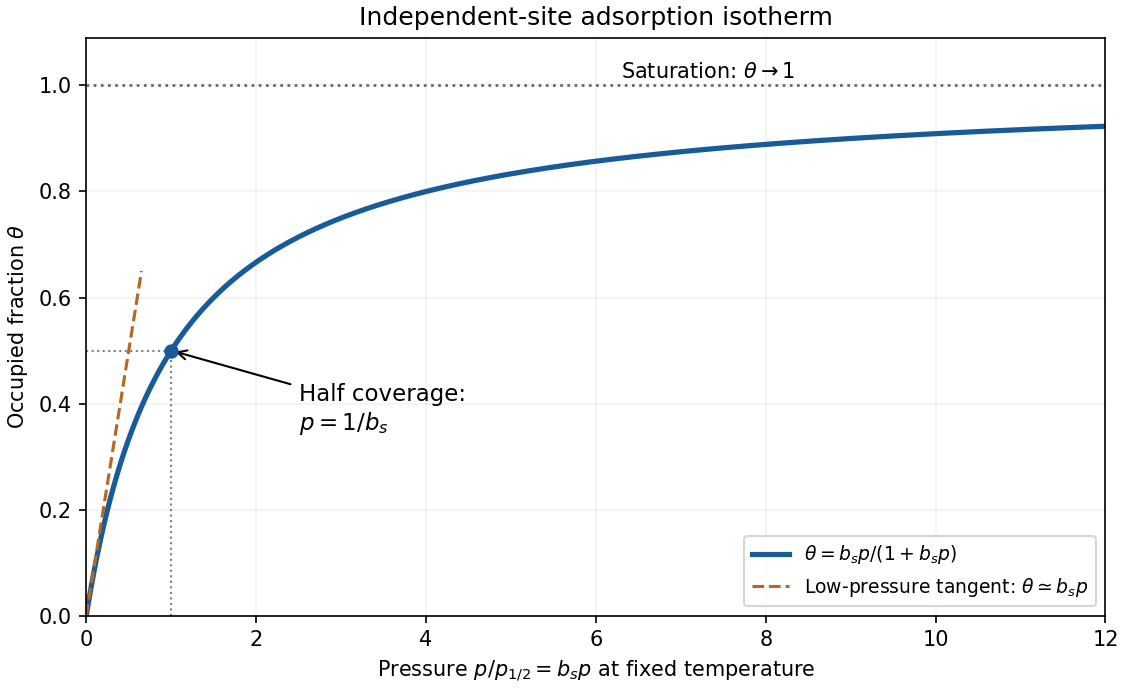
Original dimensionless Langmuir coverage curve with half-coverage and limiting behavior
. Details. 
A real uptake measurement must separate adsorbed molecules from free gas in the apparatus. Langmuir's original mica experiment compared a mica-containing bulb with a similar blank and inferred uptake from calibrated gas volumes and pressures. His stated blank contribution and bath-temperature drift limited the inferred adsorption; a saturating curve alone does not establish ideal equivalent sites.[ref]
The Adsorption of Gases on Plane Surfaces of Glass, Mica and Platinum by Irving Langmuir. pp. 1376–1378: mica apparatus and blank; p. 1385: limitations
Articles by others on the same topic
There are currently no matching articles.