Set , and . Then and , givingThe common carrying-capacity scale becomes one, while is the ratio of the two intrinsic growth rates. Intraspecific competition is twice as strong as the cross-species effect in these dimensionless equations.
In coordinate order the Jacobian matrix isAt the origin it is , giving a repelling node equilibrium; when the repeated positive eigenvalue is semisimple. At coexistence it isIts trace is , determinant , and characteristic discriminant . Hence both eigenvalues are real and negative, proving a stable node equilibrium for every .
The other equilibria are and . Their triangular Jacobians have eigenvalues and respectively. Thus both single-species equilibria are saddles, with their attracting directions on the corresponding coordinate axes and unstable directions allowing invasion by the other species. There are no further nonnegative equilibria because the two non-axis nullclines intersect only at .
The non-axis nullclines are and , intersecting at . Each biological population grows below its own line and decreases above it. The axes are invariant; along a positive axis the surviving species follows logistic growth towards its unit carrying capacity. The origin remains fixed.
All strictly positive initial states converge to coexistence. An entropy-shaped Lyapunov function for weak competition proves the global conclusion beyond the local arrows: put and useEach bracket is nonnegative, vanishing only at its equilibrium value, and tends to infinity at zero or infinity. Differentiation givesThus positive trajectories remain in a compact level set inside the quadrant and approach its unique zero-derivative state. ThereforeThe phase portrait shows the stable coexistence point, invading directions near the axis saddles, and the two straight nullclines.
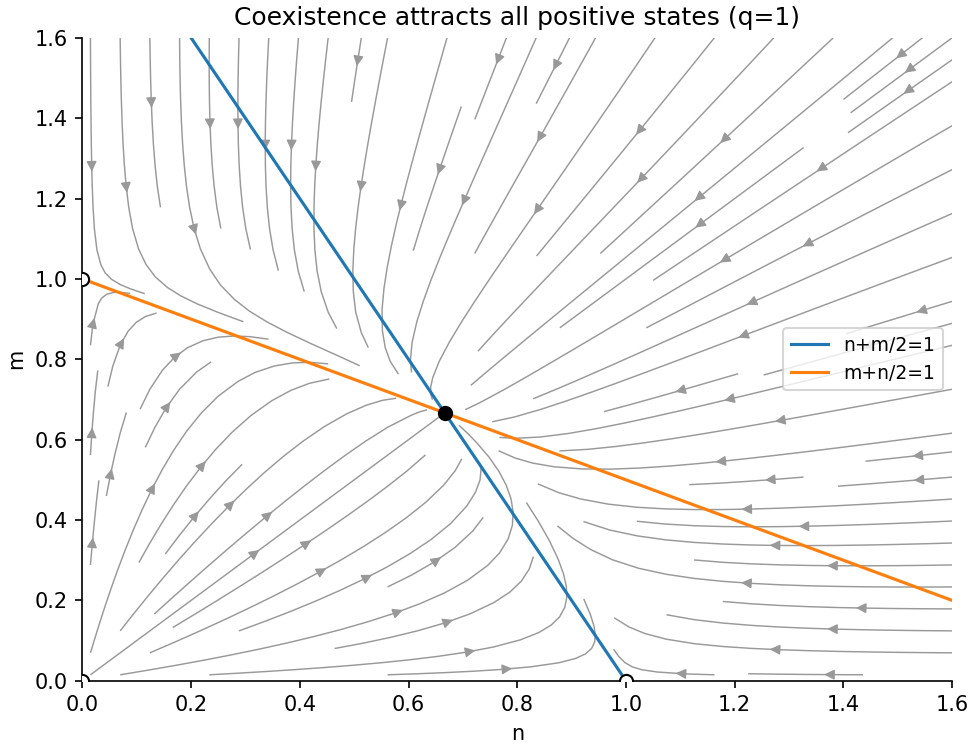
Competing populations converge to coexistence in the positive quadrant
. Details. 
The coexistence Jacobian matrix calculated in part (a) has negative diagonal entries and positive determinant. For any spatial mode with squared wave number , the linearized matrix is . Its trace is more negative than before, and its determinant isHence both eigenvalues retain negative real parts for every mode and every . This is the mechanism by which negative self-response excludes two-species Turing instability, excluding diffusion-driven instability using only the reaction Jacobian matrix already computed, together with the diagonal diffusive damping. In particular unequal diffusion is not enough to produce a Turing pattern when both local self-responses are negative in this two-species competitive model.
For , has eigenvectors and with eigenvalues and . The Neumann spatial modes are , . Combining each with those two reaction directions gives temporal ratesEvery linear perturbation therefore decays at least as fast as . The slowest mode is the spatially uniform antisymmetric change of the two biological populations. ThusSmall nonlinear perturbations have the same bound, not just a formal mode calculation. In one spatial dimension take sufficiently small smooth Neumann data, or small data in a norm such as that controls quadratic products. The linear semigroup decays at rate , and the nonlinear remainder is quadratic. Standard small-data variation-of-constants estimates first give decay for any fixed . Choose ; then the remainder is , and its Duhamel convolution with is because . This sharpens the preliminary bound to the displayed rate. Special initial data with no slow-mode component may decay faster, but the general estimate cannot be improved uniformly.
Articles by others on the same topic
There are currently no matching articles.