Let . Every term changes sign when both variables change sign, so . Consequently the derivative of equals , proving the stated rotational symmetry.
This is equivariance under a half-turn, not time reversibility. Reversibility of an autonomous differential equation requires a reverser satisfying , so that is a solution. The half-turn would require , the opposite of what holds. The usual mechanical candidate also fails when damping is present: its second equation would require identically. The symmetry relates two orbits with the same direction of time, and does not reverse their arrows.
The planar divergence is for . Since the plane is simply connected, the Bendixson-Dulac theorem excludes any nonconstant periodic orbit: the flux across a closed trajectory would be zero because the vector field is tangent, whereas Green's theorem makes it the strictly negative integral of the divergence over the enclosed region.
Alternatively define . Direct differentiation givesA nonconstant periodic solution would require the integral of this strictly dissipative expression over a period to vanish. That forces and hence an equilibrium, a contradiction. This energy argument identifies the damping mechanism behind the geometric criterion.
The equilibria satisfy and , giving and . At the origin,Their product is , so the origin is a saddle equilibrium for every real .
At either nonzero equilibrium,The determinant is positive and the trace is . Thus both equilibria are attracting for , repelling for , and have purely imaginary eigenvalues at . More precisely they are stable foci for and stable nodes for ; they are unstable foci for and unstable nodes for . At the two discriminant-zero endpoints they are repeated-eigenvalue degenerate nodes, with a nondiagonalizable Jacobian. At , linearization alone does not determine nonlinear stability or prove a nonlinear centre.
At , the origin has stable and unstable eigenvalues and ; the two nonzero equilibria are repelling foci with eigenvalues . A compatible portrait has one attracting closed orbit surrounding all three equilibria. Its total enclosed index is , as a periodic orbit requires. Its half-turn image is also attracting, so uniqueness of the attracting cycle makes that cycle half-turn symmetric. Orbits spiral away from either focus equilibrium and approach the surrounding cycle; the stable separatrices approach the saddle instead. The figure integrates representative trajectories and shows the local saddle directions.
These trajectories cannot escape to infinity. A Liénard boundedness function supplies one explicit boundedness argument using the Liénard coordinate with and . Then and . Put and . This function is coercive after addition of a constant. Its derivative obeysusing . The right side is negative outside a compact region, yielding bounded forward motion.
In the displayed portrait, generic non-equilibrium initial states tend to the cycle; points on the saddle's stable manifold tend to the origin; and initial data exactly at a repelling focus equilibrium remain there. The Poincaré-Bendixson theorem excludes a chaotic compact limit set for this smooth planar flow. Strictly, the assumption gives uniqueness only of an attracting periodic orbit: it does not by itself exclude exceptional nonattracting periodic or separatrix limit sets. Those would need additional global information if one wanted a classification stronger than the compatible portrait requested.
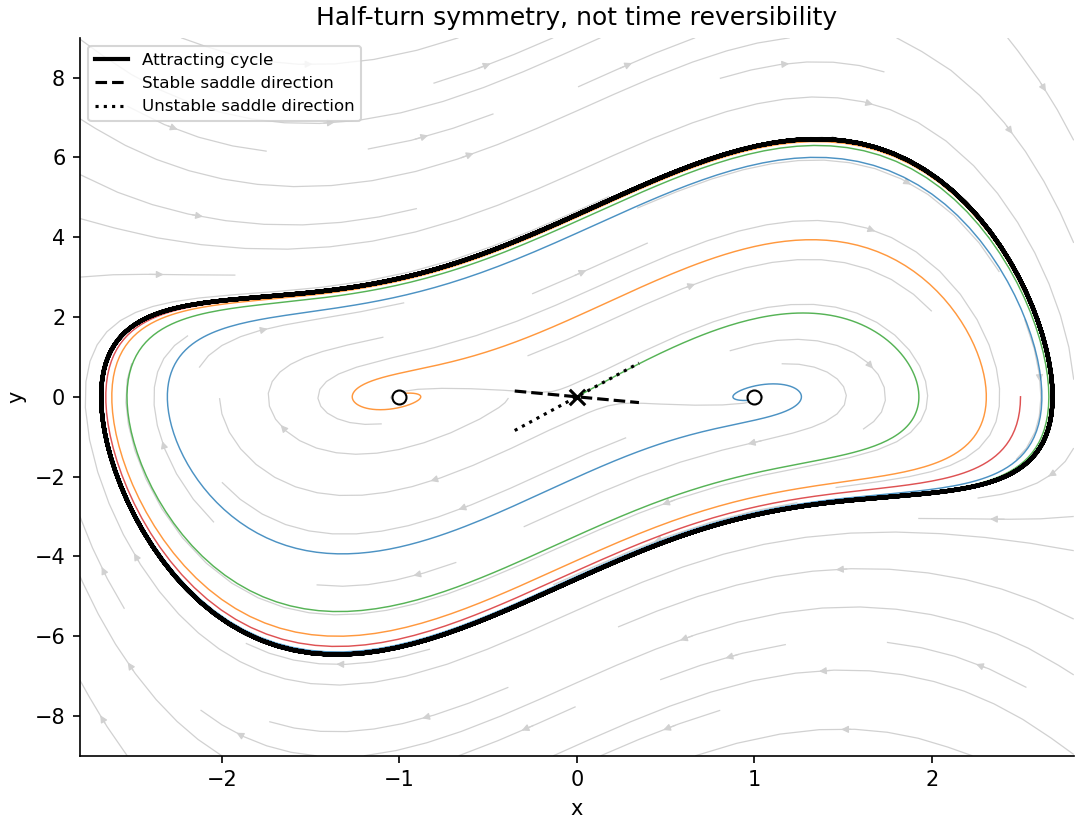
A compatible attracting cycle, repelling foci and saddle separatrices at Omega minus two
. Details. 
First assume and regard modulo . The section has return time . Solving the resonantly forced oscillator from this section givesAt , the sine vanishes and the cosine is one, while differentiating the secular term adds to . Hence the Poincaré map isFor , every iterate has . Thus every oscillator trajectory is unbounded, regardless of its initial amplitude. For an arbitrary section phase , the return map translates by , which is still nonzero. At the map is the identity, and all motions are bounded harmonic oscillations, including the zero-amplitude equilibrium.
The zero-frequency case allowed by the printed parameter range is different. If , then is constant and . There is no phase-crossing Poincaré section. For , choosing and gives bounded equilibria, contradicting an unqualified “all trajectories” statement. For at zero frequency, free-particle motion is unbounded unless . The resonance conclusion therefore requires the natural nonzero-frequency assumption.
Articles by others on the same topic
There are currently no matching articles.