Let . Every term changes sign when both variables change sign, so . Consequently the derivative of equals , proving the stated rotational symmetry.
This is equivariance under a half-turn, not time reversibility. Reversibility of an autonomous differential equation requires a reverser satisfying , so that is a solution. The half-turn would require , the opposite of what holds. The usual mechanical candidate also fails when damping is present: its second equation would require identically. The symmetry relates two orbits with the same direction of time, and does not reverse their arrows.
The planar divergence is for . Since the plane is simply connected, the Bendixson-Dulac theorem excludes any nonconstant periodic orbit: the flux across a closed trajectory would be zero because the vector field is tangent, whereas Green's theorem makes it the strictly negative integral of the divergence over the enclosed region.
Alternatively define . Direct differentiation givesA nonconstant periodic solution would require the integral of this strictly dissipative expression over a period to vanish. That forces and hence an equilibrium, a contradiction. This energy argument identifies the damping mechanism behind the geometric criterion.
The equilibria satisfy and , giving and . At the origin,Their product is , so the origin is a saddle equilibrium for every real .
At either nonzero equilibrium,The determinant is positive and the trace is . Thus both equilibria are attracting for , repelling for , and have purely imaginary eigenvalues at . More precisely they are stable foci for and stable nodes for ; they are unstable foci for and unstable nodes for . At the two discriminant-zero endpoints they are repeated-eigenvalue degenerate nodes, with a nondiagonalizable Jacobian. At , linearization alone does not determine nonlinear stability or prove a nonlinear centre.
At , the origin has stable and unstable eigenvalues and ; the two nonzero equilibria are repelling foci with eigenvalues . A compatible portrait has one attracting closed orbit surrounding all three equilibria. Its total enclosed index is , as a periodic orbit requires. Its half-turn image is also attracting, so uniqueness of the attracting cycle makes that cycle half-turn symmetric. Orbits spiral away from either focus equilibrium and approach the surrounding cycle; the stable separatrices approach the saddle instead. The figure integrates representative trajectories and shows the local saddle directions.
These trajectories cannot escape to infinity. A Liénard boundedness function supplies one explicit boundedness argument using the Liénard coordinate with and . Then and . Put and . This function is coercive after addition of a constant. Its derivative obeysusing . The right side is negative outside a compact region, yielding bounded forward motion.
In the displayed portrait, generic non-equilibrium initial states tend to the cycle; points on the saddle's stable manifold tend to the origin; and initial data exactly at a repelling focus equilibrium remain there. The Poincaré-Bendixson theorem excludes a chaotic compact limit set for this smooth planar flow. Strictly, the assumption gives uniqueness only of an attracting periodic orbit: it does not by itself exclude exceptional nonattracting periodic or separatrix limit sets. Those would need additional global information if one wanted a classification stronger than the compatible portrait requested.
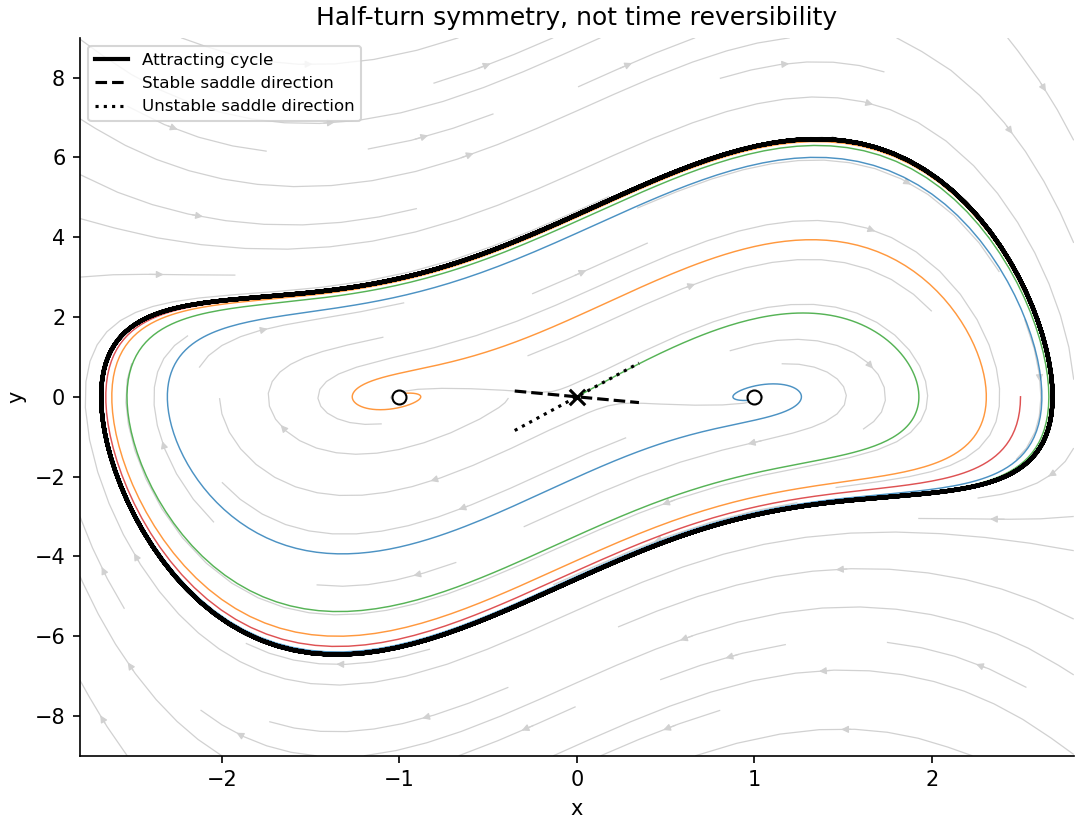
A compatible attracting cycle, repelling foci and saddle separatrices at Omega minus two
. Details. 
First assume and regard modulo . The section has return time . Solving the resonantly forced oscillator from this section givesAt , the sine vanishes and the cosine is one, while differentiating the secular term adds to . Hence the Poincaré map isFor , every iterate has . Thus every oscillator trajectory is unbounded, regardless of its initial amplitude. For an arbitrary section phase , the return map translates by , which is still nonzero. At the map is the identity, and all motions are bounded harmonic oscillations, including the zero-amplitude equilibrium.
The zero-frequency case allowed by the printed parameter range is different. If , then is constant and . There is no phase-crossing Poincaré section. For , choosing and gives bounded equilibria, contradicting an unqualified “all trajectories” statement. For at zero frequency, free-particle motion is unbounded unless . The resonance conclusion therefore requires the natural nonzero-frequency assumption.
For , the fixed points are and when the latter is defined. On the physical interval the nonzero branch exists for , meeting zero at . Their multipliers are and , respectively. Thus zero is linearly attracting for and repelling for ; the positive point is linearly attracting for and repelling for . At and the relevant multiplier has magnitude one, so linearization is inconclusive. At , attracts small positive points to zero nonlinearly.
Factoring and removing its fixed-point factors gives . Its distinct roots areThey map to each other, giving a genuine two-cycle only beyond . The cycle multiplier isSolving in givesAt , the two roots coalesce with , where the fixed-point multiplier is : a supercritical period-doubling bifurcation creates the attracting two-cycle. At the upper endpoint its multiplier reaches , marking the next loss of linear stability. The two-cycle is superstable at , where . At exactly the fixed point remains weakly attracting through higher-order terms: for , the second iterate is , showing alternating perturbations decay slowly.
For a nearby orbit, linearized separation satisfies . Repeated use of the chain rule gives to first order. Taking the logarithm of its magnitude and dividing by gives the exponential growth rateThe infinitesimal-perturbation limit is taken before interpreting long-time growth; finite separations eventually leave the linear regime. The limit is assumed to exist, with a limsup used when needed.
On a -cycle, blocks of successive derivatives repeat. If , the remainder of fewer than terms has vanishing contribution to the long-time average andLinear attraction means , giving . A superstable cycle has , meaning at least one derivative in the cycle vanishes. Its infinitesimal return multiplier is zero and the corresponding logarithmic exponent is . This concerns the derivative cocycle; actual finite perturbations can converge by higher-order rather than literally vanishing in one step.
In the two-symbol shift representation, is fixed under a shift and codes the fixed point labelled . The constant all-ones sequence supplies the analogous example. The dot only marks the present position; shifting it advances one iterate. The assertion uses the faithful orbit coding assumed in the question.
Use the primitive repeating word . One shift changes the sequence and three shifts return it, so the least period is three. A word such as repeated would instead have least period one; primitivity is what distinguishes a true three-cycle from a periodic notation for a fixed point.
The sequence has exactly one and otherwise zero entries. Under forward shifts that exceptional symbol moves out of every fixed observation window; the same happens under backward shifts in the other direction. Thus both temporal limits are the all-zero fixed sequence, while the orbit itself is nonconstant: it is homoclinic to that fixed point. The bi-infinite coding specifies a chosen full orbit even when the original interval map is not invertible.
Choose , with zeros on the entire left tail and ones on the entire right tail. Forward shifts converge in the symbolic metric to the all-one fixed point, while backward shifts converge to the all-zero fixed point. Its two limiting invariant states differ, so it is a heteroclinic orbit. Reversing the two tails reverses these asymptotic roles.
One explicit future itinerary is obtained by concatenating all binary words, ordered first by length and then lexicographically:Extend it arbitrarily to negative indices, for example by zeros. Every finite binary block occurs in its forward itinerary, and indeed occurs arbitrarily far out as a subword of longer words. Its shift orbit is therefore dense in the full two-symbol shift space. It is not eventually periodic: arbitrarily long runs of zeros and ones occur, together with all other finite words.
The full shift has sensitive dependence because sequences agreeing on an arbitrarily large initial window can differ just beyond it, and shifting brings that disagreement into view. Thus this itinerary supplies a dense aperiodic orbit in the chaotic symbolic system assumed by the question. A merely nonrepeating sequence would not be enough: restricted aperiodic sequences can have much simpler, nonchaotic orbit closures. Nor does symbolic description alone assign a numerical Lyapunov exponent without information about the underlying map and its coding.
The Lorenz vector field has constant divergence . Liouville formula for a fundamental matrix for the derivative of the flow therefore givesThis concerns transported three-dimensional phase volume, not the Euclidean distance between each pair of trajectories.
A quasiperiodic orbit with the usual smooth two-frequency torus closure would lie on an invariant embedded two-torus. That torus bounds a solid torus of positive finite volume in . Since the vector field is tangent to its boundary, its outward flux is zero, contradicting the divergence theorem, whose volume integral is . This negative-divergence obstruction to invariant tori excludes such quasiperiodic tori. The argument uses global negative divergence and the enclosed volume; saying only that an attracting torus has zero volume would not exclude it.
At an equilibrium the sum of eigenvalues is , so they cannot all have positive real parts: no equilibrium is a fully repelling source. For a periodic orbit of period , one Floquet multiplier equals one in the flow direction. The product of the other two is , so they cannot both have modulus greater than one: no periodic orbit is fully repelling either. Saddle equilibria and saddle periodic orbits remain possible; contraction of volume does not imply contraction in every direction.
The first equilibrium equation gives , and the third gives . The second then becomes . Hence the equilibria areAt the origin, one eigenvalue is and the remaining two solve . Their discriminant is . For both are negative, so the origin is linearly stable, with all eigenvalues real and negative. For one is positive and one negative, so it is a saddle equilibrium with one unstable and two stable directions. At its eigenvalues are : linearization has a neutral direction and cannot alone prove nonlinear stability. Given the source's global attraction for , there are no nontrivial limit cycles or persistent chaotic invariant dynamics in that regime; all initial states tend to the origin.
To establish the local pitchfork, one needs the simple eigenvalue to cross zero, the two symmetry-related branches to exist and acquire the expected local stability, and nondegeneracy of the nonlinear coefficient. The derivative of the crossing eigenvalue is . At , the characteristic polynomial isFor sufficiently close to one, all coefficients are positive and , so the cubic Routh-Hurwitz criterion makes both new equilibria stable. Together with the symmetry and the square-root branches, this yields the supercritical pitchfork. A local centre-manifold coordinate proportional to has leading normal form , explicitly displaying the nonzero stabilizing cubic coefficient. At that cubic also gives weak local nonlinear attraction along the centre direction.
A useful operational definition of chaos for a deterministic flow is bounded, nonperiodic long-time dynamics on an invariant set with sensitive dependence on initial conditions: arbitrarily close starting states can separate by a fixed macroscopic amount. Boundedness distinguishes recurrent irregular dynamics from simple exponential escape; aperiodicity excludes a limit cycle; sensitivity distinguishes chaotic unpredictability from a regular quasiperiodic signal. These are properties of the asymptotic dynamics, not a short irregular transient. One precise topological convention, Devaney chaos on a compact invariant set, instead specifies topological transitivity, dense periodic orbits, and sensitive dependence. Transitivity expresses indecomposability of the recurrent motion, while dense periodic orbits mean every region contains unstable recurrent structure. The convention should be stated because these formulations are not identical in complete generality.
An attractor is an invariant set approached by trajectories from a neighbourhood or positive-measure basin, according to the adopted attractor convention. Calling it strange refers to irregular, typically fractal geometry rather than a smooth point, cycle or torus. Strangeness alone does not force chaos. Strange nonchaotic attractors provide counterexamples: geometrically irregular attracting sets can lack positive exponential separation. Primary examples appear in [ref]
https://doi.org/10.1016/0167-2789(84)90282-3. Strange attractors that are not chaotic, Physica D 13 (1984), pages 261–268
. This geometric convention does not assert that every such example occurs in the autonomous three-variable Lorenz family.Two complementary numerical diagnostics are to estimate the largest Lyapunov exponent and to construct a return map. For the first, integrate the variational equation alongside the Lorenz trajectory, repeatedly normalize , and average the logarithms of the accumulated stretch factors after discarding a transient. A positive converged exponent suggests sensitive exponential separation; the full spectrum should include a zero flow exponent and have sum , providing checks. For the second, record transverse crossings of a Poincaré section or successive maxima of a state variable, then look for the stretching and folding of an aperiodic return set rather than one point or a finite cycle. Nearby-orbit separation or a broadband power spectrum can add evidence, but plots alone do not prove chaos. Repeat with smaller integration step, longer runs and several initial conditions to distinguish numerical error, long transients and coexistence of attractors from persistent dynamics.
Articles by others on the same topic
There are currently no matching articles.