Original solutions to the paper released at the source request. The complete editable transcription is retained in the private examination archive.
The four dimensional equations express mass conservation, momentum balance with pressure, gravity and viscous stress, heat advection and conduction, and a linear thermal-expansion equation of state. For heating from below, suitable plate conditions are and at , and , at . No slip and thermal insulation on the sidewall provide one suitable lateral completion; prescribed lateral temperatures would be another specified thermal setup.
Let be thermal diffusivity and kinematic viscosity. Use , , and as length, time, velocity and temperature scales. Subtract the static reference pressure with and scale its remainder by . ThenDensity becomes . Substitution and division by the corresponding diffusion/viscous scales giveIn the Boussinesq small-density-contrast limit retain buoyancy while neglecting the other factors. At infinite Prandtl number, after any fast initial adjustment, the equations areThe velocity is instantaneously constrained by a viscous elliptic balance; the temperature still evolves.
Take the divergence of the vector Poisson equation. Derivatives commute, and divergence of a curl is zero, so . Its boundary value is zero, hence the maximum principle gives throughout . The vector identity now gives , orThe layer domain is simply connected because its horizontal section is simply connected. For a curl-free field on such a domain, define as its line integral from a fixed base point to . Contractibility of loops and Stokes theorem make the integral path independent, and differentiation gives its gradient equal to the field. Thus .
Incompressibility then gives , while the prescribed normal curl gives . Green's identity yieldsHence is constant on the connected domain and . The extra condition belongs to the stated potential boundary problem; the reconstruction argument above uses the divergence and normal-curl conditions. On a multiply connected domain a curl-free field need not be a globally single-valued gradient.
Finally . Taking the curl of the infinite-Prandtl momentum balance and using givesThe derivation is an instance of velocity reconstruction from a mixed-boundary vector Poisson problem.
The official course archive advertises an answer for this question. Its four parts are omitted from the original solutions under the existing-answer policy.
Define to be one in phase 1 and zero in phase 2, including its dependence on both transverse coordinates even though the averaged fields depend only on . With no interphase mass transfer, its distributional phase-mass equation is . At a pipe cross section of area , setThus is an intrinsic phase density and is the density-weighted mean axial velocity. This weighting is necessary when density varies within the phase; it becomes the ordinary intrinsic mean for an incompressible phase of constant density.
Integrate over the cross section. The transverse divergence contributes no boundary mass flux at the impermeable pipe wall, and the material interface has no mass leakage. The section area is constant, soFor phase 2 use and fraction , with the analogous intrinsic density and density-weighted velocity:The intrinsic quantities are defined where their phase fraction is nonzero. These are the intrinsic phase averages in a two-fluid pipe model.
Freeze a uniform state with , , and seek a finite characteristic speed . Denote its perturbation amplitudes by . The two phase-mass equations and two momentum equations giveEliminating the amplitudes givesWith , factor the quadratic over the complex numbers to obtainFor nonzero relative velocity the speeds are a nonreal conjugate pair. A Fourier perturbation on the growing branch has magnitude . Arbitrarily short waves therefore grow arbitrarily quickly, preventing a continuous dependence estimate in the usual finite-order Sobolev norms. This generic slip state is ill-posed as an initial value problem.
The pressure has no independent time-evolution equation; it enforces the incompressible volume constraint, so the request concerns the finite characteristic speeds rather than a freely propagating pressure mode. At the two speeds coincide and this particular nonreal-speed argument disappears; further degeneracy analysis is needed there, rather than calling coincident real speeds complex. The issue is complex characteristic speeds of a pressure-coupled two-fluid model.
For constant phase density, let be the intrinsic mean axial speed and defineThe profile coefficient measures the momentum flux relative to a uniform velocity profile with the same mean. Cauchy-Schwarz gives where the mean is nonzero, with equality for a uniform phase profile. At zero mean it is safer to retain the second moment itself rather than divide by .
In the stated common-pressure, no-extra-force closure, the averaged conservative momentum equation isFor constant , expand its derivatives and use . The terms combine asThereforeThis is the phase momentum profile coefficient correction. It accounts for the second moment of velocity, not merely a rescaling of the convective speed. A variable coefficient would also produce .
Stretch and write , , with horizontal velocity and time left order one. The longitudinal viscous term is , so set . For , the leading bulk equations are , and .
The normal-stress condition gives at leading order, and the tangential condition gives . HenceNo slip at the bed, , yields . Averaging through the depth givesThe kinematic condition becomes at leading order. Integration of continuity from the impermeable bed then gives
A nonzero contact speed or evaporative flux is singular in the strictly no-slip sharp-contact-line model with mobility proportional to . A finite nonzero limiting would require , which is singular for a linearly vanishing height and generally incompatible with a prescribed finite slope at the exact line. Thus a dynamic finite-contact-angle condition needs microscopic regularization, such as slip or a precursor film. In the slow-drying limit a fixed contact angle can instead be used for the leading quasistatic outer profile; it is not an exact regular finite-rate contact-line solution.
At leading quasistatic order , so the symmetric profile satisfying the imposed outer angle isIts cross-sectional volume is . The moving endpoints contribute no boundary-height term, and the end flux vanishes, giving . ConsequentlyThese are leading slow-time results up to extinction; the approximation need not remain uniform at the final vanishing scale.
To recover the small velocity, differentiate the quasistatic profile using :Symmetry makes the flux zero at the centre, so . Division by the height givesThe flow is inward on both sides, suggesting transport of suspended matter toward a central deposit rather than a perimeter ring. Coffee commonly leaves the opposite, ring-like pattern. A possible missing ingredient is contact-line pinning: holding the perimeter fixed makes evaporation require outward replenishment, and stronger evaporation near the edge reinforces that transport. Receding constant-angle and pinned contact lines therefore have qualitatively different deposit mechanisms.
For comparison, the same uniform-evaporation parabolic model with fixed gives and , an outward velocity. This comparison isolates the boundary assumption even before adding edge-enhanced evaporation.
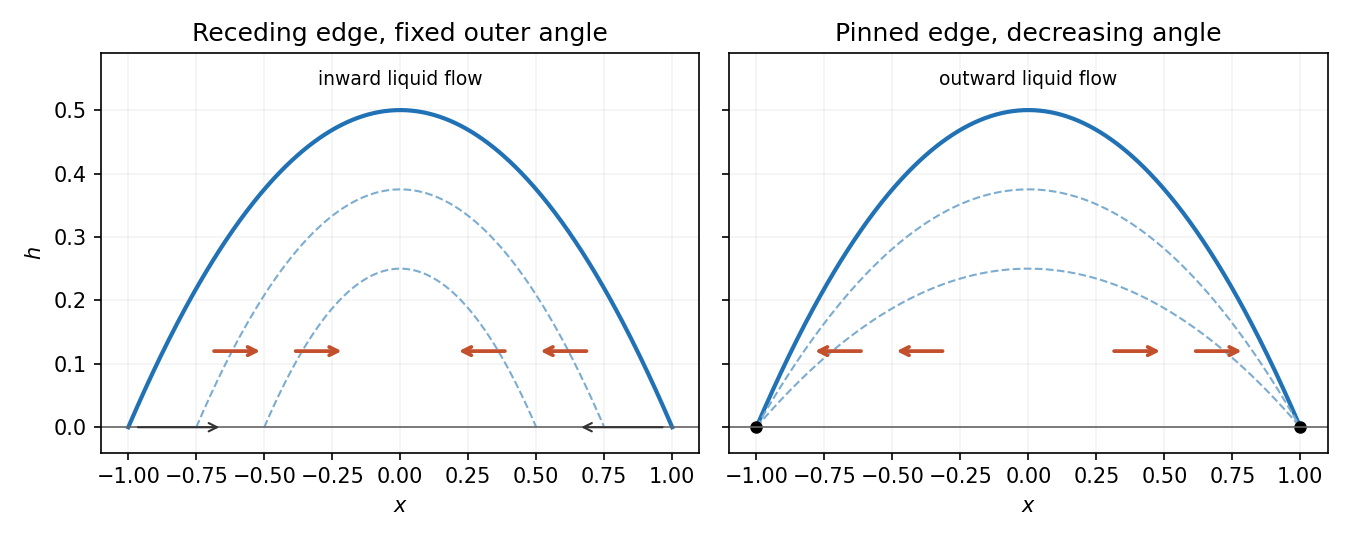
Leading parabolic-drop models predict inward flow for a receding fixed-angle contact line and outward flow for a pinned contact line
. Details. 
The receding solution is the quasistatic evaporation of a receding parabolic drop.
Articles by others on the same topic
There are currently no matching articles.