taphonomic bias is systematic distortion of biological information between a living community and the fossil record. Death, carcass decay, scavenging, transport, burial, chemical alteration, exposure and collection all filter what is observed. A deposit therefore samples organisms, body parts and environments unequally. This is more than incompleteness: preferential preservation of a particular tissue or habitat can produce a misleading pattern of abundance, anatomy or evolutionary timing.
An autochthonous fossil assemblage contains remains preserved where the organisms lived; an allochthonous fossil assemblage contains material transported from elsewhere. These describe provenance, rather than two levels of fidelity. In an allochthonous fossil assemblage, currents can separate elements by size, shape and density, concentrate resistant teeth or scales, remove delicate bodies and mix organisms from different habitats. Erosion and redeposition can also introduce older fossils into younger sediment. Such reworking differs from simple transport of recently dead animals. time averaging mixes deaths from different times even without long-distance transport. A concentration of robust remains consequently need not represent either a locally abundant living population or a single ecological event.
An autochthonous fossil assemblage avoids some transport distortion, but still selects organisms and characters. A bottom-dwelling community rapidly buried in place can be unusually well represented while swimmers above it, unmineralized tissues and organisms living outside that depositional setting are missing. Conversely, an intact carcass can travel before burial, whereas locally decayed remains can become disarticulated without transport. Articulation, abrasion, preferred orientation, sedimentary context and age agreement must therefore be evaluated together. Local preservation does not imply an unbiased biological census.
The contrast between cyclostomes and early members of the gnathostome lineage is particularly revealing. Living cyclostomes, hagfish and lampreys, have no extensive mineralized external skeleton comparable to the armour of many early jawless relatives of gnathostomes. Their bodies are dominated by tissues whose preservation usually requires exceptional conditions. The abundance of isolated mineralized scales, plates or teeth can thus make a hard-bodied lineage conspicuous where a soft-bodied contemporary is virtually invisible. Importantly, the armoured jawless assemblage traditionally called ostracoderms is not simply the ancestral cyclostome record: many of its members belong on the gnathostome stem. Absence of jaws does not by itself establish cyclostome affinity.
There is also a character-level filter. Robert S. Sansom and colleagues followed experimental carcass decay of living chordates, and then examined hagfish and lampreys in detail. Anatomical characters did not disappear at random: loss of diagnostic features could make a derived animal appear more primitive. This produces stemward slippage if investigators mistake an unpreserved feature for a feature absent in life. The result is relevant both to isolated soft-bodied fossils and to the apparently long primitive intervals preceding well-preserved groups.[ref]
Non-random decay of chordate characters causes bias in fossil interpretation by Robert S. Sansom and others. Experimental character-loss sequences and simulated consequences for fossil interpretation
[ref]Decay of vertebrate characters in hagfish and lamprey (Cyclostomata) and the implications for the vertebrate fossil record by Robert S. Sansom and others. Comparative decay of cyclostome tissues and diagnostic characters
A useful experimental design records fresh anatomy first, samples replicated carcasses through time under stated temperature and chemical conditions, and scores the same characters in each specimen. Comparisons between animals and between preservational conditions test whether the loss order is reproducible. Such experiments identify plausible biases; they do not recreate every burial chemistry or prove that every uncertain fossil has undergone the same sequence. In a phylogenetic character matrix, genuinely unobservable anatomy should normally be coded as unknown rather than automatically absent. Comparison across differently preserved specimens can sometimes recover information that one specimen lacks.
Exceptional discoveries show what the ordinary record omits. The Late Devonian lamprey Priscomyzon from South Africa preserves a recognizable oral apparatus and branchial region without a massive mineralized skeleton. It shows that early lamprey anatomy can be recovered when the appropriate soft-tissue window is available; the gap before such a discovery is not evidence that the lineage had just originated.[ref]
A lamprey from the Devonian period of South Africa by Robert W. Gess and others. Description and Late Devonian occurrence of Priscomyzon
The Cretaceous hagfish Tethymyxine preserves evidence including slime-producing structures, allowing characters unavailable in most older deposits to be brought into an analysis using phylogenetics. It supplies a minimum occurrence and anatomical information, not the date when hagfish originated.[ref]Hagfish from the Cretaceous Tethys Sea and a reconciliation of the morphological–molecular conflict in early vertebrate phylogeny by Tetsuto Miyashita and others. Fossil anatomy, slime-gland evidence and combined phylogenetic analysis
Conversely, Early Silurian Qianodus is known through mineralized tooth whorls: such durable small remains can establish an early occurrence of a toothed gnathostome even where complete bodies are missing.[ref]The defensible comparison concerns preservation probabilities as well as biological histories. First fossil occurrences are minimum ages, and unequal counts need not measure unequal diversity. Independent anatomical characters, comparable depositional settings, searches for small hard parts and exceptional soft-tissue deposits together give a better test of early vertebrate history than a literal reading of the most conspicuous remains.
The transition places vertebrate origins within a prolonged assembly of animal body plans, ecological interactions and preservational opportunities. It does not identify one boundary at which a complete modern vertebrate suddenly appeared. Three questions must be separated: when the relevant lineages diverged, when diagnostic features evolved, and when those features became recoverable as fossils.
The Ediacaran precedes the Cambrian, whose beginning is approximately 539 million years ago. Ediacaran communities already contained macroscopic organisms and evidence of animal movement and feeding. Kimberella, for example, has been interpreted from its body organization as a mollusc-like bilaterian; its relevance is that substantial animal differentiation predates the boundary, rather than that it is a vertebrate ancestor.[ref]
The Late Precambrian fossil Kimberella is a mollusc-like bilaterian organism by Mikhail A. Fedonkin and Benjamin M. Waggoner. Body reconstruction and bilaterian interpretation
trace fossils record activities that may otherwise leave no body remains. Increasingly elaborate movement and sediment disturbance reveal ecological capacities, but an isolated burrow does not identify a notochord, a head or a particular branch of the animal phylogenetic tree.Across the transition, animal skeletons, predation, burrowing and water-column communities became more prominent. Their appearance changes both biology and observation. Resistant skeletons improve preservation, while bioturbation can destroy the sedimentary surfaces that had preserved some earlier soft-bodied communities. Different preservational windows reveal different subsets of life. An apparent replacement in the fossil record can therefore combine real ecological turnover with taphonomic bias. One should compare anatomy and environments across several deposits rather than treating all Ediacaran absences as biological absences.
The Cambrian exceptional deposits provide positive evidence. Haikouichthys and Myllokunmingia from Chengjiang reveal small fish-like animals with combinations of axial, muscular and branchial structures interpreted as early vertebrate organization.[ref]
Lower Cambrian vertebrates from south China by D.-G. Shu and others. Descriptions and reconstruction of the two Chengjiang taxa
Metaspriggina from the Burgess Shale adds evidence from a distinct assemblage, including prominent eyes, segmented musculature, organized into myomeres, and serial branchial supports.[ref]A primitive fish from the Cambrian of North America by Simon Conway Morris and Jean-Bernard Caron. Anatomical description and reconstruction of Metaspriggina
These are more informative than an undifferentiated claim that “fish existed”: they allow particular characters to be mapped onto alternative phylogenetic trees.A plausible sequence involves a swimming chordate organization with a notochord and segmental musculature, followed by elaboration of anterior sensory and feeding systems along the vertebrate lineage. Nevertheless, fossil compressions can obscure boundaries or superimpose unrelated structures. Confidence should come from repeated specimens, bilateral agreement, positional relationships and combinations of characters, rather than resemblance of one dark patch to an organ. A structure absent from a compressed specimen may be unpreserved. Nor does a plausible early vertebrate have to be a member of the living vertebrate crown group, still less a direct ancestor of a living species. A stem group can contain extinct side branches showing different combinations of ancestral and derived states.
Living organisms constrain the reconstruction without forming a ladder. Molecular analyses place tunicates, rather than cephalochordates, as the closest living relatives of vertebrates.[ref]
Tunicates and not cephalochordates are the closest living relatives of vertebrates by Frédéric Delsuc and others. Phylogenomic comparison of chordate relationships
A modern lancelet is consequently a comparative relative with its own history, not an unchanged stage through which vertebrates passed. The same warning applies to living hagfish and lampreys. Their anatomy can reveal inherited features and secondary specializations; simplicity alone cannot polarize a character.The New Head hypothesis connects cranial sensory and feeding innovations with neural crest and ectodermal placodes. This is a developmental explanation for assembling a more elaborate head. Experiments on living chordates can test where cells originate, which structures they form and which regulatory interactions are needed. The fossil presence of eyes or branchial supports cannot directly demonstrate the embryonic migration of neural crest. Conversely, a conserved regulatory gene alone does not establish that a complete modern head existed in an Ediacaran ancestor. Developmental, molecular and anatomical evidence address complementary parts of the argument.[ref]
Neural crest and the origin of vertebrates: a new head by Carl Gans and R. Glenn Northcutt. Proposed developmental basis and functional significance of head innovation
Ecological context helps explain why these capacities might diversify. More active swimming, prey detection and food processing can create opportunities and selective pressures for improved sensory and locomotor coordination. molecular oxygen availability constrains the metabolic activities that can be sustained. Erik A. Sperling and colleagues compared modern low-oxygen animal communities and related the scarcity of carnivory at low oxygen levels to hypotheses about Cambrian ecological expansion.[ref]
Oxygen, ecology, and the Cambrian radiation of animals by Erik A. Sperling and others. Modern oxygen-gradient observations and the proposed ecological connection
This motivates a mechanism; environmental correlation alone neither dates the vertebrate ancestor nor establishes oxygenation as a sufficient single cause.The useful conclusion is a constrained historical sequence, with explicit gaps. Ediacaran evidence establishes antecedent animal complexity; Cambrian exceptional preservation documents recognizable early vertebrate combinations; comparative phylogenetics and evolutionary developmental biology test their placement and assembly. molecular clocks can estimate earlier divergences, but their dependence on rates and fossil calibration prevents them from turning every absence into a precise origin date.
Sarcopterygii is the clade comprising the most recent common ancestor of living coelacanths, lungfish and tetrapods, together with all its descendants. In this crown-based usage, humans are sarcopterygians: acquisition of limbs and loss of a fish-like outline do not remove descendants from a clade. Extinct taxa assigned along the stem require an explicitly broader total-group usage. A diagnosis lists characters useful for recognizing a group; a synapomorphy is a shared derived character whose position has been inferred on a phylogenetic tree. Those are related but not interchangeable statements.
Two particularly instructive traditional diagnostic features are the fleshy, internally supported paired appendages and true enamel associated with the dentition. The first survives conspicuously in our arms and legs. The second survives in our tooth crowns, although modern evidence requires qualification of its traditional status as an exclusively sarcopterygian innovation.
The paired-appendage transformation. A lobed fin contains musculature and a substantial endoskeleton extending into the appendage. In the relevant ancestral pattern, a single proximal skeletal element connects to the girdle: the humerus in the pectoral appendage, and the femur in the pelvic appendage. Subsequent elements elaborate the jointed internal axis. The important comparison is historical organization and articulations, not merely that both a fin and an arm contain bone. fins in other lineages also possess internal supporting elements, so the presence of any fin skeleton is too broad a diagnosis.
Within the lineage leading to tetrapods, the pectoral series can be recognized as humerus, radius bone and ulna, followed by increasingly elaborate distal elements. Tiktaalik retains fin rays but has a distal jointed skeleton capable of limb-like positioning against a substrate. Its combination of characters shows that parts of a wrist-like support system preceded a fully digit-bearing hand. Comparing several articulated specimens and the geometry of joint surfaces constrains the reconstruction better than matching isolated bones by outline.[ref]
The pectoral fin of Tiktaalik roseae and the origin of the tetrapod limb by Neil H. Shubin and others. Pectoral anatomy, joint configurations and proposed substrate-supported postures
Further changes included anatomical digits, loss of external fin rays in the limb, changes to the girdles and altered force transmission through the trunk. They did not all arise simultaneously. Early digit-bearing tetrapods were not uniformly five-fingered terrestrial walkers; aquatic settings and polydactyly make it misleading to present the modern human hand as the immediate purpose or original endpoint of the transition. Acanthostega, with eight anatomical digits in its forelimb, supplies a concrete counterexample to an ancestrally universal five-digit condition.[ref]
Polydactyly in the earliest known tetrapod limbs by Michael I. Coates and Jennifer A. Clack. Digit counts and implications for the ancestral tetrapod limb
Our own upper limb retains the proximal single-bone and paired-bone organization, but the shoulder, elbow, wrist and fingers are extensively specialized. Rotation of the radius bone relative to the ulna contributes to turning the forearm; an opposable thumb and independently controlled fingers support grasping. In the lower limb, the femur, tibia and fibula show the corresponding serial organization, while the pelvis, hip, knee and foot transmit loads in habitual bipedalism. These are derived modifications within tetrapods, rather than defining traits of all Sarcopterygii. Comparing our arm with a fish pectoral fin concerns biological homology between organisms; comparing arm and leg also involves serial homology within the body.
The dental transformation and its qualification. human tooth crowns have an outer layer of enamel over dentine. enamel is highly mineralized and is produced by epithelial ameloblasts, whereas dentine is a different tissue formed by odontoblasts. Identifying a fossil surface as enamel therefore requires tissue architecture and developmental or molecular comparison, not simply a shiny hard covering. In our teeth the coating has specialized organization into enamel rods and contributes to wear resistance during biting and chewing. tooth classes and crown shapes diversify the ancestral feeding apparatus; they are not themselves basal sarcopterygian synapomorphies. After eruption, loss of the enamel-producing cellular layer severely limits biological replacement of worn crown enamel.
The traditional contrast between sarcopterygian true tooth enamel and other hard coverings needs an explicit historical correction. Qingming Qu and colleagues combined fossil histology with evidence for enamel-matrix genes in the skin of gar. In Psarolepis, external odontodes carried enamel while the teeth lacked an enamel coating. Their evidence supported an origin in dermal coverings followed by expansion into the mouth, and an ancestry deeper than Sarcopterygii alone.[ref]
New genomic and fossil data illuminate the origin of enamel by Qingming Qu and others. Fossil tissue distribution and gar enamel-matrix gene expression
Thus enamel and its oral deployment must be coded separately; tooth enamel remains a useful traditional diagnostic comparison, but the tissue itself is not a uniquely sarcopterygian synapomorphy. Shared tissue can undergo heterotopy, loss and later modification.The two histories illustrate different forms of transformation visible in our bodies: an internally supported paired fin became a jointed, digit-bearing, specialized limb, and an inherited mineralized epithelial covering acquired a complex role in our dentition. A rigorous diagnosis states the anatomical level being compared and distinguishes inherited organization from later functional specialization. Neither the modern function nor the external human appearance determines membership of Sarcopterygii.
A monophyletic group includes an ancestor and all its descendants; a paraphyletic group includes an ancestor but excludes some descendants; a polyphyletic group combines separate lineages while excluding their relevant common ancestry. The distinction concerns how membership relates to a phylogenetic tree, rather than how many visible similarities the members possess.
Consider a simplified tree of living amniotes: mammals form one branch, while the other contains lepidosaurs, turtles and archosaurs; living archosaurs comprise crocodilians and birds. Within the latter branch, birds are surviving dinosaurs. The tree below omits extinct branches and most living diversity, and its branch lengths represent neither age nor quantity of evolutionary change. It illustrates three choices of group on the same ancestry.
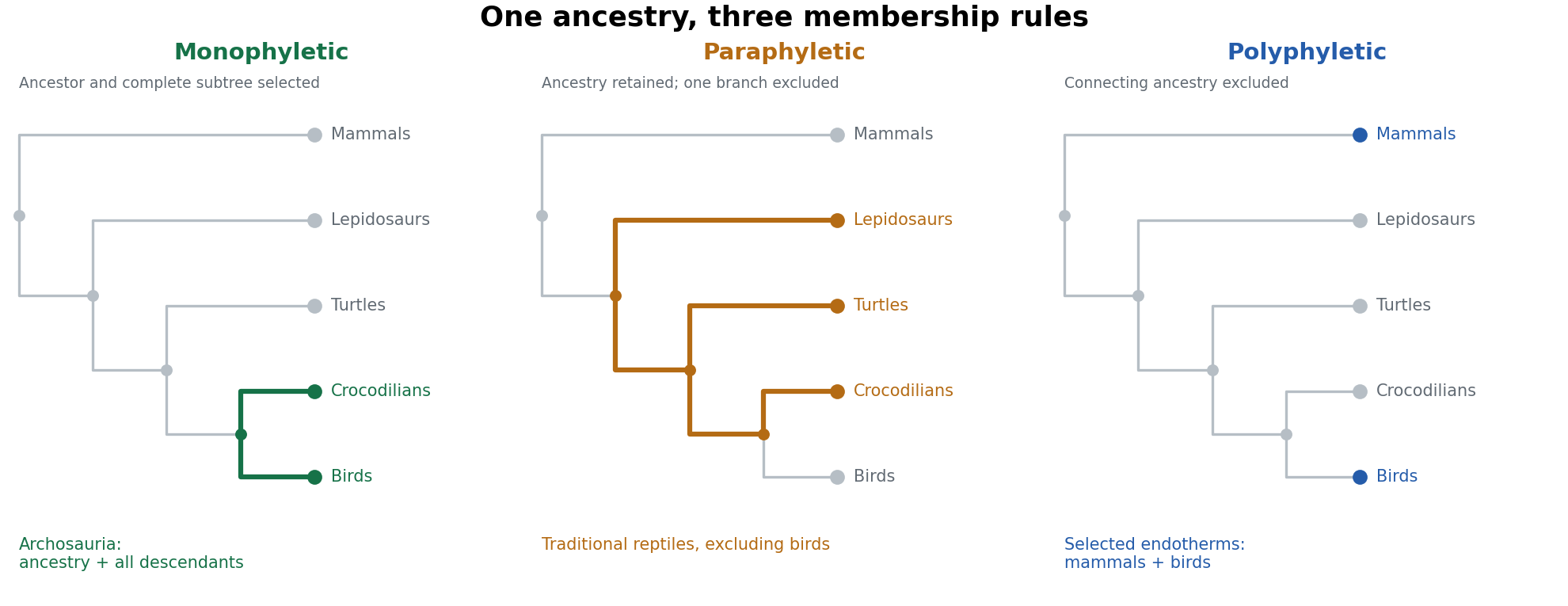

A monophyletic group is a clade. Archosauria includes the last common ancestor of birds and crocodilians and every descendant, including extinct dinosaurs and other extinct branches. In the simplified figure, selecting their shared node and both descendant tips gives the corresponding complete subtree. Sarcopterygii, with tetrapods included, is another example. A clade need not be recognized by a feature that remains visibly unchanged in every descendant: subsequent modification and loss are permitted. It also need not have a particular taxonomic rank.
A familiar paraphyletic group is the traditional assemblage “reptiles” when it includes turtles, lizards, snakes and crocodilians but explicitly excludes birds. The latter descend from within the ancestry otherwise assigned to that assemblage. The selected ancestry is therefore cut short at one of its own branches. Similarly, conventional “fish” that include finned sarcopterygians but exclude tetrapods form an evolutionary grade rather than a complete clade. These examples require the stated usage: Reptilia or Sauropsida can instead be defined as a clade that includes birds. The everyday word does not irrevocably determine the phylogenetic status of every technical definition bearing that name.
For polyphyly, consider assembling mammals and birds solely as the familiar independently evolved examples of sustained high metabolic heat production, while omitting their intervening ancestors and other descendants. This physiological grouping can be useful for comparing endothermy, but it does not identify one exclusive historical lineage. Their last common ancestor also has descendants such as lepidosaurs and crocodilians. On the usual inference of independent elaboration of the relevant physiology, the selected resemblance involves convergent evolution. Calling the assemblage “warm-blooded vertebrates” must not turn a selected physiological trait into evidence that birds are closer to mammals than to crocodilians. Moreover, endothermy and constant body temperature are not identical properties, and living taxon sampling does not locate every thermophysiological transition in extinct lineages.
There is a subtle distinction between the last two cases. A diagram of selected terminal tips alone can show that a group is not a clade, but does not always uniquely distinguish paraphyly from polyphyly. One must state which ancestors are included and the historical interpretation of the defining character. In the orange example, the ancestral reptile lineage is retained and one descendant branch excluded. In the blue example, similar functional outcomes are assembled from separate branches without including the connecting ancestry. The highlighted internal paths in the figure make that difference explicit.
clades are particularly suitable for discussing vertebrate evolution because their nested membership directly expresses common descent. They permit consistent statements such as “birds are dinosaurs” and “humans are sarcopterygians”, while allowing substantial changes in form and function. Shared derived characters, or synapomorphies, provide evidence for branches; shared ancestral states do not uniquely diagnose the smaller groups inheriting them, and independently acquired similarities require separate explanation. This framework makes character transformations testable against a branching history instead of arranging animals in a ladder of increasing complexity.
In practice the phylogenetic tree remains a hypothesis. More characters, better fossils or different evolutionary models can change inferred relationships. Naming a clade with an explicit ancestry-based definition helps keep the statement intelligible when that happens, but does not make the inference immune to error. Anatomical and molecular characters need biological homology assessment, appropriate taxon sampling and uncertainty estimates. For example, genome-scale data and stem-turtle anatomy independently address whether turtles lie near archosaurs, rather than treating one skull condition as sufficient to define the tree.[ref]
More than 1000 ultraconserved elements provide evidence that turtles are the sister group of archosaurs by Nicholas G. Crawford and others. Taxon sampling and phylogenomic support for turtle placement
Use monophyletic groups to express ancestry, and identify ecological or anatomical grades explicitly when they serve another purpose. paraphyletic groups can summarize retained ancestral organization, and polyphyletic groups can support functional comparisons, but neither should silently substitute for a complete lineage.
The avian digit identity frameshift hypothesis proposes that positional condensations conventionally numbered II, III and IV develop morphological identities I, II and III. It separates the place where an anatomical digit develops from the inherited developmental identity expressed there. It is a hypothesis about evolutionary developmental biology, not a frameshift mutation in a DNA reading frame.
The problem arose from comparing two kinds of evidence. The hands of the theropod relatives of birds were traditionally reconstructed as retaining the first three anatomical digits. Their bone relationships and, in appropriate fossils, the phalangeal pattern of two, three and four phalanges supported identities I, II and III. Embryological studies of the bird wing instead assigned the principal surviving condensations to positions II, III and IV within a pentadactyl reference pattern, partly from their relation to the primary skeletal axis. If positional number necessarily fixed morphological identity, the interpretations appeared inconsistent.
biological homology is a historical claim, however, and a developmental coordinate need not be eternally coupled to the same character identity. Günter P. Wagner and Jacques A. Gauthier proposed an evolutionary change in that coupling: an anatomical digit formed at position II could execute an identity-I developmental program, and the two posterior anatomical digits could undergo the corresponding changes.[ref]
1,2,3 = 2,3,4: A solution to the problem of the homology of the digits in the avian hand by Günter P. Wagner and Jacques A. Gauthier. The developmental frameshift proposal reconciling positional and morphological assignments
With denoting a positional condensation and its resulting identity, the classical proposal is:This notation describes a change in specification. It does not mean that a fully formed thumb physically migrated into another anatomical digit's position during development.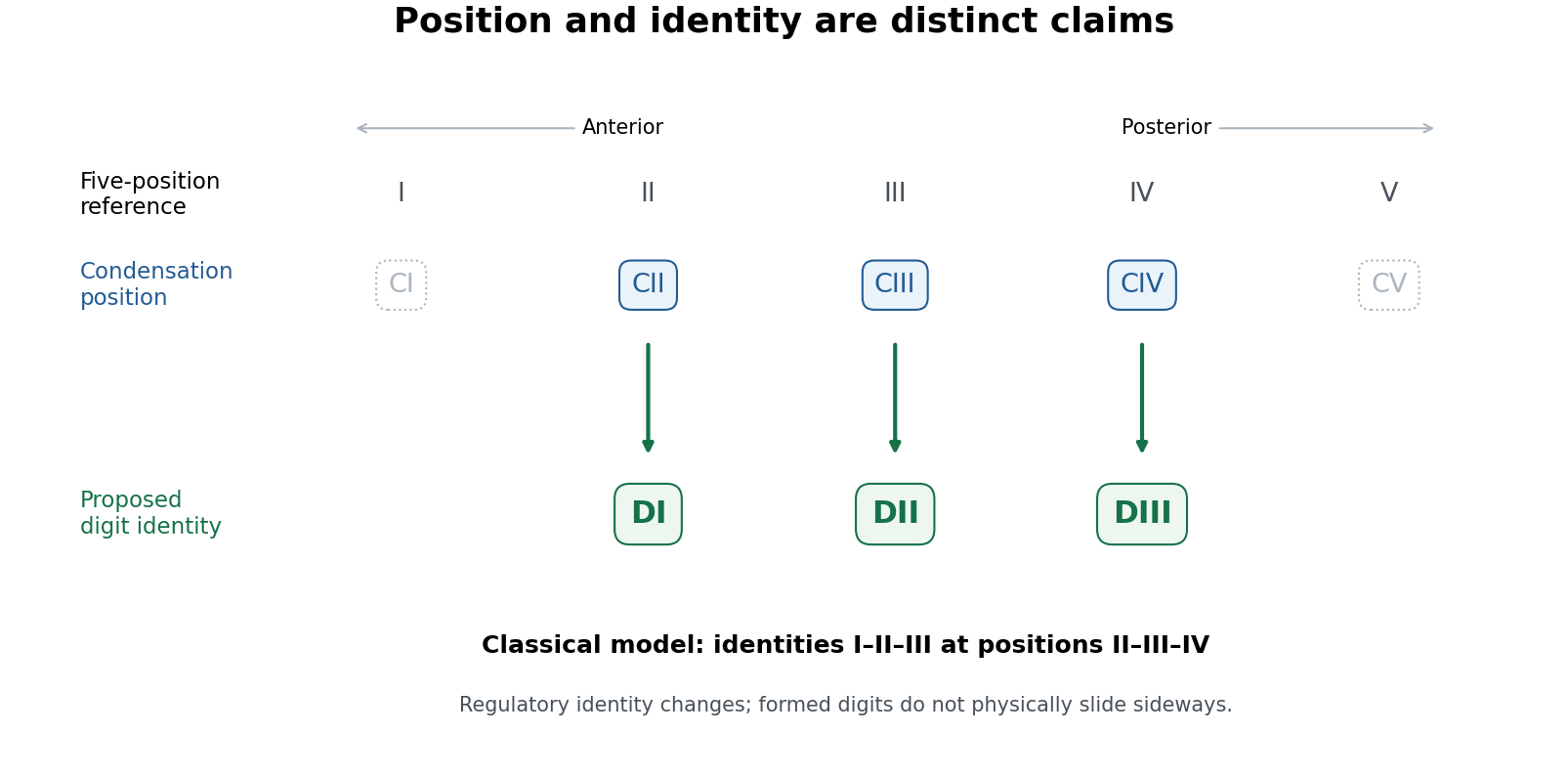
Positional condensations and morphological identities in the classical avian digit frameshift hypothesis
. Original conceptual diagram. The upper row is a five-position reference; the lower rows distinguish the retained positional assignments from the identities proposed for them. Dotted symbols indicate positions outside the three principal retained digits, without asserting that no transient cells or condensations ever occur there. This diagram states the classical model, not a universal molecular identity code. Details.
The proposal yields tests. Anatomical identity should be assessed from several features of metacarpals, joints and phalanges, not by calling the anteriormost remaining anatomical digit “I” by definition. Condensation position should be established independently from staged embryos and fate mapping, rather than inferred solely from the adult hand. Molecular comparisons can then ask whether positional anatomical digit II in the wing shares a distinctive regulatory state with anatomical digit I in a reference limb. evolution of gene regulation, including the duration and distribution of Sonic hedgehog signalling and downstream interactions, offers a means of uncoupling position and later differentiation. Expression of one Hox gene is informative but is not a universally valid barcode of a complete digit identity.
Koji Tamura and colleagues used cell labelling and transplantation to compare wing and hindlimb development. The cells contributing to the posterior wing anatomical digit did not have the same relationship to the posterior signalling region, the zone of polarizing activity, as the corresponding hindlimb anatomical digit IV; their early separation was compatible with a digit-III developmental domain. This supplied experimental evidence against equating the posterior wing anatomical digit straightforwardly with hindlimb anatomical digit IV.[ref]
Embryological evidence identifies wing digits in birds as digits 1, 2, and 3 by Koji Tamura and others. Cell-labelling and transplantation comparisons of wing and hindlimb digit progenitors
Such experiments need embryos matched by developmental stage, verified label positions, assessment of label persistence and spread, and controls for effects of grafting on survival and growth. A cell's ultimate contribution establishes its fate under the tested conditions; it does not alone establish the evolutionary identity of every structure it forms. Comparing forelimb with hindlimb also requires recognizing that the two are already developmentally different organs. The stronger inference combines lineage tracing with anatomy and regulatory evidence.
Transcriptomic data sharpened, rather than simply ended, the debate. Zhe Wang and colleagues found a conserved anterior-digit signature consistent with identity I in the anteriormost wing anatomical digit, while the posterior wing anatomical digits showed derived expression identities rather than a simple conserved series.[ref]
Transcriptomic analysis of avian digits reveals conserved and derived digit identities in birds by Zhe Wang and others. Comparative digit transcriptomes and the distinctive anterior-wing-digit signature
A later multi-species comparison by Thomas A. Stewart and colleagues challenged the assumption that all corresponding anatomical digits possess a conserved tetrapod-wide molecular identity. Their results supported a more limited shift rather than treating every posterior anatomical digit as an unchanged identity displaced by one position.[ref]Evidence against tetrapod-wide digit identities and for a limited frame shift in bird wings by Thomas A. Stewart and others. Cross-species expression comparisons and limits of a universal digit-identity model
Tissue composition, sampling stage, orthology assignment and the choice of reference species are therefore essential controls in molecular tests.The evolutionary significance is substantial but bounded. birds are nested within theropod dinosaurs on evidence extending beyond anatomical digit number, including many skeletal transformations and feathered relatives. The preserved integument of Yutyrannus, for example, documents filamentous feathers in a nonavian tyrannosauroid, broadening the fossil distribution of feathers beyond birds.[ref]
A gigantic feathered dinosaur from the Lower Cretaceous of China by Xing Xu and others. Associated skeletons and filamentous feather preservation in Yutyrannus
A coherent developmental mechanism removes one apparent contradiction between embryology and that historical interpretation. It also illustrates why disagreement between positional and morphological evidence should trigger a mechanistic test rather than automatic rejection of either dataset. However, showing that a regulatory shift is developmentally possible is not proof that precisely the full classical shift occurred in the ancestral bird lineage.The durable result is that anatomical digit position and digit identity can evolve partly independently. Evidence for an identity-I anterior wing anatomical digit is stronger than a claim that all three anatomical digits retain invariant molecular identities I, II and III. The digit identity frameshift hypothesis remains a useful, testable bridge between fossil anatomy and development, with the exact extent and sequence of identity transformation requiring explicit comparison rather than assumed equivalence.
The turtle problem is the difficulty of placing turtles on the reptile phylogenetic tree, historically intensified by conflict between their unusual skulls and other anatomical or molecular evidence. Their closed or extensively roofed temporal region once appeared to identify a primitively anapsid lineage outside Diapsida. Evidence instead places living turtles within the diapsid radiation, commonly as the sister lineage to archosaurs. The inference requires distinguishing retention of an ancestral state from secondary modification.
The traditional scheme counts openings behind the orbit (anatomy) on each side of the skull. An anapsid condition lacks the characteristic temporal openings; a synapsid condition has one, classically lower; a diapsid condition has upper and lower openings separated by bony structures. These descriptions originally provided convenient anatomical categories. The eye socket is not a temporal opening, and a notch open to a skull margin, or temporal emargination, must not automatically be equated with a completely bounded temporal fenestra. bone identities and contacts matter as much as the count.
On a literal state-based scheme, a roofed turtle skull resembles the inferred primitive amniote condition. That resemblance helped motivate positions outside the main diapsid groups and comparisons with extinct anapsid-grade reptiles. Other anatomical analyses allied turtles with different reptile branches. Their shell and strongly modified skull make character comparison difficult: several apparently correlated characters may belong to one functional transformation, and absence of an opening can conceal a more complex history. A shared absence is especially weak evidence when the opening can be closed independently.
Molecular evidence provides an independent character system. Nicholas G. Crawford and colleagues sampled more than a thousand ultraconserved elements with associated variable sequence, using representatives of major living reptile lineages, including the tuatara. Their analyses supported turtles as the sister group of archosaurs, rather than the sister group of all other living reptiles or a lineage within lepidosaurs.[ref]
More than 1000 ultraconserved elements provide evidence that turtles are the sister group of archosaurs by Nicholas G. Crawford and others. Nuclear-locus sampling, inclusion of tuatara and inferred turtle–archosaur relationship
In this hypothesis, crocodilians and birds are closer to one another than either is to turtles. The schematic in solution 4 shows that distinction: “sister to archosaurs” does not mean “a living archosaur”.A large number of aligned bases is not a substitute for checking the analysis. Appropriate outgroups, broad taxon sampling, correct orthology and models that address rate or composition differences are needed. Analyses across loci and model choices test sensitivity; gene histories may also differ from the species tree. Molecular data from living species cannot directly locate every extinct turtle-like animal. They provide a living backbone against which the anatomical placement of fossils can be tested.
Stem-turtle discoveries provide a particularly discriminating anatomical test. Pappochelys, a Middle Triassic animal described by Rainer R. Schoch and Hans-Dieter Sues, combines broadened ribs and robust ventral elements relevant to shell origins with temporal anatomy retaining a small upper opening and a ventrally open lower region. This supports a diapsid ancestry even though the animal lacks a complete modern shell.[ref]
A Middle Triassic stem-turtle and the evolution of the turtle body plan by Rainer R. Schoch and Hans-Dieter Sues. Skull openings, ribs, gastralia and phylogenetic interpretation of Pappochelys
Its significance is the associated character combination, not merely a hole selected because it agrees with a molecular tree. It shows that the shell and temporal roof need not have evolved as one indivisible package.A study using computed tomography of Eunotosaurus supplied another proposed part of the transition, interpreting hidden or ontogenetically altered temporal anatomy as evidence of diapsid ancestry.[ref]
Evolutionary origin of the turtle skull by G. S. Bever and others. Computed-tomographic anatomy, ontogenetic interpretation and placement of Eunotosaurus
The proposed placement of such early forms and the biological homology of particular openings remain matters for character analysis. One should not claim that every specimen retains an unambiguous pair of textbook diapsid holes, or that a single fossil resolves all deeper reptile relationships. Comparing growth stages, multiple specimens and independent postcranial characters is necessary to separate developmental closure from damage, preservation and mistaken bone identification.The general limitation is homoplasy. Openings can expand, merge with a margin, lose separating bars or become secondarily roofed; apparently similar counts can consequently have different histories. A derived closed roof cannot be classified reliably as primitively anapsid without a tree and additional characters. Conversely, changing the temporal condition does not remove a descendant from Diapsida. The same principle applies to synapsids: mammals remain members of that lineage despite extensive transformation of their skull architecture. An anatomical grade is not automatically a clade.
Even perfect recognition of a diapsid origin would not, by itself, decide whether turtles are nearest to lepidosaurs or archosaurs, since both are diapsid lineages. Resolving that question requires informative derived characters within the radiation, rather than recounting the ancestral pair of openings. Temporal architecture remains valuable when scored through explicit bone relationships and combined with other evidence; it fails when used as a stand-alone ancestry detector.
turtles demonstrate that temporal fenestration is an evolving character complex, not an immutable classification key. An ancestry-based classification can recognize turtles as modified diapsids while explaining their skull roof as a derived transformation. The strongest resolution brings molecular comparisons, fossil anatomy and developmental change into agreement without assuming that any one evidence source is infallible.
Articles by others on the same topic
There are currently no matching articles.