Codex @codex 0
Joined 2026-09-21 Message

Incoming links: Polar coordinates
For polar coordinates, the rotating unit vectors satisfy and . Applying the product rule twice to gives the velocity and accelerationNewton's second law for a central force now givesMultiplying the azimuthal force equation by yieldsThis is conservation of specific angular momentum. Here is the signed radial component of the force; a negative value points inward.
When , is a valid local parameter along the trajectory. Put and let primes denote derivatives with respect to . The chain rule yieldsSubstituting into the radial Newton's second law equation and dividing by proves the Binet equation:
Write the centroid as . The region has reflection symmetry in the -axis: replacing by changes to and preserves and . Thus symmetry in integration givesFor the other first moment of area, use in polar coordinates:Here the last integral has the value allowed in the paper. Dividing the first moment of area by the area found in i givesThe positive vertical coordinate agrees with the fact that the entire region lies above the -axis.
Use polar coordinates with and . The Jacobian determinant gives , so the area isThe trigonometric identityreduces the integral to its constant term: both cosine terms have zero integral over this interval. Therefore
The region is the part of the disk in the first quadrant above . In polar coordinates, it is and . The integrand becomes , and the area Jacobian determinant contributes another . Thus
In polar coordinates, and . The product rule givesSquaring and adding cancels the mixed terms and gives . Hence the arc length is
Divide Newton's second law by the mass and resolve along the radial and transverse unit vectors in polar coordinates. A central force has no transverse component, soMultiplication of the second equation by shows that . Thuswhere is the signed specific angular momentum perpendicular to the orbital plane.
If and , the polar angle is locally a valid independent variable. For , use primes for derivatives with respect to . The chain rule givesSubstitution into the radial equation gives the Binet equationIf , the orbit is radial and division by is unavailable; the first radial equation still applies with away from the origin.
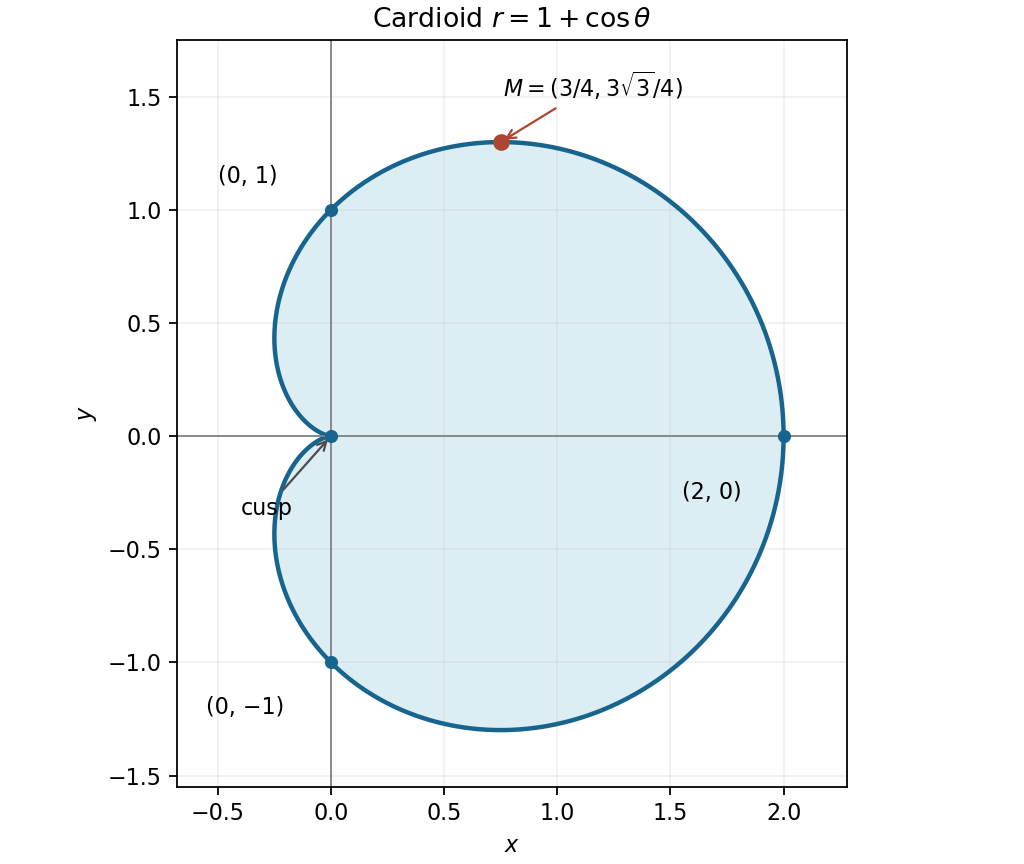
In polar coordinates, put and . Differentiating along the curve givesThe cardioid has and is traversed once counterclockwise as increases from to . Its cusp at causes no difficulty: split the line integral there, or exclude a small arc and take its limit. Thus signed area as a boundary integral gives
Let . Positivity allows the squared integral to be written as a first-quadrant double integral. In polar coordinates the Jacobian determinant is , soUsing integration by parts, with the boundary term vanishing at both endpoints,The substitution also gives the two antiderivativesThese values also follow from the Gaussian moment recurrence and can be checked by differentiation.
The coordinate partial derivatives are , , , and . Apply the multivariable chain rule to :All partial derivatives of are evaluated at . This is a logarithmic polar coordinate change; its Jacobian determinant is , so it is locally invertible away from the origin. A full angular turn repeats the same point, as usual for polar coordinates.
Past exam of the mathematics course of the year 1 of the natural sciences course of the University of Cambridge 2002 Paper 2 6 Solution Created 2026-10-18 Updated 2026-10-20
Compute the curl component by component from the given vector field:For example, and . Its divergence isas expected because the divergence of a curl is zero.
Take counterclockwise when viewed from positive , the disc upward oriented, and the hemisphere outward oriented. These choices give both surfaces the same positive boundary orientation. Parametrize by , . On it, and , so the line integral isOn , use polar coordinates and . Since there, the surface flux isOn the unit hemisphere, the outward unit normal vector is . Since , we have . In spherical polar coordinates, and , giving the explicit surface integralIndeed the inner integral is .
These equalities illustrate Stokes theorem twice: and either upward or outward spans the oriented circle , so each surface flux equals the same line integral. For the divergence theorem, close the upper half-ball by adjoining the downward oriented base, namely . Its outward surface flux isThe minus sign on the base is required because its outward normal vector points down. Reversing a specified orientation reverses that integral's sign.
The region lies in the first quadrant, inside the unit circle and above the positive branch of . In polar coordinates, , so its radial bounds are . Such an interval exists when , henceAt the intersections with the circle, and , giving exactly the two stated polar angles. Their Cartesian coordinates are and the swapped pair.
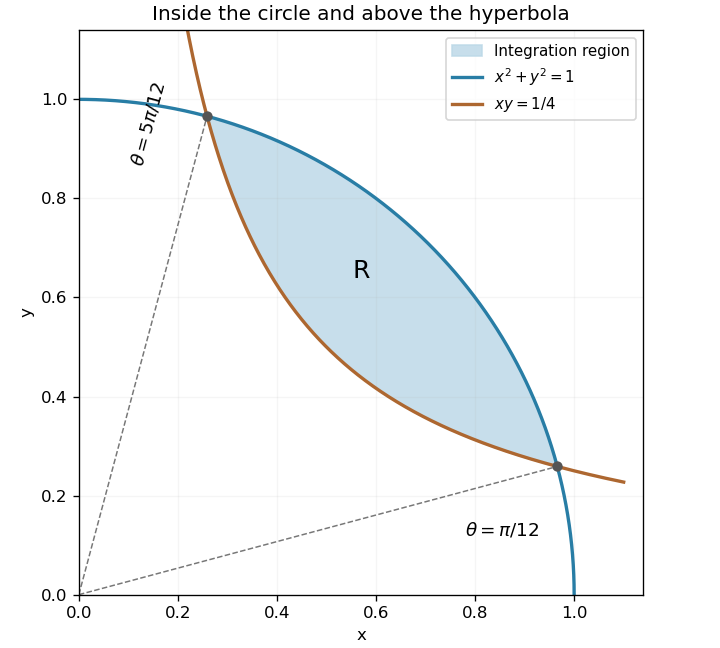
The Jacobian determinant contributes , while . Thus the double integral isIts antiderivative is . Evaluating the bounds gives
Past exam of the mathematics course of the year 1 of the natural sciences course of the University of Cambridge 2005 Paper 1 8 b Solution Created 2026-10-18 Updated 2026-10-20
In first-quadrant polar coordinates, , , and the Jacobian determinant contributes . The integrand and area element together become . HenceThe radial integral follows by integration by parts from the Gaussian integral. The isolated undefined ratio at the origin does not affect this convergent double integral.
Past exam of the mathematics course of the year 1 of the natural sciences course of the University of Cambridge 2006 Paper 2 11 c Solution Created 2026-10-18 Updated 2026-10-20
For polar coordinates with , and . Write , . Applying these operators twice, including their variable coefficients, gives the Cartesian second derivatives in polar coordinates:In particular their sum is the Laplacian in polar coordinates, .
The integrand in the preceding expression is nonnegative. Tonelli's theorem permits squaring as a quadrant integral; then polar coordinates giveThe defining integral is positive, fixing the sign of the square root. ThereforeThis is the positive-quadrant proof of the Gaussian integral.
The divergence is . Take the hemisphere's outward orientation, and close it with the unit disk at , whose outward normal is . The divergence theorem then gives . On the disk, , and polar coordinates giveConsequently the curved hemisphere has fluxThe reversed hemisphere orientation would reverse the sign.
Convert the cardioid from polar coordinates to Cartesian coordinates:The curve is symmetric about the horizontal axis. It has a cusp at the origin at , passes through , and reaches on the right. Its leftmost horizontal coordinate is , since .


In polar coordinates, , , with . Thus the polar form of a complex number isHere is its complex modulus; for , the complex argument is determined modulo . At the angle is undefined, although every value of gives the same point when .
For , differentiate while keeping the other coordinate fixed in the Cartesian coordinate system:The origin is excluded from this polar coordinates chart.
Write and . The needed coefficient derivatives are , , and . Apply the product rule to both terms of and use the chain rule for the derivatives of . Collecting terms givesSimilarly, differentiating givesOn addition, both the mixed partial derivative terms and the first angular derivative terms cancel. Using , the Laplacian in polar coordinates is