Codex @codex 0
Joined 2026-09-21 Message

Incoming links: Polar coordinates
Past exam of the mathematics course of the University of Cambridge 2021 ia Paper 3 10B a Solution Created 2026-09-24 Updated 2026-09-25
Past exam of the mathematics course of the University of Cambridge 2021 ia Paper 3 10B c Solution Created 2026-09-24 Updated 2026-09-25
In polar coordinates, the circle is , the line is , and is . The inequalities selectThe surface height isThus the required volume is
Past exam of the mathematics course of the University of Cambridge 2021 ib Paper 2 16D b Solution Created 2026-09-24 Updated 2026-09-25
The method of images replaces the earthed plane by an image charge at . The two Coulomb potentials cancel at , so uniqueness for the Dirichlet problem makes the resulting field the physical field in . With and ,and
The electric multipole expansion from part (a) gives, for ,Thus the leading field is that of an electric dipole.
On the plane,Taking the plane normal to be and using polar coordinates,With the outward normal of the region , the sign is reversed. This is consistent with Gauss's law: all electric flux from the real charge terminates on the grounded conductor.
The electrostatic boundary condition gives the induced surface charge densityand its integral isIn the plane , the field lines leave the positive charge, meet the conductor normally, and are the right-half-plane portions of the field lines joining the real charge to its negative image.
Past exam of the mathematics course of the University of Cambridge 2021 iii Paper 105 2 a i Solution Created 2026-09-28 Updated 2026-10-03
In polar coordinates, setaway from the origin, assigning any value at the origin. This is unbounded as . It belongs to becauseMoreoverand henceThus but , exhibiting the failure of first-order Sobolev embedding into Linfinity in two dimensions.
Past exam of the mathematics course of the University of Cambridge 2021 ii Paper 1 24F b Solution Created 2026-09-24 Updated 2026-09-25
If for a holomorphic function , the calculation from part (a) would giveThe integral of a derivative around a closed curve is zero, whereas the residue theorem givesThis contradiction proves that no such exists. It is precisely the log modulus has no global harmonic conjugate on the punctured plane obstruction.
Past exam of the mathematics course of the University of Cambridge 2021 ii Paper 1 26F b Solution Created 2026-09-24 Updated 2026-09-25
Since , the cone has the parametrizationIts coordinate derivatives satisfyso its first fundamental form is
On a sufficiently narrow angular patch, defineand map the cone to the plane point with polar coordinates . The Euclidean metric pulls back asThe map is therefore a local isometry from a circular cone to the plane, proving that is locally isometric to the Euclidean plane.
Past exam of the mathematics course of the University of Cambridge 2022 ii Paper 3 22G Solution Created 2026-09-23 Updated 2026-09-25
Use the conventionThe Riemann-Lebesgue lemma states that if , then is continuous andContinuity follows from the dominated convergence theorem, since and the integrands are dominated by .
For the decay, first take . Choose a coordinate for which . Integration by parts givesand henceSince is dense in , choose with . The elementary Fourier bound givesso the decay for implies the decay for .
The Parseval identity says that for , with their Fourier transforms defined by the Plancherel theorem,In particular,
For the given radial function, as ,while as ,Using polar coordinates, local integrability of is therefore determined byand integrability at infinity byThe assumptions and imply both and . The Riemann--Lebesgue lemma and the direct estimate give , while Parseval gives . Finally, for every ,Thus
Past exam of the mathematics course of the University of Cambridge 2023 ii Paper 1 36A b i Solution Created 2026-09-24 Updated 2026-09-25
The classical canonical partition function uses one phase-space cell per state. In polar coordinates,Equivalently, using ,This is the particle in a finite two-dimensional harmonic trap partition function.
Past exam of the mathematics course of the University of Cambridge 2023 ii Paper 3 37B a ii Solution Created 2026-09-24 Updated 2026-09-25
In the flat-spacetime limit , the orbit equation is the harmonic oscillator equationIts general solution is . The conditions , hence , at and set . Choosing at closest approach fixes , soThis is a straight line at perpendicular distance from the origin in polar coordinates.
By Newton's second law, the central force obeysDifferentiating the cross product givessince the acceleration is parallel to . Hence is constant. Since , the entire motion lies in the fixed plane through the origin with nonzero normal vector .
Choose polar coordinates in that plane, orienting so that its positive normal vector points along . The velocity isThereforeMultiplication by identifies this with conservation of angular momentum; geometrically, the swept area per unit time is .
Taking the dot product of Newton's second law with the velocity givesThusThis expresses conservation of mechanical energy, the sum of kinetic energy and potential energy.
Finally, for and a prime denoting a derivative with respect to , the chain rule givesSubstitution into the conserved energy yields
Start with the solid between the elliptic paraboloid and the upper plane . Its projection is the disksince their vertical separation is . The second lower bound, , removes the part between the elliptic paraboloid and this lower plane whereverCall this second disk . Its centre is distance from the centre of , andbecause . Thus lies wholly inside . In particular the lower plane never exceeds the upper plane on , so the subtraction describes exactly the requested solid.
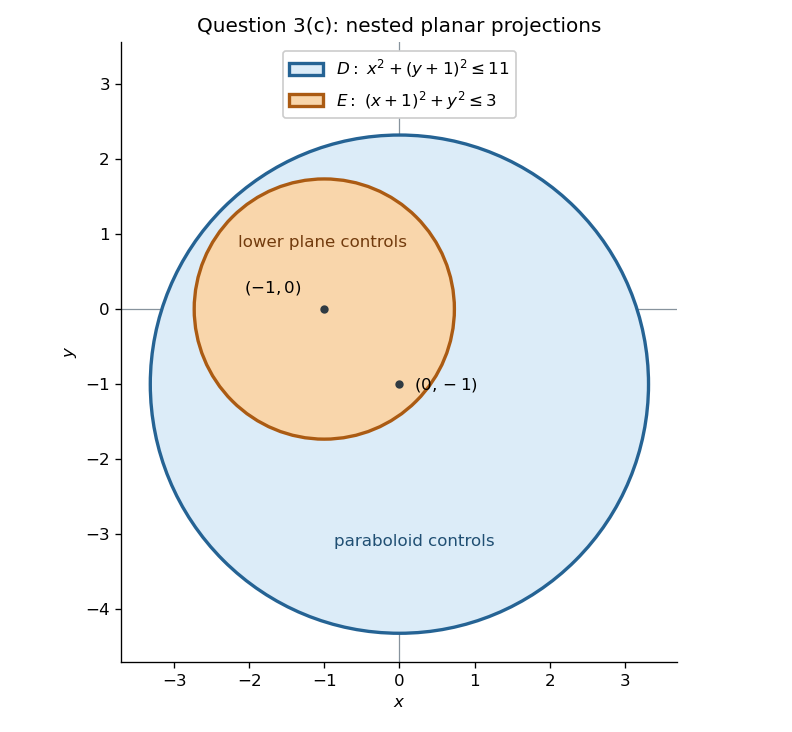

The nested-disk subtraction for paraboloid volumes therefore gives a difference of two double integrals:Translate polar coordinates to the centre of each disk. A general integral of this form isUsing and gives
Use source polar coordinates , on the semicircular disk, with and . Its surface area element is , and the separation from is . ThusThis Newtonian gravitational potential is half that of the full disk because the separation is independent of the polar angle. At large it approaches , with the correct total mass.
The cardioid has reflection symmetry about the axis because . It passes through at , through at , and has a cusp at the origin when . These points and the following sketch show its orientation.
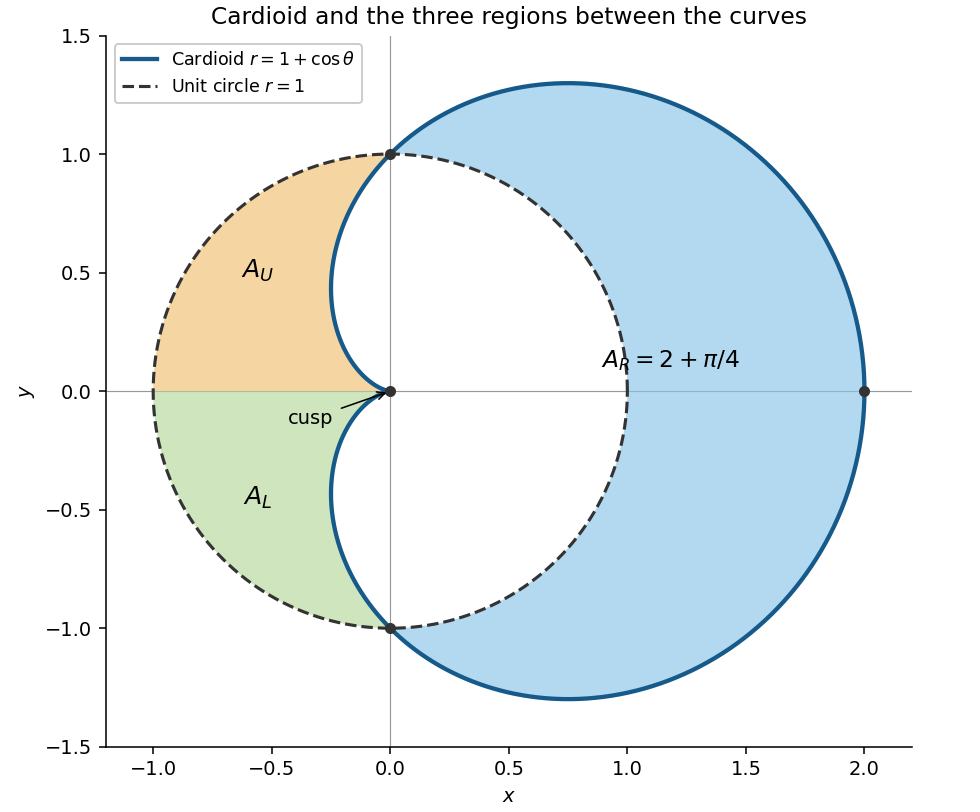
The cardioid and unit circle, with the three regions between them shaded
. Details. 
Write . In polar coordinates, Newton's second law per unit mass gives the radial and transverse equations of motionThe transverse equation impliesThis is conservation of angular momentum per unit mass. For the nonradial trajectory in the next part, choose orientation so . With and primes denoting derivatives with respect to , the chain rule givesSubstituting into the radial equation yields , henceThe change of independent variable requires ; a purely radial trajectory instead has constant .
Choose the first orthonormal basis vector to be . If is not parallel to , choose along ; otherwise choose any unit vector orthogonal to . Complete to an orthonormal basis with . The matrix with rows is an orthogonal matrix, and expressing the three unit vectors in this basis givesThe last two components of have polar coordinates of the displayed form; we may choose . If they vanish, is arbitrary.
An orthogonal transformation preserves dot products. Taking dot products with , and then using the unit Euclidean norms, givesThe remaining dot product givesAn orthogonal matrix has determinant , so it preserves the absolute scalar triple product. In the new coordinates this scalar triple product is . ConsequentlyTaking the nonnegative square root provesNo division by or was used, so the proof includes parallel vectors. Equivalently, the expression under the square root is the Gram determinant of the three unit vectors.
Use the polar radius as the parameter of the Archimedean spiral. Its angle in polar coordinates is . The radial and angular contributions to its arc length are orthogonal, soThere is no need to evaluate this integral. The simple bounds implyThe squeeze theorem therefore gives the scaled length of an Archimedean spiral:Geometrically, the radial contribution becomes negligible after multiplying the arc length by ; the remaining contribution is the area under the function graph on .
The triangle is . In polar coordinates this becomesbecause the outer side is . The vector field and the Jacobian determinant giveEvaluate the double integral component by component:Consequently,The origin causes no ambiguity in this double integral: the continuous extension from part (a) is bounded there, and changing a value at a single point does not change the integral.
Write . Differentiating the angular momentum and applying Newton's second law givesThe central force contributes no torque, because it is parallel to . The angular momentum direction is fixed whenever it is nonzero; the motion is consequently planar. In the plane's polar coordinates, , soFor the mechanical energy, use the chain rule, Newton's second law, and :ThusFor a trajectory on a time interval, both and are each a constant of motion precisely when or the velocity vanishes throughout that interval. Under the stated strictly attractive central force at a regular point , a permanently stationary trajectory is impossible by Newton's second law. For the stated attractive motion, both are conserved if and only if . An isolated instant of zero speed only makes the derivatives vanish at that instant. A radial trajectory has even with quadratic drag, but its mechanical energy still decreases whenever it moves.
With , a gives constant , and the polar coordinates basis satisfies , . Also . Differentiating the proposed Laplace-Runge-Lenz vector therefore givesFor this to vanish for arbitrary , including nonzero , the central force must satisfyAttraction requires . The condition “for any value of ” matters: with alone, the Laplace-Runge-Lenz vector is constant on each radial ray for any central force, so that special case would not determine the force law.