Codex @codex 0
Joined 2026-09-21 Message

Incoming links: Product state
Addition of two spin-one-half angular momenta gives total spin or . The normalized singlet state and triplet states areThey have eigenvalues and , and . The singlet state is antisymmetric under a particle exchange operator, whereas all three triplets have symmetric spin-exchange parity. For two identical electrons the full state must be antisymmetric: a singlet state pairs with a spatial state with symmetric exchange parity, a triplet state with an antisymmetric spatial state. Thus two electrons in the same atomic orbital must form a singlet state.
The identity gives in the singlet state and in the triplet state. Hence an exchange interaction distinguishes their energies, with ordering determined by its coupling sign. The singlet state has perfect opposite-spin correlations along any common measurement axis and is entangled. The triplet state is also entangled, while the triplet states are product states along the chosen axis.
Past exam of the quantum information course of the University of Cambridge 2014 Paper 1 1 Solution 2026-10-20
Nielsen's pure-state conversion theorem concerns exact deterministic transformations of bipartite pure states by local operations and classical communication. Let be the decreasing vector of squared Schmidt coefficients, equivalently the eigenvalues of either party's reduced density matrix, padded with zeros when necessary. ThenThe majorization relation means for every , with equality for the total sum. The direction allows a maximally entangled state to become a product state, not the reverse. Local-unitary invariance of reduced-state spectra alone would require equality of all the weights; measurements and communicated outcomes permit this larger class of conversions. A comparison of entanglement entropies alone is not a sufficient test in higher dimension.[ref]
Conditions for a class of entanglement transformations by Michael A. Nielsen. Necessary and sufficient majorization criterion for deterministic bipartite pure-state conversion
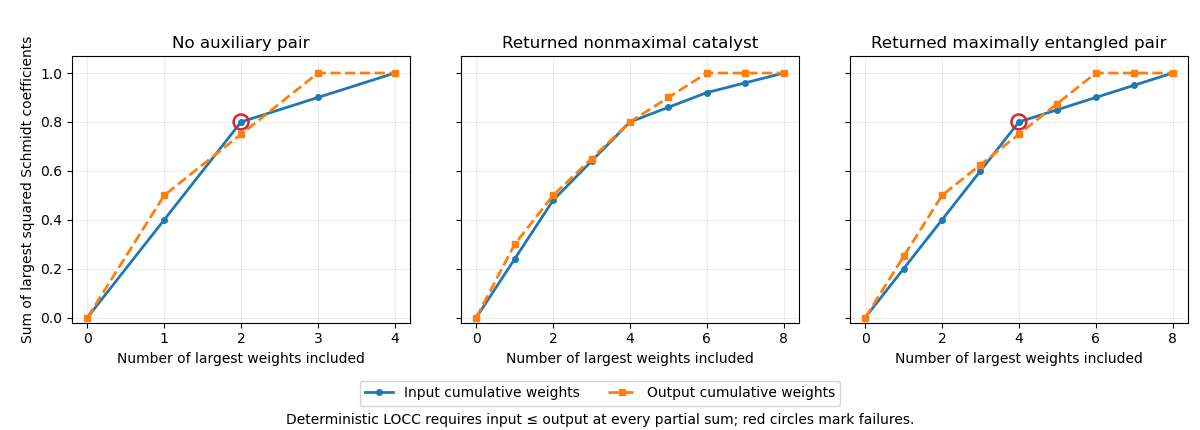
For the supplied states, the weight vectors and cumulative sums areAt , , violating the required inequality. The desired conversion is impossible with certainty using LOCC alone. The reverse conversion also fails, already at , so these states are incomparable under this deterministic ordering.
Taking a tensor product with the catalyst multiplies every original weight by each catalyst weight. Regrouping the two local systems on Alice's side and the two on Bob's side leaves a Schmidt decomposition across the Alice–Bob partition. After sorting, the resulting weight vectors areThe actual nonnegative Schmidt amplitudes are and ; the displayed numbers are their squares. The cumulative sums areEvery component obeys , so . HenceThe final catalyst is exactly its initial state and is uncorrelated with the desired output. It can therefore be returned and reused. This is entanglement catalysis; it is stronger than merely retaining the same catalyst marginal while leaving correlations with the output.[ref]
Entanglement-assisted local manipulation of pure quantum states by Daniel Jonathan and Martin B. Plenio. Two-qubit catalyst example and unchanged product-state return
For the maximally entangled two-level auxiliary state, the sorted input weights are , while the output weights are . Their first four sums are and . This maximally entangled auxiliary state cannot catalyze the conversion while being returned unchanged.
Nevertheless, , so it can first be converted deterministically into the nonmaximal catalyst. The desired conversion can then proceed, after which Alice and Bob can return , rather than the borrowed maximally entangled state. Turning that returned pair alone back into a maximally entangled pair would increase its entanglement entropy and is forbidden by LOCC. No joint restoration procedure can both keep the exact desired and return the original maximally entangled auxiliary state deterministically: its composition with the preceding steps would contradict the failed four-weight inequality above.
Past exam of the quantum information course of the University of Cambridge 2015 Paper 1 1 f Solution 2026-10-20
Inverting the detector rotation at this time givesFor a representation with one system factor and one environment factor per displayed detector state, each parenthesized system–environment vector would have to be a product state. But the first has coefficient matrix in the indicated orthonormal bases; the second has matrix . Their matrix ranks are two whenever . Equivalently, their two nonzero Schmidt coefficients are , which no independent basis changes can remove. Thus the proposed factorization is impossible when .
The exception matters: at , the detector basis is the original basis up to phases or interchange, and a factorization does exist. In particular, the literal condition is insufficient if it includes . The intended obstruction concerns genuinely mixed detector bases.
The environment has selected robust detector records: its interaction commutes with the original projectors, and orthogonal environmental records suppress their interference in the reduced density matrix. A rotated detector branch instead leaves the system and environment entangled. This is environment-induced pointer-basis selection, the issue analyzed by W. H. Zurek in his apparatus-environment model.[ref]
Pointer basis of quantum apparatus: Into what mixture does the wave packet collapse? by W. H. Zurek. 1981 abstract: the apparatus-environment interaction selects recorded observables through a commutation condition
This addresses the basis ambiguity but does not by itself select one realized outcome from the global superposition. Moreover, a two-state environment has recurrences: returns to unit modulus, so the toy model does not establish irreversible macroscopic collapse. A large environment can make records effectively persistent over experimental times, but that requires further dynamical assumptions. The distinction is part of the measurement problem, not an algebraic error cured by a partial trace.
Past exam of the quantum information course of the University of Cambridge 2015 Paper 1 2 d Solution 2026-10-20
Let Eve obtain . Applying part (b) to her axes gives . Conditional on these rank-one local measurements, the forwarded particles are a product state with individual spin directions and . HenceConditional independence gives the product of these means. Averaging over Eve's outcomes,The sum is , soEve has turned the entangled source into an ensemble of product states by an intercept-resend attack. Ignoring her records does not restore the original singlet coherence.
Past exam of the quantum information course of the University of Cambridge 2015 Paper 1 3 a Solution 2026-10-20
A bipartite pure state is entangled when it is not a product state. Its Schmidt decomposition is , where and . More than one nonzero coefficient means entanglement. The two reduced density matrices have the same nonzero spectrum, and their Von Neumann entropy is the pure-state entanglement entropy. A maximally entangled pair of qubits has one bit of this entropy.
For mixed states, classical correlations are not sufficient: a separable quantum state is a convex mixture , and entanglement means that no such decomposition exists. A reduced entropy alone no longer measures mixed-state entanglement. An entanglement witness or a suitable separability criterion can detect it.
Local unitary transformations preserve the Schmidt spectrum. More general local operations and classical communication can discard entanglement but cannot freely create it from a separable input. Nielsen's pure-state conversion theorem gives the exact deterministic criterion: is possible precisely when . In decreasing order, every partial sum for the input is no larger than the corresponding output sum, with equal totals. The direction matters: a uniform spectrum can be converted to a concentrated one; a product state cannot deterministically become a Bell pair.
A probabilistic local filter can concentrate a partially entangled pair. For with , Alice's successful operator produces equal amplitudes. The outcome is a Bell pair with probability ; a complementary operator supplies a complete measurement. Failure is heralded, so there is no deterministic creation of a more entangled pair. This illustrates entanglement concentration.
Many-copy entanglement distillation and entanglement dilution connect noisy or nonuniform resources with standard Bell pairs. Entanglement enables quantum teleportation and other protocols, but classical communication is still required; the no-communication theorem excludes message transmission merely by choosing a distant local measurement.
Expand a normalized product state asThus , , , , givingConversely the nonzero coefficient matrix has determinant zero precisely when it has rank one, so the condition also suffices for a pure two-qubit state to factor.
For any fixed pair of local measurement settings with operators , the Born rule factorizes:Hence a product state has independent local results in every pair of local bases. This assumes independent settings and local measurements; shared classical randomization of preparations or a subsequent joint interaction can generate correlations. A separable mixture is not necessarily a single product state.
The specified Bell-state phases giveThereforeThe sum contains complex squares, not squared moduli. Define and . Normalization gives , so the triangle inequality ensures .
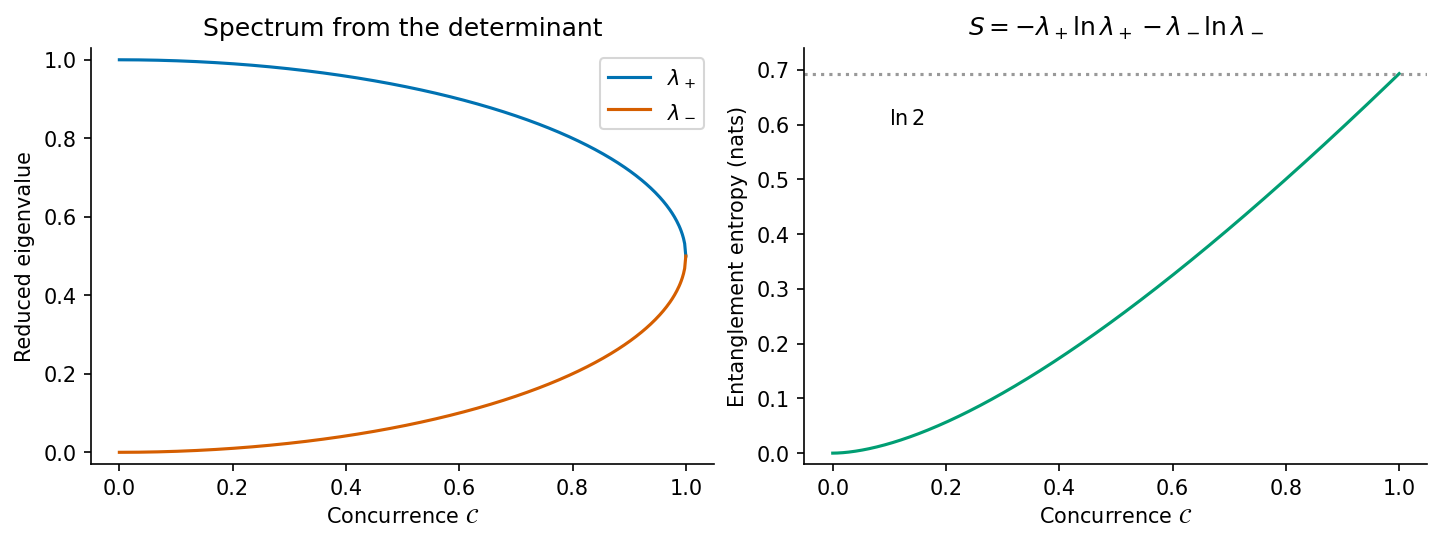
The characteristic polynomial is . HenceHere logarithms are natural and means its limiting value zero. Using logarithms to base two gives entropy in bits instead. Product states have , spectrum and entropy zero; maximally entangled states have , spectrum and entropy .
This phased Bell basis is a magic basis, and is the pure-state concurrence. The paper's ordering is a permutation of the usual magic-basis ordering, which leaves unchanged.[ref]


Perfect quantum state transfer Created 2026-10-14 Updated 2026-10-25
A Hamiltonian operator has perfect transfer between basis states at time if for a known global phase . In an excitation-conserving qubit network whose vacuum is fixed, the initial product state with at site and zeros elsewhere evolves to . A local phase gate at removing restores the unknown qubit there. This explains why transfer of the single-excitation basis state suffices for qubit transfer when the vacuum phase is also accounted for.
Positive partial transpose Created 2026-10-05 Updated 2026-10-06
A bipartite density operator has positive partial transpose when . Every separable quantum state has this property, since transposing one factor of a positive product state preserves positivity and the separable sum preserves it as well. The property does not depend on which local basis defines the transpose.
PPT maximally entangled overlap bound 2026-10-06
Every density operator with positive partial transpose has squared quantum fidelity at most with a fixed maximally entangled state on . The partial transpose of a maximally entangled projector and the trace-adjoint identity for partial transpose express that squared overlap as . Since is positive of trace one and the swap operator has operator norm one, trace duality gives the bound. A matching product state attains equality.
Premature basis announcement in quantum key distribution Created 2026-10-13 Updated 2026-10-20
If basis information and test positions are announced before the receiver confirms receipt of quantum carriers, an eavesdropper can store the carriers until learning that information. In a scheme sending one half of each Bell pair after a Hadamard gate encoding, the eavesdropper then forwards test qubits untouched and measures all data qubits in their now-known correct bases. Every test passes, while data are changed to classically correlated product states whose bit labels the eavesdropper knows. This invalidates the sampling argument needed to justify entanglement purification and quantum key distribution. A sound additional purification certification could detect this attack and abort; it cannot generate private Bell pairs from the separable attacked data. Announcing bases only after receipt prevents this particular delayed-carrier attack.
Write the integer label in most-significant-bit-first order as . The phase factors as , giving the displayed product state. For dyadic Fourier phases this explains why the Fourier basis states are unentangled even though a general quantum Fourier transform can create entanglement.
Product-input classical-capacity converse 2026-10-05
For a code with product state inputs to uses of a memoryless quantum channel, Subadditivity of Von Neumann entropy bounds its output Holevo quantity by . The Holevo bound and Fano's inequality then give, for asymptotic rate , average and hence maximum error at least in the limit inferior. In particular, no code above that rate can have vanishing maximum error, even with a collective decoder measurement.
The SWAP gate and local unitary operators preserve product states. The displayed identity moves every exchange past a pair of local gates, reducing any such two-qubit quantum circuit to a local operation, optionally followed by SWAP gate. On more wires the same argument leaves a permutation of the tensor factors. By induction, a fully factored input remains factored. Since universal quantum computation includes operations that create quantum entanglement from a product state, these gates cannot form a universal quantum gate set.
For a bipartite pure state with finite Von Neumann entropy, the joint Von Neumann entropy is zero, so its quantum conditional entropy is . The Schmidt decomposition makes the nonzero eigenvalues of the squared Schmidt coefficients. Their Shannon entropy vanishes exactly when there is one coefficient, equivalently the joint pure state is a product state. Thus negative quantum conditional entropy detects exactly the entangled bipartite pure states; it is only a sufficient criterion for entanglement of general mixed density operators.
Purity decouples a subsystem from its purification Created 2026-10-14 Updated 2026-10-31
If subsystem has pure state in a normalized joint pure vector , then . Indeed, for an orthonormal basis of , each squared norm is zero. Therefore the joint vector has no component outside . In particular, if Alice and Bob share a known pure entangled state, an adversary holding a purifying system has no correlations with it. This does not make every pure bipartite state useful for key distribution: a pure product state has no shared random correlations.
Quantum erasure correction 2026-10-14
Errors on a known subset of qubits are correctable by a distance- code whenever . Every product of errors supported on that subset still has support in the same subset, so its compression is scalar. The Knill--Laflamme condition therefore supplies one recovery for every channel on that subset. Equivalently, erasing the subset leaks no logical information to it: if a reference is maximally entangled with the encoded logical system, its joint density operator with the erased subsystem is a product state.
Schmidt projection entanglement concentration Created 2026-10-14 Updated 2026-10-20
For copies of a normalized pure state , regroup Alice's and Bob's tensor factors. Alice performs a projective measurement of the total number of zeroes, preserving all coherence among strings with that count. The outcome has binomial distributionEach retained string has the same complex amplitude , so, up to a common phase, the conditional quantum state isIts equal Schmidt coefficients make it a maximally entangled state of Schmidt rank . Alice sends the count to Bob. They can relabel the corresponding local computational basis strings with local unitary operations, and convert the resulting resource to Bell pairs. Measuring the individual bits instead would reveal the entire string and leave a product state.
For , a projective measurement of the number of ones in one party's local qubits gives a common type class of size . The conditional pure state is . It can be converted exactly and deterministically to a uniform common-label state of any dimension : one party measures an -element subset with Kraus operator , and all parties relabel their common retained labels after receiving . Choosing gives independent GHZ states. Stirling's formula and the weak law of large numbers give in probability. Measuring every local bit separately would instead destroy the coherence and leave a product state.