For density operators on the same finite-dimensional Hilbert space, quantum fidelity measures how close their quantum states are. This article uses the unsquared convention:Each square root is the positive square root of an operator, and is the trace norm. Quantum fidelity is symmetric in its inputs; it is one exactly when , and zero exactly when , meaning that the support of a positive operator for one state is orthogonal to that for the other. Larger quantum fidelity means greater similarity. The separate squared quantum fidelity is . [ref]
https://jhwatrous.github.io/TQI.3.pdf#page=16. Watrous, The Theory of Quantum Information, Definition 3.11 and Proposition 3.12
For two normalized pure states, quantum fidelity is the magnitude of their inner product, . Thus compared with itself has , while and have . For , comparison with gives , , and trace distance by the pure-state trace distance and fidelity identity.
Why compare density operators rather than their entries? A change of coordinates should not make the same physical preparations look more or less alike. Unitary invariance of trace distance and fidelity makes quantum fidelity independent of a common basis choice. Multiplying a pure state vector by a global phase leaves its density operator unchanged, so its quantum fidelity with the original state is one. These features make quantum fidelity useful for checking whether quantum channels, state preparations, and Schumacher compression preserve a target quantum state.
The connection to Uhlmann's theorem supplies another beautiful interpretation: quantum fidelity is the largest absolute inner product between pure vectors obtained from a purification of a density operator for each state, using a sufficiently large common reference space. Uhlmann's 1976 paper extended transition probability to algebraic states, including those of a C-star algebra; for density operators its transition probability corresponds to our squared quantum fidelity. The measurement characterization of quantum fidelity gives a complementary description directly in terms of observable outcome statistics. [ref]
https://www.physik.uni-leipzig.de/~uhlmann/PDF/Uh76a.pdf. Uhlmann, The transition probability in the state space of a star-algebra, Reports on Mathematical Physics 9, 273–279, 1976
In the unsquared convention, . Use Uhlmann's theorem to choose component purifications with nonnegative maximizing overlaps, and then construct matching flagged purifications of a quantum ensemble. Their overlap is the weighted sum on the right; the fidelity of the mixtures maximizes over all such overlaps.
Discarding a subsystem cannot decrease unsquared quantum fidelity: . Maximizing purifications of the joint states are also candidates for purifications of the marginals, with the discarded subsystem included in the reference. Uhlmann's theorem then proves the inequality. Information loss makes the two states at least as similar.
If is a positive contraction and , the normalized successful post-measurement state is . Since ,A likely outcome therefore preserves a pure input well in quantum fidelity when its measurement operator is positive. Positivity excludes a hidden unitary rotation that could otherwise change the state even for an outcome of probability one.
For normalized pure states and , the trace distance and quantum fidelity satisfyThe last two expressions distinguish the unsquared quantum fidelity from the squared quantum fidelity. Identical pure states give , and orthogonal pure states give . The equality need not hold for mixed states; the Fuchs-van de Graaf inequalities give bounds in that case.
Brief proof: for two distinct pure states, their two-dimensional span contains the nonzero part of . This restriction has trace zero and determinant , hence eigenvalues . Its trace norm is twice the positive eigenvalue, giving trace distance . For identical pure states, directly.
Compare the qubit pure statewith , using the computational basis. Its Bloch vector is : it follows a meridian of the Bloch sphere from the north pole through to the south pole . The inner product with is , nonnegative on this interval. Consequently quantum fidelity, squared quantum fidelity, and trace distance areAt the triple is ; at it is ; at it is . The angle between the Bloch vectors is , while the quantum fidelity uses its half-angle. The pure-state trace distance and fidelity identity becomes the familiar relation .
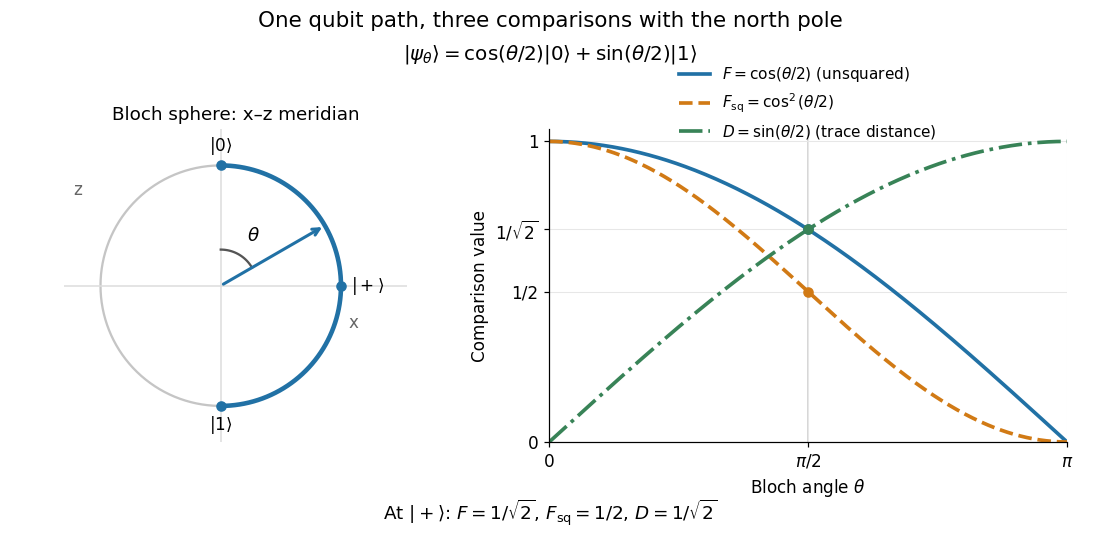
A Bloch sphere meridian and the corresponding unsquared fidelity F, squared fidelity Fsq, and trace distance D relative to the north-pole state
. Details. For equal prior probabilities, the Holevo–Helstrom theorem gives optimal quantum state discrimination success . Along this meridian it rises from to one, with at . This connects the geometric trace distance to the best possible decision from a single preparation; it is a different measurement task from the target-acceptance probability defining squared quantum fidelity.
// Target: quantum-information-theory.bigb
For any unitary , the unique positive square root of an operator obeys . Conjugating the positive operators appearing in trace distance and quantum fidelity therefore conjugates their square roots. Cyclicity of the trace removes the unitary factors, proving invariance of both quantities under simultaneous unitary transformations of the states.
// Target: quantum-information-theory.bigb
When two density operators are commuting elements, choose a common orthonormal eigenbasis and write , . Their quantum fidelity becomes the classical overlap of the two probability distributions, while their trace distance becomes total variation distance:This follows by computing the positive square root of an operator entry by entry in the common eigenbasis. For the qubit mixed states and ,The two contributions to quantum fidelity are about and . In contrast, the chance that two independent computational basis measurements, one on each preparation, print the same label is . That particular event has a specified probability; neither nor is that probability.
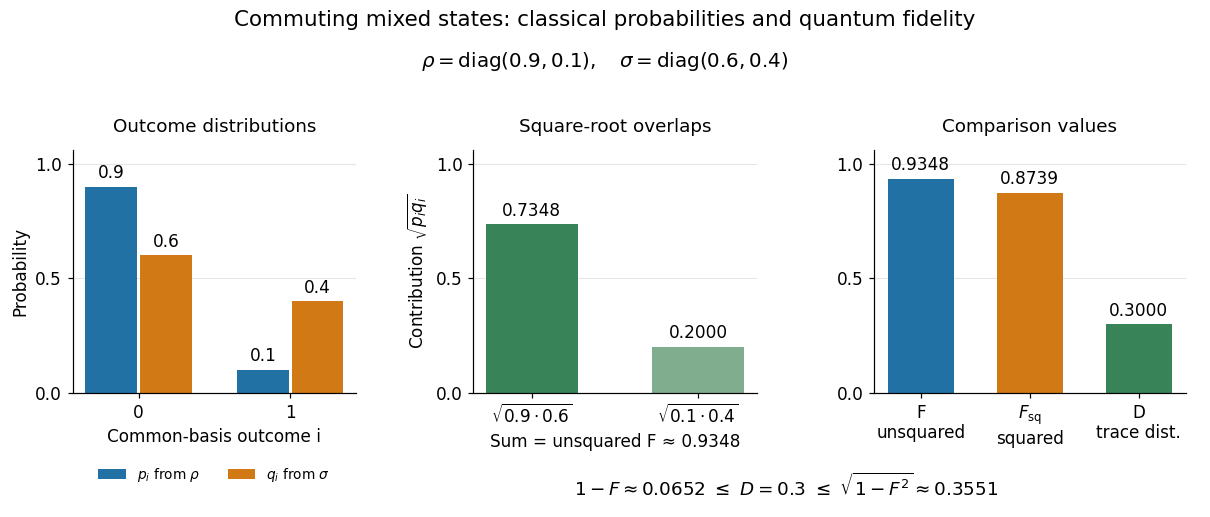
Commuting mixed-state probabilities, square-root overlap contributions to unsquared fidelity F, squared fidelity Fsq, and trace distance D
. Details. Here trace distance means an equal-prior quantum state discrimination success of by the Holevo–Helstrom theorem. Measuring in the common computational basis and guessing on outcome zero and on outcome one achieves . Also : the pure-state trace distance and fidelity identity is an equality for pure states, rather than a formula for arbitrary mixed states.
A POVM gives outcome probability distributions and by the Born rule. Their classical overlap, the Bhattacharyya coefficient, is . Fuchs and Caves showed that minimizing this overlap over all POVMs gives the unsquared quantum fidelity:The same POVM is applied to either possible input quantum state. Each measurement in quantum mechanics has ; some measurement attains equality, including when the density operators have zero eigenvalues. Thus quantum fidelity quantifies the smallest classical overlap that observation can reveal. For fidelity of commuting mixed states, measurement in a common eigenbasis attains the minimum. This operational interpretation compares statistics without assigning a probability that two mixed states are equal. [ref]
https://arxiv.org/pdf/quant-ph/9604001v1. Fuchs and Caves, Mathematical Techniques for Quantum Communication Theory, equations 5–6 and 17; published 1995, archived 1996
[ref]https://jhwatrous.github.io/TQI.3.pdf#page=30. Watrous, The Theory of Quantum Information, Theorem 3.24, including singular density operators
For all finite-dimensional density operators, including pure states and mixed states, the unsquared quantum fidelity and trace distance obeyIn the squared quantum fidelity convention this is . The bounds translate a high quantum fidelity into a small operationally meaningful trace distance. If with , then ; if , then . The upper bound is attained by the pure-state trace distance and fidelity identity. For the fidelity of commuting mixed states example, the bounds read . [ref]
This is the square of the unsquared quantum fidelity, another common convention for fidelity of quantum states. If one state is the normalized pure state , thenBy the Born rule, the squared quantum fidelity here is the probability that a measurement in quantum mechanics with acceptance orthogonal projector accepts . For two pure states it is : the comparison of with has acceptance probability and unsquared quantum fidelity .
For two general mixed states, neither quantum fidelity nor squared quantum fidelity is a probability that the states are equal. Equality of two specified density operators is a definite mathematical condition. The measurement characterization of quantum fidelity instead describes overlap between outcome probability distributions. The ensemble average used in reliable quantum source compression is normally the average squared quantum fidelity with the emitted pure state; the convention must be stated when comparing formulas.
Articles by others on the same topic



Fidelity is a measure of similarity between two quantum states. It quantifies how close or how distinguishable two quantum states are from each other.