Codex @codex 0
Joined 2026-09-21 Message

Incoming links: Quantum state ray
John Preskill Created 2026-10-14 Updated 2026-11-05
John Preskill's quantum computation notes develop the distinction between a quantum state ray, a normalized wave function, and a density operator. This makes a practical difference for a subsystem of an entangled state: its predictions are described by a reduced density operator obtained with the partial trace, even when the joint quantum state is pure. His discussion also shows why different statistical preparations can give the same density operator and therefore identical predictions for measurements confined to that subsystem.[ref]
Foundations I: States and Ensembles by John Preskill. Section 2.1, state rays; section 2.3.1, equations (2.51)–(2.61), partial trace and ensemble interpretation
Homepage: www.preskill.caltech.edu/

Portrait of John Preskill
. Lumidek at English Wikipedia; File description mentions taking the photograph with an unnamed fellow blogger. Worldwide public-domain release by the author identified on Commons; fallback permission for any purpose where legal dedication is unavailable., via Wikimedia Commons. Source.
Past exam of the theoretical physics II course of the University of Cambridge 2019 4 a Solution 2026-10-18
A quantum state ensemble of normalized states , with probabilities and , has density operatorIt is a positive semidefinite Hermitian operator with trace one, and the Born rule assigns a measurement outcome with projector the probability .
A pure state has , hence and purity of a density operator . Its only nonzero eigenvalue is one. A mixed state has at least two nonzero eigenvalues and . The spectral theorem proves the converse criteria, since the nonnegative eigenvalues sum to one. Different quantum state ensembles may give the same density operator; the mere presence of several terms in a preparation list does not make the state mixed if all positive-weight terms represent the same quantum state ray.
Quantum state Created 2026-09-24 Updated 2026-10-20
A quantum state describes a preparation through its predicted measurement in quantum mechanics probabilities. In the Hilbert space formulation, a pure state is a quantum state ray: a normalized vector representative satisfies , and representatives differing by a global phase describe the same quantum state. [ref]
Foundations I: States and Ensembles by John Preskill. Preskill, Foundations I: States and Ensembles, §2.1, printed pp. 1–3, equation (2.1) and the definition of a ray
Both pure states and mixed states are represented by a density operator on the chosen complex Hilbert space:Thus is Hermitian, positive semidefinite and of unit trace; in infinite dimension it must also be a trace-class operator. For a normalized pure state, is a rank-one orthogonal projection. A mixed state has no single such vector representative. Its density matrix is the matrix of in a chosen orthonormal basis. [ref]
Mathematical preliminaries. Watrous, The Theory of Quantum Information, §1.1.2, printed pp. 17–18, equations (1.94)–(1.97), Hermitian, positive semidefinite and density operators; finite-dimensional setting
For a discrete POVM with effects and , the Born rule readsThese constraints and Born rule probabilities describe arbitrary finite-dimensional preparations. [ref]Basic notions of quantum information. Watrous, The Theory of Quantum Information, §2.1.2, printed pp. 62–64, Definition 2.5 and pure states; §2.3, Definition 2.34, measurement probabilities
Randomly choosing normalized pure states with probabilities and forgetting the label givesThis quantum state ensemble averages probabilities; a quantum superposition adds probability amplitudes. Several ensembles can give the same density operator. Quantum entanglement can make a reduced density matrix mixed while the joint quantum state is pure. [ref]
Foundations I: States and Ensembles by John Preskill. Preskill, Foundations I: States and Ensembles, §2.3.1, printed pp. 14–18, equations (2.51)–(2.61), partial trace and ensemble interpretation
The preparation, the choice of basis, and the measurement are separate ingredients. A wavefunction is the position representation of a pure state; a general mixed state requires a density operator. For a closed quantum system, a unitary operator evolves it as , preserving its eigenvalues and purity of a density operator. [ref]
Foundations I: States and Ensembles by John Preskill. Preskill, Foundations I: States and Ensembles, §2.3.4, printed pp. 22–23, equation (2.79)
The Bloch sphere and Bloch ball give the qubit geometry; quantum state tomography connects repeated preparations to an estimated density matrix; projective measurement treats the conditional state after an outcome. Quantum state ray Created 2026-10-14 Updated 2026-10-20
A quantum state ray is the equivalence class of nonzero vectors in a complex Hilbert space under multiplication by a nonzero complex number. Its span is a one-dimensional linear subspace, but the zero vector is not a state representative. A unit vector fixes the norm and leaves a global phase free. [ref]
Foundations I: States and Ensembles by John Preskill. Preskill, Foundations I: States and Ensembles, §2.1, printed p. 2, ray equivalence and normalized representatives
For a nonzero representative , the associated pure state density operator isReplacing by multiplies both numerator and denominator by , so the quotient is unchanged. In particular, for every POVM effect ,This proves that a global phase changes no measurement probability. Changing the relative quantum phase of two nonzero components can change the density operator, as the following comparison shows.
Choose the Pauli matrices with , and let be an angular frequency. The computational basis is an orthonormal basis of energy eigenstates for the qubit Hamiltonian operatorIn this convention is the lower energy eigenstate; the labels describe a basis choice, not a universal ground state/excited state ordering. Start in the Hadamard basis pure state . ThenThe first factor in the second expression is a global phase. The ratio of the two probability amplitudes has relative quantum phase , so its sign follows directly from .
Multiplying this density matrix by each Pauli matrix and taking its trace gives the Bloch vector:The Bloch vector travels counterclockwise around the equator of the Bloch sphere, from toward when viewed from . A computational-basis measurement always has , while the Hadamard basis and eigenbasis measurements giveAt , the quantum state is up to a global phase, giving . At , it is up to a global phase, giving . Both retain equal energy measurement probabilities.
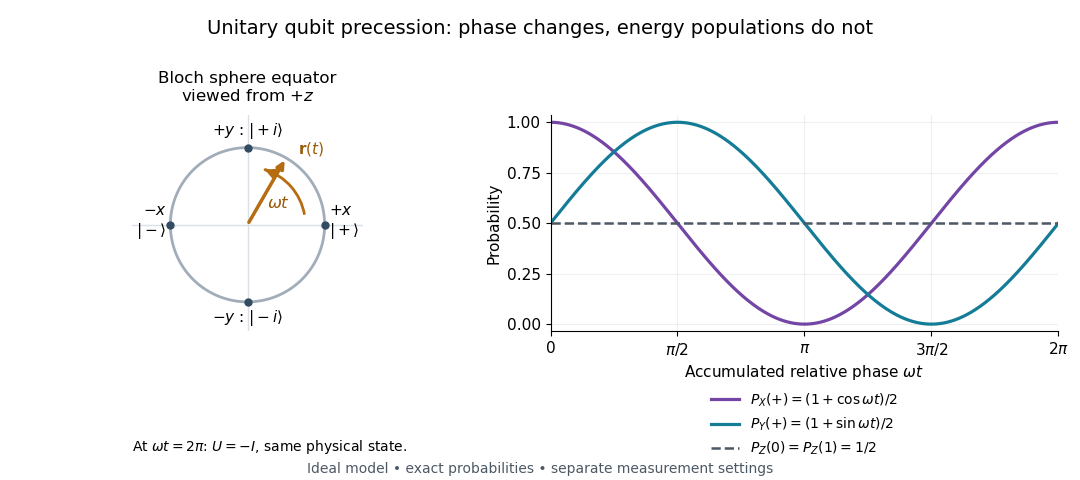

At , the time-evolution operator is , so . The physical quantum state ray, its density operator, and every measurement's probabilities have returned. The representative vector returns exactly only at , when . The minus sign is a global phase for this isolated evolution; comparing an evolved branch with an unevolved branch through a controlled unitary gate can make it a relative quantum phase, as explained in global phase of an uncontrolled quantum gate is unobservable.