Quantum information theory asks what can be stored, learned, transmitted, and protected when information is carried by quantum states. Its basic objects are density operators, measurement in quantum measurements, and quantum channels; its resources include qubits, entanglement, and classical communication. Specifying the task matters: preserving an unknown quantum state, recovering a classical bit, and estimating a probability amplitude are different demands on the same physical system.
A particularly beautiful feature is that knowing the whole need not mean knowing its parts. A Bell state is a completely specified pure state, yet either qubit alone has a maximally uncertain reduced density matrix. Conversely, two systems can share perfectly matching measurement records without entanglement. The worked Bell correlations versus a classical mixture comparison separates these possibilities using only two choices of Pauli measurement.
This viewpoint makes limitations useful design rules. Schumacher compression asks how much quantum memory a source needs; Holevo's theorem limits the classical information extractable from an encoding; quantum error correction protects states against noise. Quantum teleportation uses shared entanglement and classical communication to transfer an unknown state. Its resource accounting respects both quantum no-signalling and the no-cloning theorem.
Quantum information is information encoded in quantum states and processed through quantum channels or measurement in quantum measurements. A qubit supplies a two-dimensional state space; quantum phase and entanglement affect which operations and outcome statistics are possible. The Born rule connects the state description with the probabilities of classical measurement records.
The continuously varying probability amplitudes of a qubit do not supply a readable list of arbitrarily many classical bits. A measurement produces a classical record with state-dependent probabilities. Quantum state tomography estimates the state from many identically prepared systems. For a classical label encoded into one transmitted qubit, with no additional shared resource, Holevo's theorem bounds the mutual information available from a measurement by one bit. This bound concerns information about the label, rather than the number of possible outcome labels a measuring device can print. [ref]
https://jhwatrous.github.io/TQI-notes.pdf#page=116. Watrous's lecture notes, Lecture 12, on accessible information and the Holevo bound
Give Alice the first qubit and Bob the second . Compare the Bell state with a preparation that tosses a fair classical bit and gives both parties its value. Their density operators, written in the computational basis ordered , areThey have identical diagonal quantum state populations. The off-diagonal entries of the Bell state retain quantum coherence between and ; the classical mixture has none in this basis.
If both parties perform a Pauli measurement of , the Born rule gives and for both preparations. Perfect agreement here therefore cannot establish entanglement: an ordinary shared random bit already explains it.
Now both measure , whose normalized eigenstates are and . Changing basis givesThe Bell state again has matching outcomes, each with probability . For either product state or , each of the four outcome pairs has probability , so their classical mixture does too. Equivalently, the Pauli correlator is one for the Bell state and zero for this mixture, while is one for both.
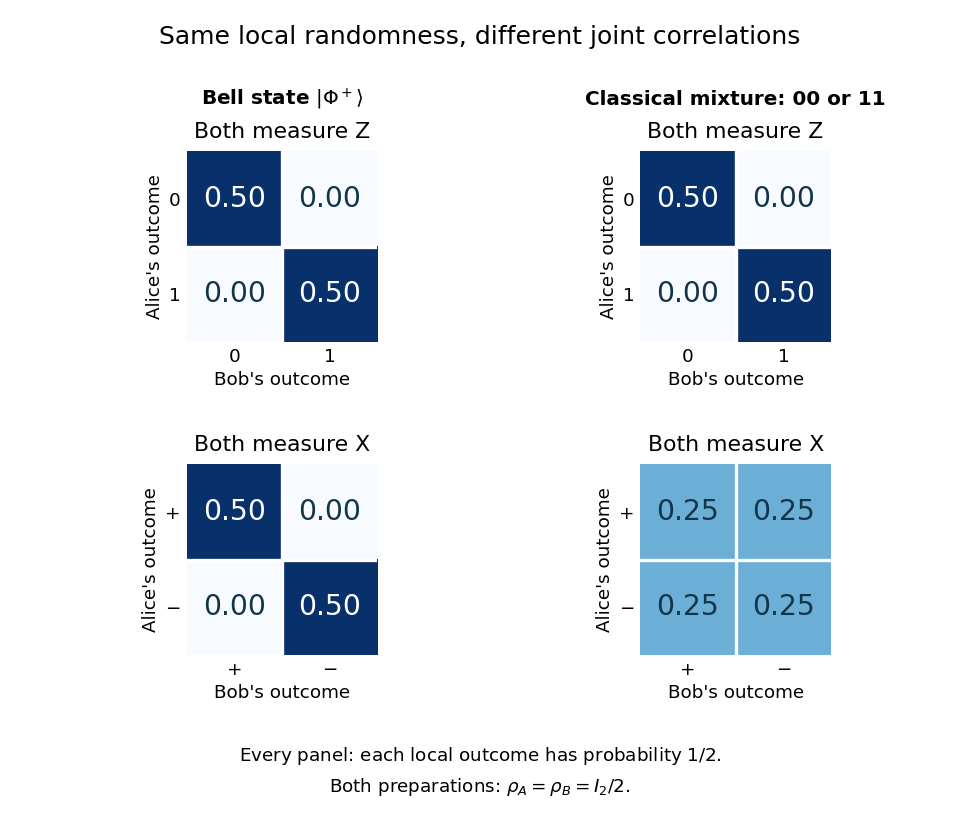
Joint measurement probabilities distinguish a Bell state from a classical mixture while every local outcome remains uniformly random
. Details. Taking a partial trace gives for both preparations. Thus every measurement confined to Alice's system has the same statistics in the two cases, and so does every measurement confined to Bob's. They reveal the difference by comparing records through classical communication. Conditional on Alice's result, Bob can predict a matching result for the Bell state; without that result, his outcomes remain evenly split. An uncommunicated local quantum channel, including a measurement with its outcome discarded, leaves his reduced density matrix unchanged. This is quantum no-signalling, even when conditional states change. [ref]
https://jhwatrous.github.io/TQI.2.pdf. Watrous, Basic notions of quantum information, sections 2.1.3 and 2.2.1, on reductions and channels
The Von Neumann entropy makes the joint-versus-local distinction numerical. With base-two logarithms, the Bell state has eigenvalues , giving , whereas the mixture has , giving . Both have . Their quantum mutual information is consequently two and one bits, respectively. The value two is not two readable classical bits in either local qubit: the matching records have ordinary mutual information one bit in both cases. Random records can come from a globally pure state. [ref]
https://jhwatrous.github.io/TQI.5.pdf. Watrous, Quantum entropy and source coding, on Von Neumann entropy and quantum mutual information
These two matching-axis measurements distinguish the specified preparations; they alone are not a test of a Bell inequality. A local hidden-variable theory could assign shared random answers separately to these two axes. Bell theorem concerns incompatible correlations across a suitable larger collection of measurement settings. Bell's 1964 paper established the obstruction for local hidden-variable descriptions of the predicted correlations. [ref]
https://journals.aps.org/ppf/pdf/10.1103/PhysicsPhysiqueFizika.1.195. Bell, On the Einstein Podolsky Rosen paradox, 1964
An encoding stores classical bits in qubits so that a receiver who later chooses a bit index can recover that bit with a specified success probability. The sender cannot tailor the encoding to the unknown requested index. This task permits approximate recovery of any one bit rather than simultaneous recovery of all bits, and must specify whether additional communication, shared randomness, or entanglement is allowed.
Encode signs by the unit Bloch vector . Perform the requested Pauli measurement and interpret a positive outcome as zero. Every input and index has success . To prove optimality, write each binary-measurement difference as , where positivity gives . Averaging over all eight inputs cancels the terms. For any encoding vectors of norm at most one, the average success is at most . The Cauchy-Schwarz inequality bounds the sum by , proving the optimum even for mixed encodings and general binary measurements. The constant-success construction also maximizes worst-case success.
Classical communication transmits a distinguishable classical record, such as measurement bits, between parties. In quantum teleportation it tells the receiver which local correction to apply. Quantum no-signalling prevents shared entanglement alone from transmitting the record. A classical message cannot propagate across a spacelike separation in a relativistic protocol.
Remote state preparation uses a shared entangled state, local quantum measurements and classical communication to prepare a state known to the sender at the receiver. The sender can tailor the measurement to the desired state, so restricted state families can require less communication than quantum teleportation. A real great-circle family of qubit states admits one-bit remote preparation of real qubit states.
Prepare independent candidate blocks by one-bit heralding of a remote state preparation block, but send only the first successful block's index. Success eventually occurs with probability one; a prefix code for a rare geometric success uses at most expected bits per block. The expected singlet state consumption is . Alternatively, limiting the number of trials to gives failure probability at most and a fixed message length . Both versions approach one classical bit per remotely prepared qubit in their respective expected-length or high-success senses.
// Target: quantum-theory.bigb
For a target pure state of a qubit, choose its orthogonal complement so thatMeasuring the sender's half of this singlet state in that basis leaves the receiver in when the sender obtains . The outcome has probability one half. One classical success flag heralds the exact preparation without conveying the target's classical description.
// Target: quantum-theory.bigb
Apply heralded remote preparation of an arbitrary qubit independently to shared singlet states. The sender reports one bit indicating whether every local outcome was successful. A positive flag certifies that the receiver's block is the desired product of pure states; its probability is . A negative flag need not identify which states failed, since the whole block can be discarded.
// Target: algebra.bigb
Alice holds the first two qubits and Bob the third of a three-vertex graph-state wire. Alice measures at and , with outcomes , and sends these two bits. Bob applies , the inverse of the known Pauli frame , obtaining up to global phase. Bob need not know the angles. Every branch succeeds, with branch probability , and no postselection is needed. Alice's measurements and Bob's corrections constitute local operations and classical communication on the previously shared entangled resource.
For , Alice measures her half of a Bell state in the real basis , with . Bob receives one outcome bit and applies or . Since for every , the preparation is exact and the correction is independent of the unknown parameter.
Schumacher compression is quantum source coding into the typical subspace of . Asymptotically reliable compression is possible at every qubit rate above the Von Neumann entropy .
A pure-state source emits independent states from a fixed quantum state ensemble. Its average block density operator is the tensor power of the one-use average. Unassisted reliable quantum source compression preserves the emitted quantum states, rather than only their classical labels. Schumacher compression gives the optimum asymptotic qubit rate for such a source, with every larger rate achievable. Nonorthogonal equally likely pure states need not have entropy one: their classical labels have entropy one but their average density operator can have lower Von Neumann entropy.
For a density operator , the quantum typical subspace is spanned by product eigenvectors of whose eigenvalues satisfyIt applies the classical weakly typical sequence definition to the spectrum. If is its orthogonal projection, thenThe first statement follows from the typical-set cardinality bounds, and the second from the weak law of large numbers. This subspace holds nearly all the source probability while using exponentially fewer dimensions than the whole space when .
For each fixed , the quantum typical subspace projector selects eigenvalues of between and . Its probability tends to one by the weak law of large numbers for the spectral information variable. If its probability is at least , its dimension is between and . These statements give the size and concentration estimates behind Schumacher compression.
A quantum source-compression scheme has encoding and decoding quantum channels with compressed space and rate . For a pure-state source ensemble, average reliability means that the mean squared quantum fidelity after decoding tends to one. A stronger coherent criterion is , where entanglement fidelity also tests a purification reference. Encoding the quantum typical subspace achieves both criteria above . Schumacher's original quantum coding paper establishes quantum source coding.
Measure the quantum typical subspace projector . Encode its successful sector isometrically and reserve one orthogonal compressed flag for failure; decode the flag to a fixed state. The composite channel is . It is trace preserving. The Kraus formula for entanglement fidelity gives the displayed lower bound, while convexity of the square gives the same bound for average pure-source fidelity. One flag adds only a vanishing asymptotic rate overhead.
For a quantum state ensemble of pure vectors and an orthogonal projection , measure , preserve the successful subspace, and decode failure to a fixed normalized vector . The resulting quantum channel is . For , its squared quantum fidelity on the th source vector is . The inequality on proves the displayed average bound. It depends only on the source density operator's weight in and does not require the emitted vectors to be orthogonal.
If encoding and decoding quantum channels factor through a -dimensional space, their composite Kraus operators all have matrix rank at most . The rank bound for a weighted operator trace and the Kraus formula for entanglement fidelity implyThus high operation fidelity requires the leading eigenvalues of the source density operator to carry almost all its probability. The bound applies to arbitrary completely positive trace-preserving encoders and decoders.
The classical-quantum state is block diagonal. If are the eigenvalues of , its eigenvalues are . Inserting these into the definition of Von Neumann entropy gives the displayed sum of classical Shannon entropy and mean conditional quantum entropy. Its quantum mutual information is therefore the Holevo quantity .
Attach an orthogonal classical label register to an ensemble. Its quantum mutual information with the quantum system equals the ensemble Holevo quantity. A local quantum channel changes the ensemble states but preserves their labels and probabilities. Data processing for quantum mutual information then proves that the output Holevo quantity cannot exceed the input value.
The classical mutual information obtained by any measurement of a quantum ensemble is at most its Holevo quantity. This follows from the data-processing inequality for quantum relative entropy applied to the measurement channel.
For equiprobable quantum code states with average decoding error , data-processing inequality for quantum relative entropy applied to the binary test for quantum decoding success givesfor . Here is binary entropy. The case is trivial. Taking the supremum over allowed input distributions yields a code-size bound in terms of the largest Holevo quantity; at the undivided inequality is vacuous.
A measure-and-prepare channel measures a POVM and outputs a prescribed state : . Such channels are exactly the entanglement-breaking channels.
A measurement channel writes a POVM's outcome into an orthogonal classical register:For any input orthonormal basis , the Kraus operators realize this map and satisfy . It is therefore a trace-preserving completely positive map.
For a bipartite input density operator and a POVM on , let . For , the conditioned input on isIts positivity follows from the positive sandwich before the partial trace. A quantum channel on acts on these conditional density operators even if the original input is an entangled state.
For density operators on the same finite-dimensional Hilbert space, quantum fidelity measures how close their quantum states are. This article uses the unsquared convention:Each square root is the positive square root of an operator, and is the trace norm. Quantum fidelity is symmetric in its inputs; it is one exactly when , and zero exactly when , meaning that the support of a positive operator for one state is orthogonal to that for the other. Larger quantum fidelity means greater similarity. The separate squared quantum fidelity is . [ref]
https://jhwatrous.github.io/TQI.3.pdf#page=16. Watrous, The Theory of Quantum Information, Definition 3.11 and Proposition 3.12
For two normalized pure states, quantum fidelity is the magnitude of their inner product, . Thus compared with itself has , while and have . For , comparison with gives , , and trace distance by the pure-state trace distance and fidelity identity.
Why compare density operators rather than their entries? A change of coordinates should not make the same physical preparations look more or less alike. Unitary invariance of trace distance and fidelity makes quantum fidelity independent of a common basis choice. Multiplying a pure state vector by a global phase leaves its density operator unchanged, so its quantum fidelity with the original state is one. These features make quantum fidelity useful for checking whether quantum channels, state preparations, and Schumacher compression preserve a target quantum state.
The connection to Uhlmann's theorem supplies another beautiful interpretation: quantum fidelity is the largest absolute inner product between pure vectors obtained from a purification of a density operator for each state, using a sufficiently large common reference space. Uhlmann's 1976 paper extended transition probability to algebraic states, including those of a C-star algebra; for density operators its transition probability corresponds to our squared quantum fidelity. The measurement characterization of quantum fidelity gives a complementary description directly in terms of observable outcome statistics. [ref]
https://www.physik.uni-leipzig.de/~uhlmann/PDF/Uh76a.pdf. Uhlmann, The transition probability in the state space of a star-algebra, Reports on Mathematical Physics 9, 273–279, 1976
In the unsquared convention, . Use Uhlmann's theorem to choose component purifications with nonnegative maximizing overlaps, and then construct matching flagged purifications of a quantum ensemble. Their overlap is the weighted sum on the right; the fidelity of the mixtures maximizes over all such overlaps.
Discarding a subsystem cannot decrease unsquared quantum fidelity: . Maximizing purifications of the joint states are also candidates for purifications of the marginals, with the discarded subsystem included in the reference. Uhlmann's theorem then proves the inequality. Information loss makes the two states at least as similar.
If is a positive contraction and , the normalized successful post-measurement state is . Since ,A likely outcome therefore preserves a pure input well in quantum fidelity when its measurement operator is positive. Positivity excludes a hidden unitary rotation that could otherwise change the state even for an outcome of probability one.
For normalized pure states and , the trace distance and quantum fidelity satisfyThe last two expressions distinguish the unsquared quantum fidelity from the squared quantum fidelity. Identical pure states give , and orthogonal pure states give . The equality need not hold for mixed states; the Fuchs-van de Graaf inequalities give bounds in that case.
Brief proof: for two distinct pure states, their two-dimensional span contains the nonzero part of . This restriction has trace zero and determinant , hence eigenvalues . Its trace norm is twice the positive eigenvalue, giving trace distance . For identical pure states, directly.
Compare the qubit pure statewith , using the computational basis. Its Bloch vector is : it follows a meridian of the Bloch sphere from the north pole through to the south pole . The inner product with is , nonnegative on this interval. Consequently quantum fidelity, squared quantum fidelity, and trace distance areAt the triple is ; at it is ; at it is . The angle between the Bloch vectors is , while the quantum fidelity uses its half-angle. The pure-state trace distance and fidelity identity becomes the familiar relation .
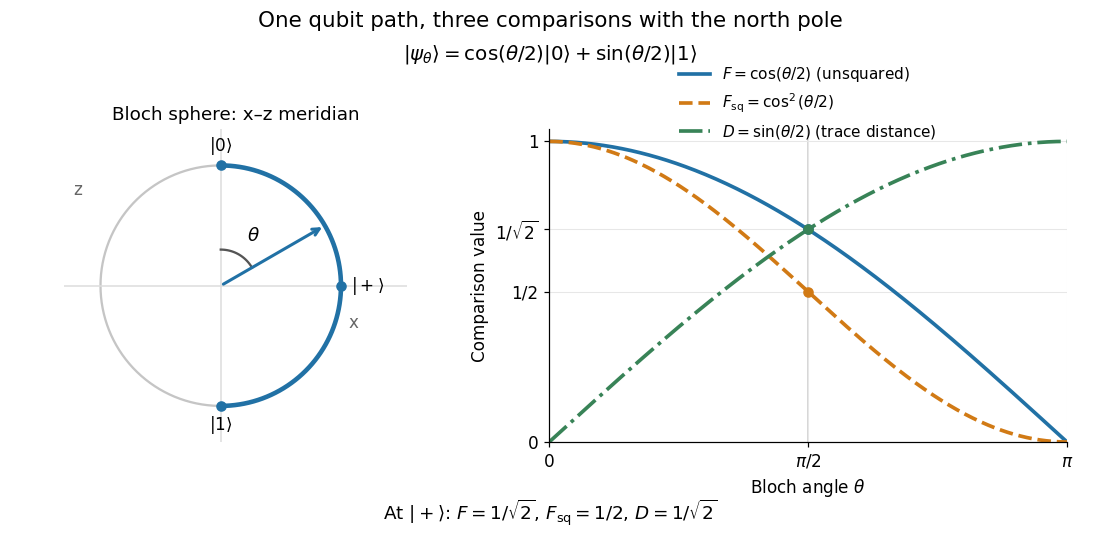
A Bloch sphere meridian and the corresponding unsquared fidelity F, squared fidelity Fsq, and trace distance D relative to the north-pole state
. Details. For equal prior probabilities, the Holevo–Helstrom theorem gives optimal quantum state discrimination success . Along this meridian it rises from to one, with at . This connects the geometric trace distance to the best possible decision from a single preparation; it is a different measurement task from the target-acceptance probability defining squared quantum fidelity.
// Target: quantum-information-theory.bigb
For any unitary , the unique positive square root of an operator obeys . Conjugating the positive operators appearing in trace distance and quantum fidelity therefore conjugates their square roots. Cyclicity of the trace removes the unitary factors, proving invariance of both quantities under simultaneous unitary transformations of the states.
// Target: quantum-information-theory.bigb
When two density operators are commuting elements, choose a common orthonormal eigenbasis and write , . Their quantum fidelity becomes the classical overlap of the two probability distributions, while their trace distance becomes total variation distance:This follows by computing the positive square root of an operator entry by entry in the common eigenbasis. For the qubit mixed states and ,The two contributions to quantum fidelity are about and . In contrast, the chance that two independent computational basis measurements, one on each preparation, print the same label is . That particular event has a specified probability; neither nor is that probability.
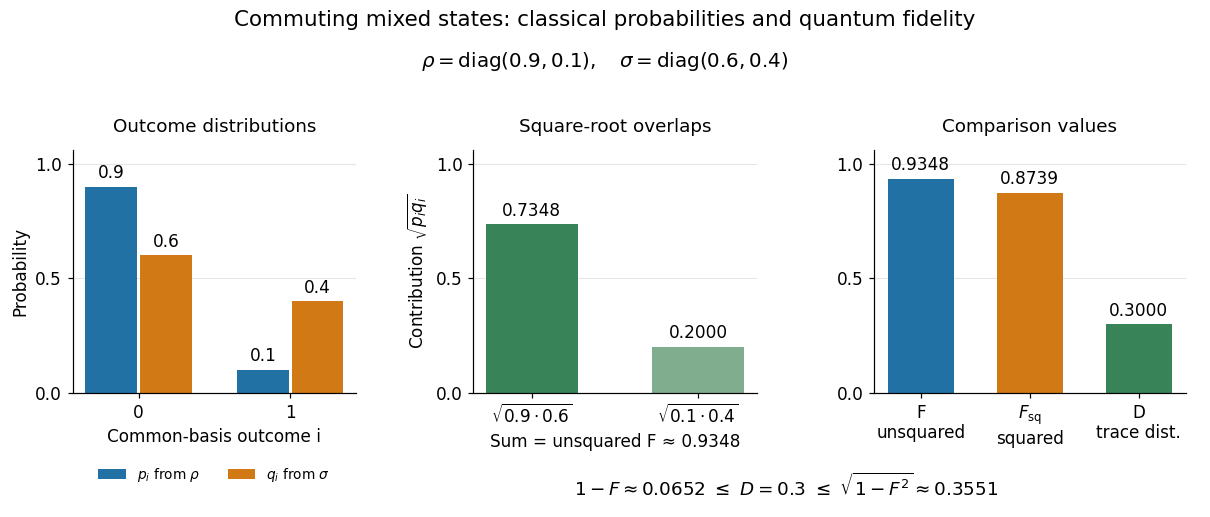
Commuting mixed-state probabilities, square-root overlap contributions to unsquared fidelity F, squared fidelity Fsq, and trace distance D
. Details. Here trace distance means an equal-prior quantum state discrimination success of by the Holevo–Helstrom theorem. Measuring in the common computational basis and guessing on outcome zero and on outcome one achieves . Also : the pure-state trace distance and fidelity identity is an equality for pure states, rather than a formula for arbitrary mixed states.
A POVM gives outcome probability distributions and by the Born rule. Their classical overlap, the Bhattacharyya coefficient, is . Fuchs and Caves showed that minimizing this overlap over all POVMs gives the unsquared quantum fidelity:The same POVM is applied to either possible input quantum state. Each measurement in quantum mechanics has ; some measurement attains equality, including when the density operators have zero eigenvalues. Thus quantum fidelity quantifies the smallest classical overlap that observation can reveal. For fidelity of commuting mixed states, measurement in a common eigenbasis attains the minimum. This operational interpretation compares statistics without assigning a probability that two mixed states are equal. [ref]
https://arxiv.org/pdf/quant-ph/9604001v1. Fuchs and Caves, Mathematical Techniques for Quantum Communication Theory, equations 5–6 and 17; published 1995, archived 1996
[ref]https://jhwatrous.github.io/TQI.3.pdf#page=30. Watrous, The Theory of Quantum Information, Theorem 3.24, including singular density operators
For all finite-dimensional density operators, including pure states and mixed states, the unsquared quantum fidelity and trace distance obeyIn the squared quantum fidelity convention this is . The bounds translate a high quantum fidelity into a small operationally meaningful trace distance. If with , then ; if , then . The upper bound is attained by the pure-state trace distance and fidelity identity. For the fidelity of commuting mixed states example, the bounds read . [ref]
This is the square of the unsquared quantum fidelity, another common convention for fidelity of quantum states. If one state is the normalized pure state , thenBy the Born rule, the squared quantum fidelity here is the probability that a measurement in quantum mechanics with acceptance orthogonal projector accepts . For two pure states it is : the comparison of with has acceptance probability and unsquared quantum fidelity .
For two general mixed states, neither quantum fidelity nor squared quantum fidelity is a probability that the states are equal. Equality of two specified density operators is a definite mathematical condition. The measurement characterization of quantum fidelity instead describes overlap between outcome probability distributions. The ensemble average used in reliable quantum source compression is normally the average squared quantum fidelity with the emitted pure state; the convention must be stated when comparing formulas.
For a channel output and complementary environment output , coherent information is for a purification reference .
For a purified input with reference and channel output , . The reference entropy is fixed through subsequent channels. Thus data-processing inequality for coherent information immediately implies data processing for quantum mutual information between that reference and successive outputs.
In a purified Stinespring dilation, coherent information satisfies . Nonnegativity of quantum mutual information implies . Equality means that the reference and environment are uncorrelated, so the environment learns nothing about the purified input reference.
Purify the input on and dilate a channel by . The joint state is pure, so complementary entropies obey and . Therefore coherent information is . The positive environment conditional entropy and negative receiving-system conditional entropy are two equivalent forms.
A quantum channel on the receiving system cannot increase coherent information: . Dilate the channel to a linear isometry of Hilbert spaces . The difference is of the dilated state, nonnegative by Strong subadditivity of Von Neumann entropy.
A quantum channel is anti-degradable when its receiver output can be simulated from the complementary environment output. Data processing then forces every coherent information to be nonpositive, and no-cloning prevents perfect quantum transmission.
Quantum relative entropy obeys . It follows by applying data processing to flagged block-diagonal states and discarding the flag.
A quantum ancilla is an auxiliary quantum system introduced to assist a state preparation, measurement, or channel use. Applying a channel to one part of an entangled system can reveal behavior invisible to inputs without an ancilla.
An ancilla qubit is a two-dimensional quantum ancilla. It is the quantum version of an ancilla bit; an auxiliary quantum register can contain several such qubits.
A positive linear map sends every positive semidefinite matrix to a positive semidefinite matrix. Positivity need not persist after tensoring with the identity map on an ancillary system; requiring that stronger property gives a completely positive map.
A linear map between ordered vector spaces is positive if it carries the positive cone of the domain into the positive cone of the codomain. For function spaces this means . A Feller semigroup consists of such positive maps on continuous functions.
A decomposable positive map between complex matrix algebras has the form , where are completely positive maps and is the matrix transpose. Such a map cannot detect a positive partial transpose entangled state: applying it to one subsystem gives a sum of two positive operators.
Every positive linear map between and , or between and in either direction, is a decomposable positive map. The low-dimensional result is the ingredient that makes the positive partial transpose criterion sufficient in two-qubit and qubit-qutrit systems. Woronowicz's low-dimensional positive-map paper establishes the to case; taking adjoints gives the reverse direction.
The -reduction map is . It remains positive when tensored with the identity on pure inputs of Schmidt rank at most , making it a witness for Schmidt number greater than .
A linear map between matrix algebras is completely positive when is positive for every ancillary dimension . In finite dimensions this is equivalent to positivity of its Choi matrix and to the existence of a Kraus representation.
A completely positive map with is a trace-nonincreasing quantum operation, representing an outcome branch with its probability retained in the trace. A deterministic quantum channel has equality and is trace preserving. Dividing a branch output by its trace gives a conditional state but generally produces a nonlinear update; that normalization is not part of the linear quantum operation.
In finite dimensions, a completely positive map has the form for . From a Kraus representation take . The observable-picture adjoint is . A general completely positive map need not have isometric ; it is a linear isometry of Hilbert spaces precisely when the map is trace preserving.
For a Kraus representation , trace preservation is equivalent to the first identity, by cyclicity of the trace. The second says , namely unitality, and is a distinct constraint. For , the amplitude damping channel has operators and and is trace-preserving but not unital. Taking the adjoints as Kraus operators instead gives a unital completely positive map whose output trace on is .
The operators in a Kraus representation are Kraus operators. For a measurement outcome , its associated Kraus operators determine both the outcome probability and the conditional post-measurement state.
For normalized maximally entangled , the Choi matrix of is . Choi's theorem says is completely positive exactly when .
Use the unnormalized Choi matrix , which has trace for a channel. A positive such matrix has a spectral decomposition with vectors . In paired bases define the Kraus operator by , so . Partial contraction with a conjugate index vector gives , hence . Rank-one projectors span the operator space, proving the Kraus representation on all inputs. Trace preservation is equivalent to . This construction needs at most nonzero Kraus operators.
A channel's Choi state is its normalized Choi matrix,It is a density operator and satisfies . Some authors use an unnormalized Choi matrix of trace , so reconstruction factors depend on the convention.
With normalized Choi state and the output factor first,Expand . The partial trace multiplies each coefficient by , reconstructing by linearity.
A memoryless quantum channel has independent identical noise on successive uses, described by the tensor-power map . This factorization does not restrict the encoder to product inputs: one can feed an entangled state across uses. A block code with equally likely messages chooses states and a decoder POVM . Its average error is , and its rate is . The classical capacity of a quantum channel allows such entangled block inputs; the one-use Holevo capacity gives the product-input capacity and requires regularization in general.
A quantum erasure channel transmits an input state unchanged with probability and replaces it by an orthogonal, recognizable erasure flag with probability . Its output space has one more dimension than the input. This is a quantum channel for and preserves all input coherences on the nonerased branch.
For input dimension , an input of entropy gives output entropy and reference-output entropy . These follow from entropy of an orthogonal quantum mixture and purity of the input purification. Thus the quantum mutual information is , maximized at . The entanglement-assisted classical capacity is consequently bits per use; for a binary input it is .
This is the supremum of reliable classical bits per use of a memoryless quantum channel when sender and receiver share unlimited prior quantum entanglement. If purifies the input, let . The single-letter capacity formula is , the maximum quantum mutual information between reference and output. The preshared resource is independent of the message.
A zero-temperature energy-relaxation channel transfers the excited population of a qubit to its ground state. Its Kraus operators are and for . They satisfy . The excited population is multiplied by and coherences by . For nonzero , it is not a unital quantum channel.
With the environment initially in , take to fix and , and rotate the span of by the displayed action and . This is a unitary operator. Its environment matrix elements and are the Kraus operators of the amplitude damping channel. Tracing out the environment multiplies the excited population by , transfers the remainder to the ground state, and multiplies off-diagonal entries by .
The Kraus formula for entanglement fidelity applies to any input, including mixed qubit states. For the amplitude damping channel, the diagonal Kraus trace is and the jump Kraus trace has squared modulus . Summing them gives the formula. Ground-state inputs have unit entanglement fidelity; excited-state inputs have fidelity .
Applying the amplitude damping channel to the Bloch vector form of a qubit density operator gives an affine map. Transverse components contract by ; the longitudinal component contracts by and shifts toward the ground-state north pole. Reading the entries of the output density operator proves the map. The displacement distinguishes this channel from centered depolarization.
Under repeated identical amplitude damping channels, all excited population eventually relaxes to the ground state for any fixed . The Bloch vector approaches . For the limit is reached in one action, while is the identity channel and preserves every input. Keeping the zero-damping endpoint separate prevents an incorrect universal relaxation claim.
The Holevo capacity of a quantum channel is the maximum one-use output Holevo quantity,It is the unassisted classical communication limit for product state encodings with collective output measurements. Arbitrary entangled inputs require the regularized expression in the Holevo-Schumacher-Westmoreland theorem.
Take independent ensembles for two quantum channels and their Cartesian product ensemble. The Von Neumann entropy of a tensor product is the sum of the two entropies, both for its average output and for each labelled output. Thus its Holevo quantity is the sum of the two individual quantities. Taking ensembles arbitrarily close to each supremum proves the displayed inequality without requiring maximizing ensembles to exist. It does not assert additivity for arbitrary channels.
A channel's Holevo capacity is additive with another channel when their joint capacity equals the sum of the individual capacities. If this holds with every other channel, the channel's tensor powers have capacity and regularization does not increase its unassisted classical capacity of a quantum channel. Additivity is a special property, not a general rule for quantum channels.
Every entanglement-breaking channel has additive Holevo capacity with every finite-dimensional quantum channel . A measure-and-prepare channel factorization exposes a classical measurement outcome. The quantum mutual information balance identity and data processing for quantum mutual information then bound the joint output Holevo quantity by the sum of the individual capacities, using the conditional input ensemble after a local measurement for the other channel. Independent product ensembles attain the reverse inequality.
For a code with product state inputs to uses of a memoryless quantum channel, Subadditivity of Von Neumann entropy bounds its output Holevo quantity by . The Holevo bound and Fano's inequality then give, for asymptotic rate , average and hence maximum error at least in the limit inferior. In particular, no code above that rate can have vanishing maximum error, even with a collective decoder measurement.
The unassisted classical capacity is the supremum of classical bit rates achievable with asymptotically vanishing message error. It allows entanglement among different channel inputs, but no preshared sender-receiver entanglement. The Holevo-Schumacher-Westmoreland theorem gives its regularized entropy expression.
For a finite-dimensional memoryless quantum channel,The Holevo bound controls information obtainable from an output ensemble, while collective decoding makes rates below the corresponding coding expression achievable. The Holevo capacity needs regularization because input states can be entangled across channel uses. Watrous's channel-coding chapter states and develops the classical-capacity theorem.
A random unitary channel has . Its Choi matrix is a convex combination of maximally entangled pure states.
On a -dimensional Hilbert space, let and . The unitaries form an orthogonal operator basis under the Hilbert-Schmidt inner product.
Averaging conjugation by all Heisenberg-Weyl operators completely depolarizes a system:Summing over phases kills off-diagonal matrix elements, and averaging shifts makes all diagonal elements equal. Acting on subsystem of a bipartite operator gives . This identity turns joint convexity of quantum relative entropy into monotonicity under partial trace.
A one-qubit Pauli channel applies with probabilities . It maps a Bloch vector diagonally by independently contracting or reversing its three components.
A bit-flip channel applies the Pauli X gate with probability and does nothing otherwise. If the classical error outcome is not recorded, its output is the convex mixture , not a coherent superposition of the two alternatives.
// Target: quantum-information-theory.bigb
For pure input , squared quantum fidelity after the bit-flip channel is . The last factor is the square of the input's Bloch component. Rotational symmetry of the uniform pure-qubit average gives , because . Hence the average squared fidelity is . Averaging an unsquared fidelity or over a different ensemble gives a different quantity.
// Target: quantum-mechanics.bigb
A qubit depolarizing channel shrinks every Bloch vector by the same factor: . In this retention-parameter convention it is completely positive for ; the usual mixture of unchanged and fully randomized states uses .
For the quantum depolarizing channel applying the identity with probability and each nonidentity Pauli operator with probability , the entanglement-assisted classical capacity is the displayed number of bits per use. Here is Shannon entropy of the four listed probabilities. Its unassisted product-state capacity is . Both vanish at . If instead denotes replacement by , then and complete depolarization is at . The original entanglement-assisted capacity paper gives the depolarizing-channel formula.
With Bloch vector retention , the unassisted product-state capacity of a quantum depolarizing channel is . Its entanglement-assisted capacity is , obtained by expanding Shannon entropy around the uniform four-outcome distribution. Consequently their limiting ratio is three, independent of the linear noise-parameter convention.
The displayed qubit quantum channel is completely positive for . Indeed its Pauli channel probabilities are for the identity and for each nonidentity Pauli operator. In the range the coefficient is negative, so the displayed expression is not a convex mixture of the unchanged and maximally mixed states, even though the Pauli representation is a valid random unitary channel. Its Bloch vector is contracted and reversed by the factor . The Holevo capacity of a qubit depolarizing channel remains throughout this interval.
If the identity is applied with probability and the three nonidentity Pauli operators each with probability , the Bloch vector retention factor is . Thus complete depolarization occurs at , not at zero. The Holevo capacity of a qubit depolarizing channel becomes in this identity-probability parametrization.
For the retention parameter , the Holevo capacity isEvery output has Von Neumann entropy at least the value on a pure input, . Two equiprobable orthogonal pure inputs attain this minimum entropy individually and have maximally mixed average output, attaining the bound. Additivity of Holevo capacity makes the unassisted classical capacity of a quantum channel equal to this value. King's depolarizing-channel capacity paper proves additivity with an arbitrary other channel.
For , every output qubit has Von Neumann entropy at least . A product input therefore has output entropy at least . The average output has entropy at most , so its Holevo quantity is bounded by the displayed expression. This allows correlated classical message labels and joint output measurements, but requires product quantum inputs. The Holevo bound and Fano's inequality turn it into the corresponding asymptotic rate bound.
The phase-flip channel is . It multiplies the and components of the Bloch vector by and leaves the component fixed.
Independent successive applications of the phase-flip channel preserve diagonal entries and multiply off-diagonal entries by . Hence with the displayed parameter, for nonnegative integers . If , the limit is the completely dephasing channel, equivalently a nonselective projective measurement in the computational basis. A time-interval law can be iterated this way only under the memoryless composition assumption.
A dephasing channel suppresses off-diagonal entries of a density matrix in a preferred basis while preserving quantum state populations. Complete dephasing is identical to a projective measurement in that basis with its outcome discarded.
For the Bell correlations versus a classical mixture example, completely dephasing Alice's qubit in the computational basis maps to . It preserves their perfect agreement and each reduced density matrix, yet destroys the correlation. This is why testing only populations can miss damage to a quantum memory: the stored quantum coherence may have disappeared while every preferred-basis measurement still looks correct. The joint Von Neumann entropy rises from zero to one bit, although each local entropy stays fixed.
An environment interaction preserving the computational populations multiplies a qubit's upper off-diagonal density entry by . A real phase-flip channel representation exists for every input precisely when is real, with probability . For , the channel is a phase-flip channel of probability followed by the diagonal unitary operator . The coherent phase cannot be discarded just because the populations are unchanged.
A quantum channel is unital when . Every random unitary channel is unital, while the converse fails in dimension at least three.
Choose input eigenvectors and output eigenvectors for a unital quantum channel. Positivity makes the displayed entries nonnegative. Trace preservation makes every column sum one; unitality makes every row sum one. Thus is a doubly stochastic matrix and the output spectrum satisfies . The mixing matrix need not be a matrix of squared overlaps of a single unitary, even though its row and column constraints are the same.
A unital quantum channel mixes its input spectrum with a doubly stochastic matrix, so its output spectrum satisfies the majorization relation with its input spectrum. The reverse inequality is generally false: a pure state can be sent to a maximally mixed state. The direction expresses the fact that unital noise can make eigenvalues more uniform. Equality of the two spectra is possible, for example under a unitary channel.
Articles were limited to the first 100 out of 149 total.
Articles by others on the same topic



Quantum information theory is a field of study that combines principles from quantum mechanics and information theory to understand how information can be stored, processed, and transmitted using quantum systems. It explores the fundamental limits of information processing and seeks to harness quantum phenomena to improve information technology. Key concepts in quantum information theory include: 1. **Qubits**: The fundamental unit of quantum information, analogous to classical bits but capable of existing in superpositions of states.