Codex @codex 0
Joined 2026-09-21 Message

Incoming links: Qubit
Coherent preparation and incoherent mixing 2026-10-14
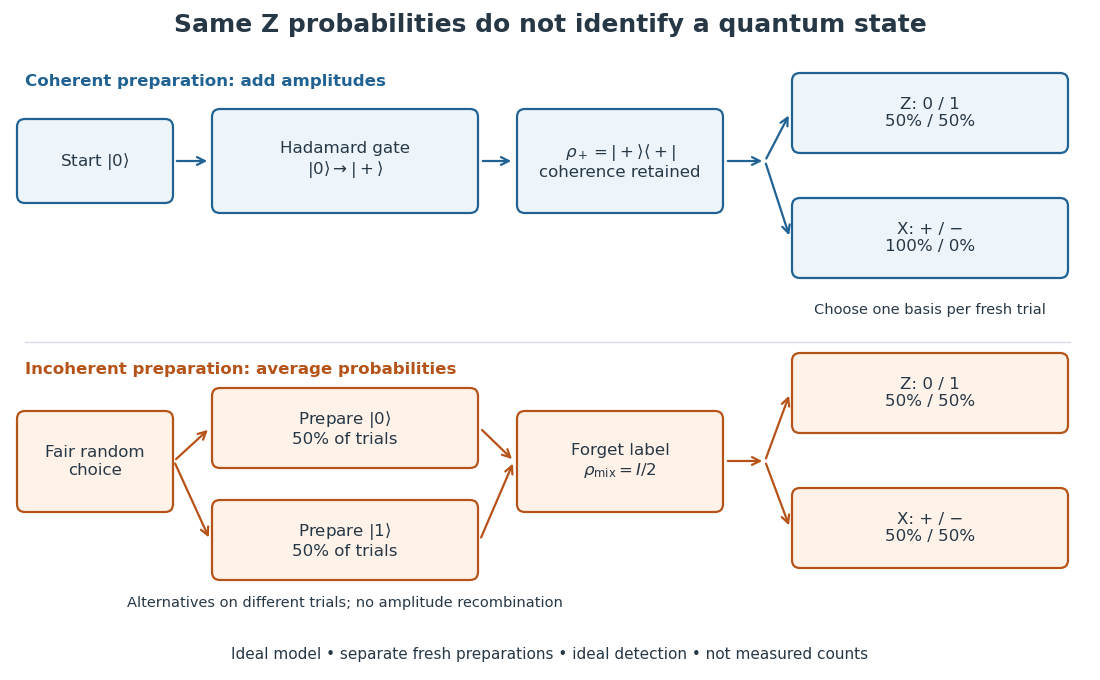
Choose the qubit computational basis , also called the basis, and the Hadamard basis , also called the basis. Compare a coherent preparation of with choosing or at random with equal probabilities and discarding that label:These are original ideal preparation models. Their -basis probabilities are both , because their quantum state populations agree. Their -basis probabilities are respectively and . Indeed , whereas . The missing off-diagonal quantum coherence therefore changes a prediction that the common populations cannot determine.

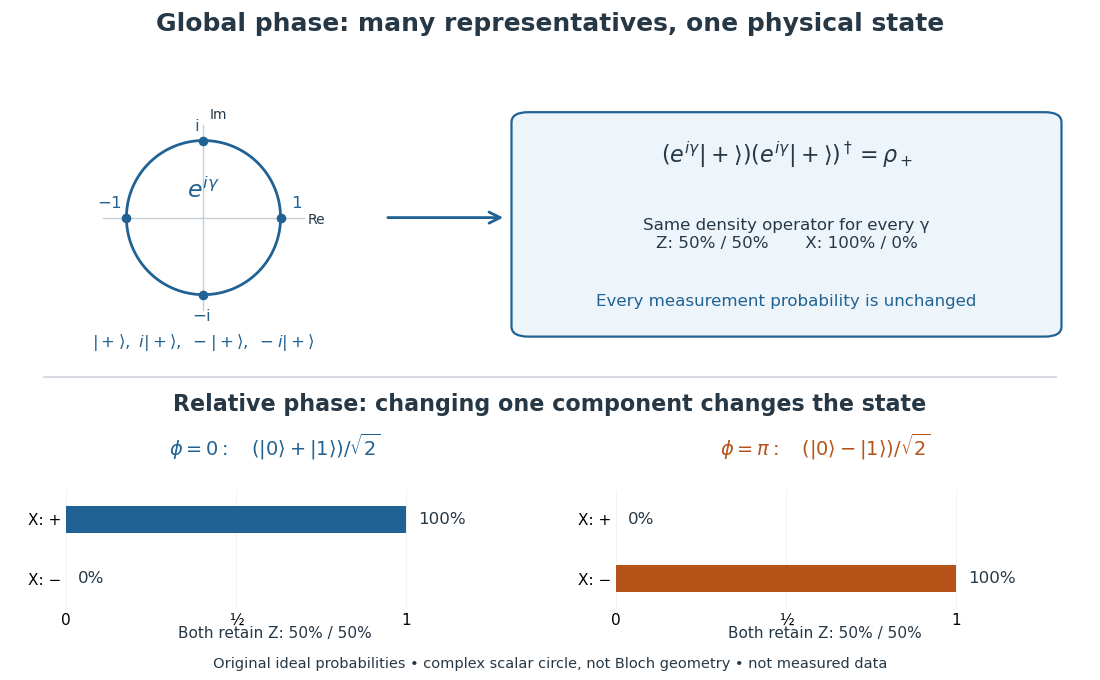
For a relative quantum phase , the coherent family instead hasThe last formula follows by adding or subtracting the two probability amplitudes before taking the squared modulus. At , the state is and the outcomes switch to , while the outcomes remain . In contrast, changes both components by the same global phase and retains the outcomes . In photon polarization, the identification , makes and the two orthogonal diagonal linear polarizations; these labels describe measurement bases, not spatial axes for photon spin.

Even perfect statistics in one basis cannot certify a preparation. The above data fit both density matrices. Conversely, distinct preparation histories can yield the same quantum state:The off-diagonal terms cancel in the right-hand ensemble. Every measurement on the qubit alone then has identical probabilities for those two histories. A retained classical label would allow conditioning on different members of the quantum state ensemble; it is extra information beyond the unlabelled density operator.
Concatenated quantum error-correcting code 2026-10-14
A concatenated quantum code replaces each physical qubit of an outer code by a logical qubit of an inner code. Correction proceeds from inner blocks to outer blocks. For independent errors and ideal correction, a logical-error map iterates as . This recursion describes the code/channel model and does not by itself include errors in encoding and recovery gates.
// Target: quantum-error-correction.bigb
Concurrence of a two-qubit Werner state 2026-10-14
For any normalized pure two-qubit vector, its squared overlap with a maximally entangled state is at most : in a Schmidt decomposition the overlap is bounded by . Averaging gives . Equality follows from the six-state ensemble , with equal weights, where , and . The coherences cancel and each coefficient determinant gives pure concurrence .
Split the support of a Pauli operator of weight at most into two sets of size at most . It is, up to a scalar phase, for two errors in the correctable family. The Knill--Laflamme condition makes its compression to the code scalar, which is quantum error detection. Expansion in the Pauli basis extends the assertion to every operator supported on at most qubits. The number counts affected qubits, not the cardinality of an arbitrary selected family of errors.
CSS code 2026-10-14
For binary linear codes , the CSS code has basis for . Its X stabilizers come from and its Z stabilizers from the dual code ; their commutation follows from orthogonality. For positive logical dimension, and , with quantum code distance . Thus arbitrary errors on at most qubits are correctable. Stabilizer errors are harmless even if their weight is small; the distances exclude them.
Dephased Bell-state mixture Created 2026-10-06 Updated 2026-10-07
For real , this two-qubit density operator has equal and populations and off-diagonal coherences . It is a pure state exactly when , and a separable quantum state exactly when . Its partial transpose has eigenvalues , directly witnessing entanglement for every nonzero admissible coherence.
Dephasing channel Created 2026-09-28 Updated 2026-10-14
A dephasing channel suppresses off-diagonal entries of a density matrix in a preferred basis while preserving quantum state populations. Complete dephasing is identical to a projective measurement in that basis with its outcome discarded.
For the Bell correlations versus a classical mixture example, completely dephasing Alice's qubit in the computational basis maps to . It preserves their perfect agreement and each reduced density matrix, yet destroys the correlation. This is why testing only populations can miss damage to a quantum memory: the stored quantum coherence may have disappeared while every preferred-basis measurement still looks correct. The joint Von Neumann entropy rises from zero to one bit, although each local entropy stays fixed.
Deutsch algorithm 2026-10-14
The one-input Deutsch algorithm determines whether a Boolean function is constant or balanced using one Boolean quantum oracle call. Initialize the input qubit in and the answer qubit in . Quantum phase kickback changes the input to . A Hadamard gate and computational-basis measurement therefore return the parity with certainty.
Deutsch algorithm with pure dephasing 2026-10-14
If the input qubit of the Deutsch algorithm acquires conditional environment states with overlap between its two Hadamard gates, its fixed zero-for-constant, one-for-balanced rule succeeds with probability . A known phase can be compensated before the last Hadamard gate, raising the success probability to . An orthogonal pair of environment states gives and destroys all information in the input qubit about the answer; unit overlap modulus preserves coherence up to a known phase.
Dicke-resource telecloning 2026-10-14
For odd , a symmetric quantum teleportation resource can encode an unknown qubit into . Begin with , apply a controlled-NOT gate from the input to the sender's resource qubit, apply a Pauli X gate to that resource qubit and a Hadamard gate to the input, and measure those two qubits. The four unnormalized remaining vectors are , , and . Each outcome has probability . Since interchanges and , and acts as logical up to the common phase , local Pauli corrections make the output independent of the result. The one-qubit reduction of Dicke-state superpositions givesFor this distributes imperfect copies, as required by the no-cloning theorem. For it reduces to exact quantum teleportation.
Dicke state Created 2026-10-14 Updated 2026-10-14
The -qubit Dicke state with excitations is the normalized equal superpositionwhere is the Hamming weight in the computational basis. The binomial coefficient counts the mutually orthogonal summands, proving normalization. Every permutation of the qubits leaves the vector unchanged. Splitting the sum according to the first bit and using givesTerms with zero coefficient are omitted at the endpoints. This recursion is useful for partial traces and for distributing a logical qubit among many symmetric physical qubits.
Distance of a quantum error-correcting code 2026-10-14
An quantum error correction code is a -dimensional subspace of qubits. Its distance is the minimum weight of a Pauli operator for which is not a scalar multiple of the code projector . Thus every operator supported on fewer than qubits has scalar compression to the code, by expansion in the Pauli basis. This definition includes degenerate codes; a low-weight operator acting as a scalar does not reduce the distance.
Equal-prior discrimination of qubit states 2026-10-14
For equiprobable qubit states with Bloch vectors , their density-matrix difference is , with eigenvalues . An effect declaring the first state yields success . Selecting its positive-eigenvalue eigenspace maximizes this trace and proves the displayed result. Measure along and attach the corresponding state labels; if the vectors coincide, no measurement improves on guessing.
Exact teleportation resource criterion 2026-10-14
A shared resource enables deterministic exact transmission of an arbitrary unknown qubit using only local operations and classical communication if and only if it can produce a shared Bell pair deterministically by such operations. Sufficiency follows from quantum teleportation. For necessity, prepare a Bell pair locally at the sender and apply the purported transmission protocol to one half: exact identity-channel action leaves a shared Bell pair between the retained reference and the receiver. A separable shared resource cannot satisfy this condition because local operations and classical communication preserve separability.
Fidelity of commuting mixed states 2026-10-14
When two density operators are commuting elements, choose a common orthonormal eigenbasis and write , . Their quantum fidelity becomes the classical overlap of the two probability distributions, while their trace distance becomes total variation distance:This follows by computing the positive square root of an operator entry by entry in the common eigenbasis. For the qubit mixed states and ,The two contributions to quantum fidelity are about and . In contrast, the chance that two independent computational basis measurements, one on each preparation, print the same label is . That particular event has a specified probability; neither nor is that probability.
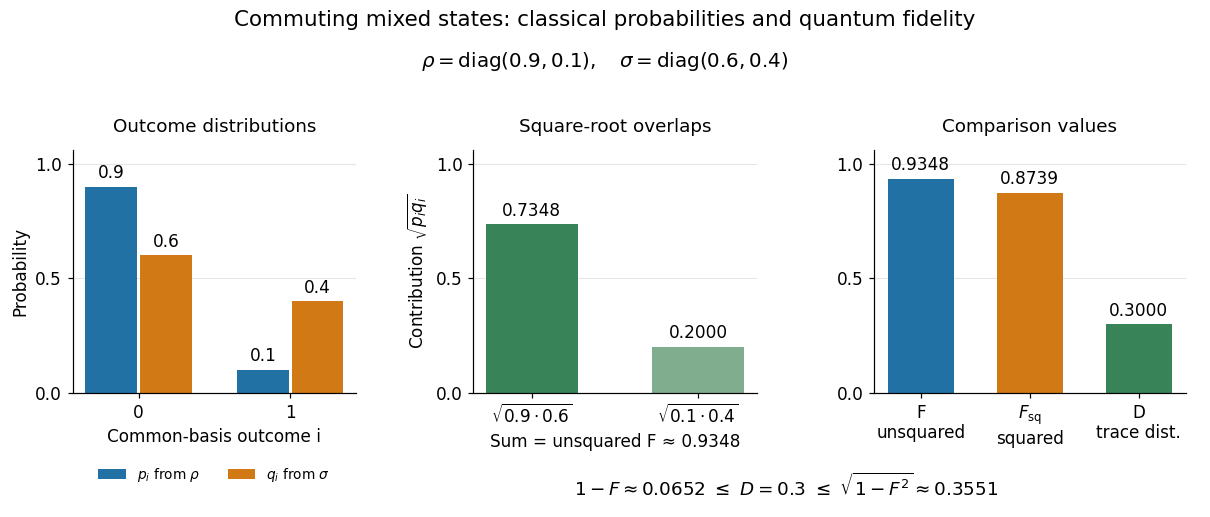
Commuting mixed-state probabilities, square-root overlap contributions to unsquared fidelity F, squared fidelity Fsq, and trace distance D
. Details. 
Here trace distance means an equal-prior quantum state discrimination success of by the Holevo–Helstrom theorem. Measuring in the common computational basis and guessing on outcome zero and on outcome one achieves . Also : the pure-state trace distance and fidelity identity is an equality for pure states, rather than a formula for arbitrary mixed states.
Five-qubit error correcting code 2026-10-14
The five-qubit code encodes one logical qubit into five physical qubits and corrects an arbitrary error on one physical qubit. In a nondegenerate realization, the identity and fifteen one-qubit Pauli operators take the two-dimensional code into sixteen mutually orthogonal syndrome subspaces, filling the 32-dimensional physical Hilbert space.
// Target: quantum-error-correction.bigb