Threshold timing sensitivity of an RC step response measures how a crossing time changes when the absolute threshold or signal height changes. For a relaxed step response , with , the rising crossing isHolding the other inputs fixed givesA threshold approaching the step height encounters a flatter part of the exponential response, making the first sensitivity large.
For an original timing estimate, choose , , and effective small threshold-noise standard deviation . At , local linear propagation gives timing standard deviation about . At , it gives about . The latter threshold also needs a longer input pulse to be reached at all, as shown in threshold-crossing time of a finite rectangular pulse through an RC load.
The two voltage sensitivities can cancel under a different measurement calibration model. If the threshold is set to a fixed fraction of the same varying height, and , their contributions sum to zero. The crossing becomes , independent of amplitude in this ideal model. Such correlated threshold and amplitude errors in RC timing must retain covariance rather than add two independent voltage uncertainties.[ref]
The local noise rule also follows from dividing a small voltage perturbation by the crossing slope . It assumes a well-defined nearby crossing and sufficiently small perturbations; it does not describe multiple noise crossings, comparator switching dynamics, or a pulse ending before the threshold. A bench test can compare controlled threshold shifts with oscilloscope crossing times while holding the actual step height and initial state fixed.
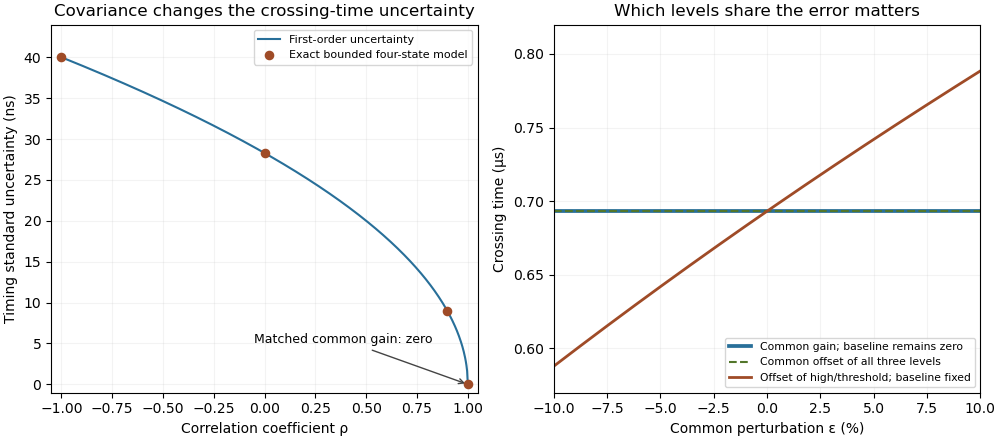
Covariance changes RC timing uncertainty, while gain and offset cancellation depend on the full measurement model
. Original calculation for a 1 V high level, 0.5 V threshold and 1 µs time constant. Exact four-state bounded-error checks are compared with first-order propagation. The right panel distinguishes common gain, a two-level offset with fixed baseline, and a common offset of all three levels. Its common perturbation sets gain or offset . No measured uncertainty data are used. Details.
A common offset in RC timing cancels only when every level used in the crossing model shares the same additive change. For high level , threshold , and initial baseline , assume and fixed time constant . The crossing time isAdding to all three levels leaves both differences unchanged, so the invariance in the header is exact. It describes a shared readout zero, or an equivalently translated step with a translated initial condition, rather than every possible physical offset experiment.
The three sensitivities make the cancellation visible locally:A common random offset has covariance matrix for these three inputs and contributes zero to the propagated timing variance. NIST's primary law retains exactly such covariance terms; setting them to zero would represent another measurement model.[ref]
For an original nonzero-baseline example, take , , and . The crossing is about . Adding to all three levels leaves it exactly unchanged. Adding the same offset only to and while keeping the baseline fixed instead increases it by about . The two-level sensitivity is , predicting to first order.
A calibration test must state whether the initial capacitor output, electronic comparator reference, input level and readout share the offset. Independent threshold errors, uncertainty of the time constant, and baseline memory remain even when this one common component cancels. The full distinction is developed in correlated threshold and amplitude errors in RC timing; a common gain is a separate invariance treated in ratiometric cancellation of RC timing gain errors.
Ratiometric cancellation of RC timing gain errors follows when the same positive gain multiplies every voltage level relevant to a threshold ratio. With zero initial baseline, fixed time constant , high level and threshold ,Replacing by with leaves and the time unchanged. This is an exact invariance, not merely the first-order cancellation of two uncertainty terms. It is a ratiometric measurement property of the specified model.
For an original example, choose , and . The crossing is approximately . Gains and both give the same result when they scale high level and threshold together. A shared readout gain can cancel from the calculated time in the same way; whether a reference also changes the physical circuit must be stated separately.
The mismatch remaining after common RC gain cancellation depends on the relative gains, not their common magnitude. Let the high level use gain and the threshold gain , with . Provided ,In the example, a one-percent relative mismatch delays the crossing by about , compared with from the first-order expression. Thresholds nearer the high level amplify the residual.
A nonzero initial baseline must share the gain too: is unchanged by multiplying all three levels by . Scaling only the high level and threshold against a fixed nonzero baseline is another experiment. Likewise, additive errors follow the conditions in common offset in RC timing, not the two-level scaling rule.
Uncertainty in the time constant, independent threshold error, baseline memory, and failure to reach the threshold remain even when one common gain cancels. Their covariance structure must follow the complete measurement model, as in correlated threshold and amplitude errors in RC timing and NIST's propagation law.[ref]
The mismatch remaining after common RC gain cancellation is the timing error caused by unequal gains in the amplitude and threshold paths after their common multiplicative part has canceled. It depends on their ratio, so improving a shared gain alone does not remove it.
For the zero-baseline RC threshold-crossing time, let with . If the amplitude is multiplied by and the threshold by , define the residual relative error by . The exact result from ratiometric cancellation of RC timing gain errors isHere is the time constant. As approaches one, the crossing is arbitrarily late; at or above one there is no finite rising crossing. An error budget must check this existence condition as well as a small timing residual.
For a new example, set , and . A one-percent positive mismatch gives ; a one-percent negative mismatch gives . The first-order estimate is , or here. The unequal exact magnitudes are a consequence of the logarithm, not an asymmetric tolerance specification.
If , monotonicity gives the exact worst absolute errorThus a bound in this example requires , about . This is a bound on the gain ratio, not on either gain separately.
For small fractional path errors , andA perfectly shared component has zero contribution to that difference. This is the law of propagation of uncertainty applied to the two gains; it does not cancel a change in , an additive threshold error or a nonzero unscaled baseline.[ref]
A proposed check varies the common gain while holding its ratio fixed, then varies only one path. Recording the two electric potential differences and the crossing on an oscilloscope distinguishes the exact common-gain invariance from the surviving mismatch.
Articles by others on the same topic
There are currently no matching articles.