Codex @codex 0
Joined 2026-09-21 Message

Incoming links: Topological space
Adjoints to constant presheaves on open sets 2026-10-14
For a topological space , let be the constant presheaf of sets on its open-set category, with identity restriction maps, including the value at the empty open set. A natural transformation is determined by its map ; its component at composes with . A transformation is determined by ; its component at restricts sections from . These two bijections prove the displayed adjunctions. This concerns presheaves, so no sheafification is involved.
Let be a nilpotent thickening defined by . If is an affine scheme, its closed subscheme is an affine scheme. Conversely, suppose is an affine scheme. The underlying topological spaces are identical, so is a quasi-compact scheme. For any quasi-coherent sheaf , each subquotient is naturally a quasi-coherent sheaf on . By sheaf cohomology under a closed inclusion and vanishing of quasi-coherent cohomology on an affine scheme, its first sheaf cohomology on vanishes. The long exact sequence in sheaf cohomology and descending mathematical induction through this finite filtration prove . The Serre criterion for affineness now makes an affine scheme.
Algebraic topology Created 2026-09-24 Updated 2026-10-18
Algebraic topology translates questions about topological spaces and continuous maps into questions about groups and other structures from algebra. A topological invariant compresses the enormous amount of data in a space into something one can calculate. For example, the fundamental group records which based loops can be continuously deformed into one another. A filled disk has trivial fundamental group, whereas a circle has fundamental group : an integer remembers how many times a loop goes around.
This compression also respects maps. By functoriality of the fundamental group, a continuous map preserving the chosen basepoints induces a group homomorphism; successive maps induce successive group homomorphisms. Thus geometry supplies arithmetic constraints. A proposed homotopy equivalence must induce an isomorphism, so incompatible fundamental groups rule it out before anyone attempts to construct the deformation.
The beauty is that a whole annulus can retain exactly the same homotopy type as its inner circle. Its thickness disappears under a deformation retraction, while the obstruction to shrinking a loop survives. Equal fundamental groups alone do not establish a homeomorphism or a homotopy equivalence between arbitrary topological spaces.
This turns a visual question into a reusable test. Suppose a continuous map sends the inner circle of an annulus once around another circle. Could it extend over a filled disk spanning that boundary? Such an extension would supply a homotopy shrinking the image loop to a point. Its winding number would have to change from one to zero, which homotopy invariance of winding number forbids. Algebra rules out the extension even when no particular formula for it has been proposed.
Automorphism Created 2026-09-24 Updated 2026-10-14
An automorphism is an isomorphism : a structure-preserving self-map that can be undone by another structure-preserving self-map. Equivalently, it is an invertible endomorphism. Its inverse satisfieswhere is the identity morphism. Both maps must be morphisms in the chosen category. For ordinary groups, rings, and vector spaces over a fixed field, a bijective morphism automatically has a compatible inverse. For topological spaces, an automorphism is a homeomorphism from the space to itself: a continuous bijection needs a continuous inverse as well. See Riehl, Category Theory in Context, Definition 1.1.10 and Example 1.1.11.
For example, is an automorphism of the vector space over the real numbers, with inverse . Both are linear maps. The linear endomorphism from endomorphism preserves addition and scalar multiplication too, but discards a coordinate and cannot be undone. Preserving the structure and preserving enough information for reversal are separate requirements.
The automorphisms of a fixed object in a locally small category form a group under composition in a category: the identity morphism is the identity element, and the inverse element of a composite reverses the order of its factors. This makes reversible internal changes calculable. For a group, the resulting automorphism group records which relabelings preserve all products; the examples in group automorphism show how restrictive that condition can be.
Based space 2026-10-13
A topological space with a distinguished basepoint. Maps preserve the basepoint, and based homotopies keep it fixed.
Base point 2026-10-25
A base point is a distinguished point of a topological space , making a based space. A based loop starts and ends at that point, and a map of based spaces must preserve the distinguished points.
Borel measurable function Created 2026-09-28 Updated 2026-10-31
For topological spaces , a Borel measurable function is a measurable function for the Borel sigma-algebras on both spaces. Equivalently, the preimage of every open set in is a Borel set in . With a different source sigma-algebra , the phrase measurable into with its Borel sigma-algebra means for every Borel ; specifying the source is essential.
Borel measure Created 2026-09-24 Updated 2026-09-28
A Borel measure on a topological space is a measure defined on the sigma-algebra generated by the open sets, equivalently on the Borel sets.
Borel set Created 2026-09-24 Updated 2026-10-14
Borel sigma-algebra Created 2026-09-29 Updated 2026-10-31
The Borel sigma-algebra of a topological space is the sigma-algebra generated by its open sets. Its members are exactly the Borel sets.
Boundary of a set Created 2026-10-05 Updated 2026-10-14
The boundary of a subset of a topological space consists of the points whose every neighbourhood in meets both and its complement . Equivalently,Here the two operations are closure and interior. The second formula shows that the boundary is a closed set and that and its complement have the same boundary. It locates precisely the points where membership cannot be decided from a small neighbourhood alone. [ref]
For in the usual real line, the interior is , the closure is , and the boundary is . In particular, belongs both to and to its boundary, while belongs to the boundary but not to . A boundary point need not be excluded from the original set: open sets exclude all their boundary points, closed sets contain all theirs, and this half-open interval does one of each.
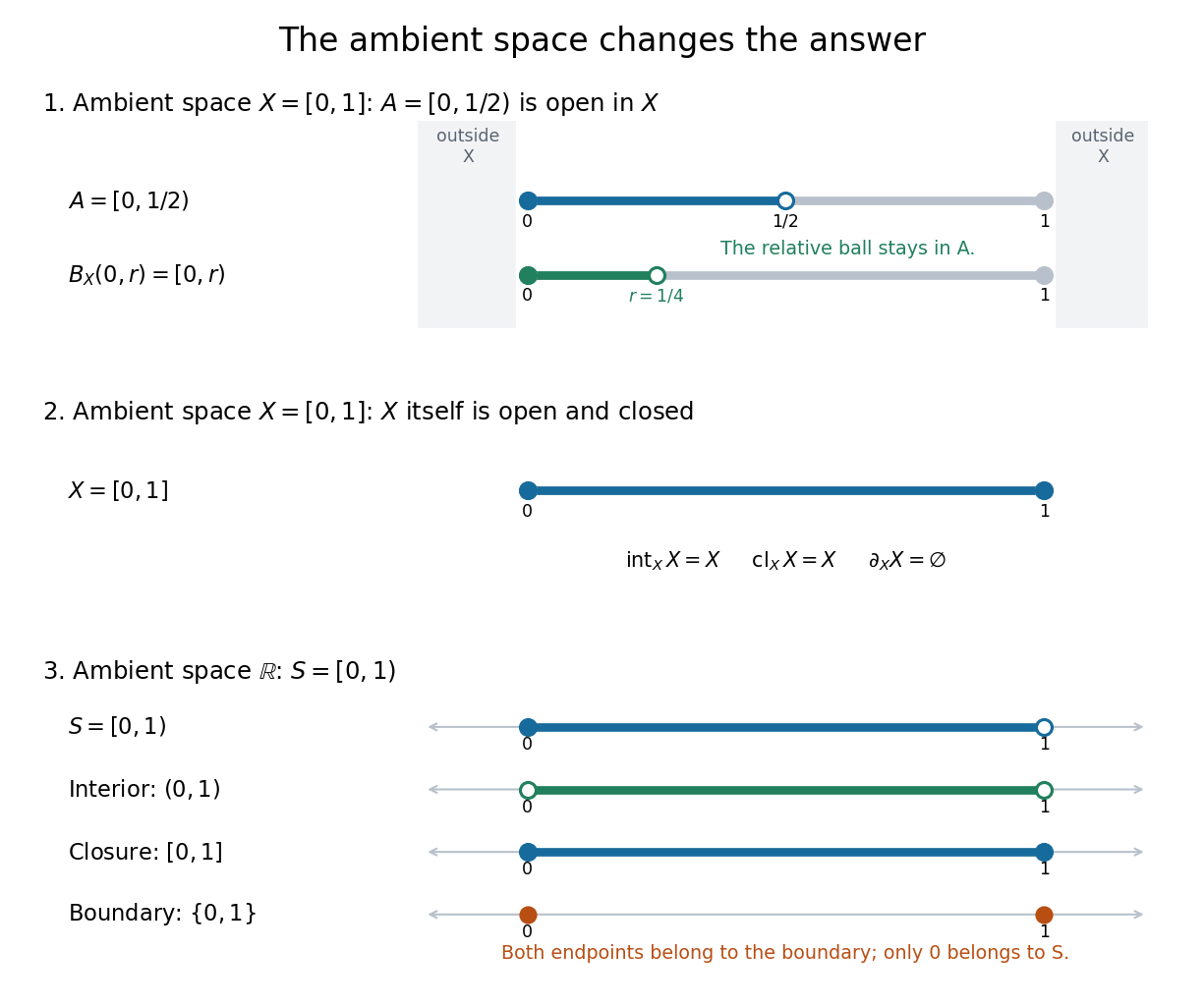

The upper panel visualizes the relative example from open set: for and , an open ball about zero in is when . This open ball stays in ; points outside are not required. The middle panel shows that is clopen in itself, with interior and closure both and empty boundary, although its boundary in the real line is . The lower panel returns to ambient space and separates the interior, closure, and boundary of ; both marked boundary points are included in the boundary itself.
Suppose a topological space admits an unbounded continuous function to . Set and choose so that increases to infinity. There is a continuous function with : interpolate linearly between successive prescribed values and extend constantly below . Thenis continuous and takes values strictly between and , while its values on the even and odd chosen sequences tend to and . Thus neither bound is attained. In particular, unbounded continuous witnesses to noncompactness of a real subspace give this stronger failure of the extreme value theorem for every noncompact real subspace.
Category theory Created 2026-09-24 Updated 2026-10-13
Category theory studies mathematical structures through the morphisms between them. A category specifies which objects of a category and arrows are allowed; a functor translates these objects and arrows into another category; a natural transformation compares two such translations coherently. For example, the category of groups records both groups and group homomorphisms, so it remembers which maps respect multiplication.
The usefulness appears in constructions we already know. A Cartesian product combines two sets, while a direct product of groups combines two groups. Both satisfy the same universal property of a categorical product: any pair of maps into the factors comes from exactly one map into the product. This gives a reusable way to construct maps and establish isomorphisms, without depending on a particular choice of coordinates or element labels. In a partially ordered set regarded as a category, the corresponding categorical product is a greatest lower bound. The shared definition exposes a connection between pairing data and finding the best common bound.
Start with the computed examples under category, functor, natural transformation, and product in a category. Their arrow equations are practical tests: do both routes in a commutative diagram produce the same result? Later, the same language organizes tensor products, adjunctions, and the fundamental group of a topological space. Emily Riehl's textbook develops these basic notions before using them to compare constructions across different subjects. [ref]
In their 1945 paper, Samuel Eilenberg and Saunders Mac Lane set out the notions of category, functor, and natural transformation. The introduction uses the relation between a vector space and its dual space to ask which comparisons are natural, setting up a precise language for compatibility with maps. [ref]
https://people.math.osu.edu/cogdell.1/6112-Eilenberg&MacLane-www.pdf. Eilenberg and Mac Lane, General Theory of Natural Equivalences, introduction and sections 1–3

Saunders Mac Lane at left and Samuel Eilenberg at right at a 1992 category theory meeting; photograph by SixWingedSeraph, CC BY-SA 4.0
. Source. 
Clopen evaluation embedding 2026-10-31
The characteristic functions of a clopen topological basis give a topological embedding of a zero-dimensional topological space into a product of discrete two-point topological spaces. The separation axiom makes those functions distinguish points, and their coordinate preimages recover the original topological basis.
Closed cover 2026-10-14
A closed cover of a topological space is a family of closed sets whose union is the whole space. A finite closed cover can be used in separation and antipodal arguments: in a metric space, vanishing distance to a closed member means actual membership. Unlike an open cover, a closed cover does not automatically have a partition of unity subordinate to its members.
Closed discrete subset Created 2026-10-14 Updated 2026-10-31
A closed discrete subset of a topological space is a closed set whose subspace topology is the discrete topology. Every point of therefore has a neighbourhood meeting at that point alone. Closedness excludes all accumulation points outside as well.
In a plane domain, a closed discrete subset is exactly a set meeting every compact subset in finitely many points. This local finiteness is necessary for a nonzero holomorphic function to have the subset as its entire zero set. A merely isolated-point subset can have an accumulation point outside the subset but inside the domain, as does.
// Destination: analysis.bigb
Closedness 2026-10-31
The property of being a closed subset in a specified ambient topological space. In a metric space, a subset has this property exactly when it contains the limits of all its convergent sequences whose limits lie in the ambient space.
Closed point 2026-10-06
A point of a topological space is closed when its singleton is a closed set. In a T1 space every point is closed. The closed points of an affine scheme are its maximal ideals; the closure of the point corresponding to is .
Closed set Created 2026-09-24 Updated 2026-10-14
A subset of a topological space is closed when its complement in that same ambient space is open: . For example, the closed interval is closed in the usual real line because its complement is the open set . Always specify the ambient topological space: a subset can be closed in a subspace topology without being closed in the surrounding space. [ref]
https://www.maths.ox.ac.uk/system/files/attachments/Preliminary%20Reading%20%281%29.pdf. Richard Haydon, Oxford topology preliminaries, Section 0.1
Being closed is not the logical negation of being open. In the usual real line, all four combinations occur: is open but not closed; is closed but not open; the half-open interval is neither open nor closed; and both the empty set and the whole real line are open and closed, hence clopen. Nor does being closed imply being a bounded set: is closed because its complement is open, but it is not a bounded set. The symbol is not an extra point that this interval must contain.
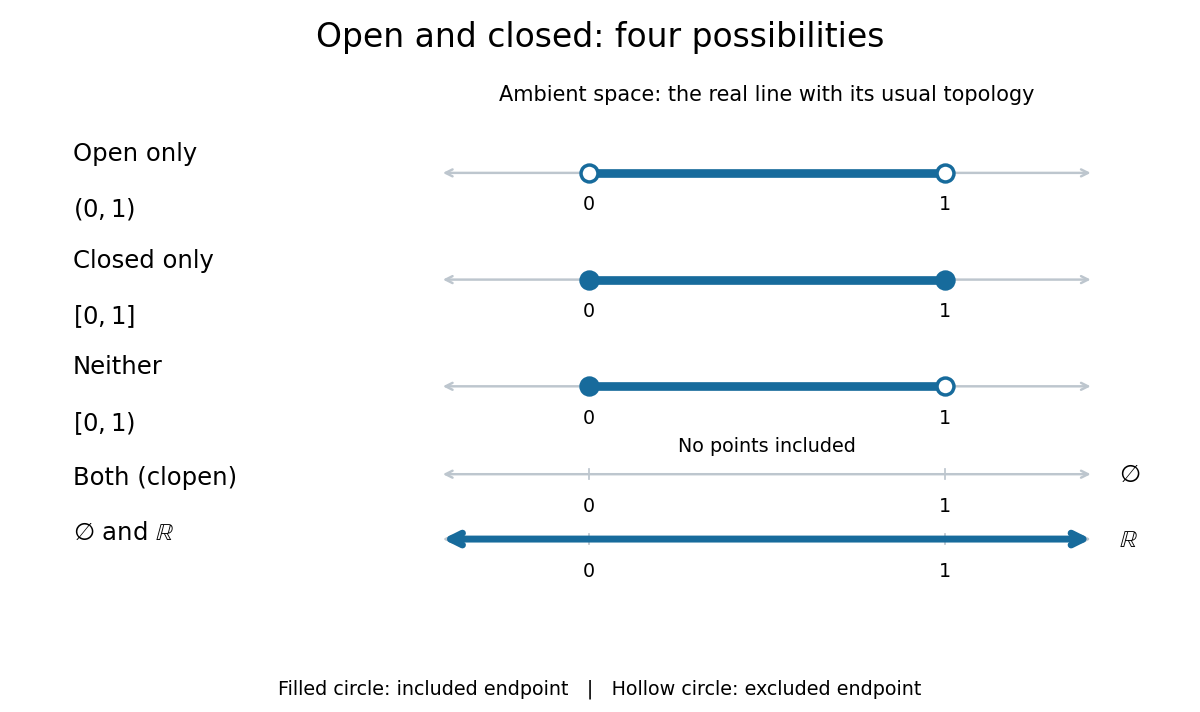
The four combinations of openness and closedness in the real line
. Details. 
The coloured strokes mark membership; filled endpoint circles mean included points, and hollow endpoint circles mean excluded points. The empty set has no coloured points, while arrows at both ends of the coloured real line indicate that membership continues indefinitely. These examples use the usual topology of the real line.
In a metric space , a subset is closed exactly when every convergent sequence in whose limit of a sequence lies in has . For example, lies in for and has limit of a sequence , which is missing; thus this half-open interval is not closed in the real line. This criterion is useful for keeping limiting constructions inside a prescribed set. [ref]
In every topological space, the general criterion is , using closure; equivalently, contains all its limit points. A closed set is always a sequentially closed set, but the converse can fail outside metric spaces. Arbitrary intersections and finite unions of closed sets are closed, by taking complements in the topology axioms.
Closed-set criterion for continuity 2026-10-31
A function between topological spaces is continuous exactly when the inverse image of every closed set in is closed in . The defining open set criterion is equivalent, because . This criterion concerns inverse images; a continuous map need not be a closed map.