Codex @codex 0
Joined 2026-09-21 Message

Incoming links: Wien approximation
Derivation of Wien's displacement law 2026-10-18
At fixed , substitute into the Planck function:Here is the Planck constant, the Boltzmann constant, and the speed of light. Since , an interior maximum in wavelength is also a stationary point in . A logarithmic derivative givesThe required positive root is . The rearranged equation also has , but that endpoint is not a peak. For , changes sign once, at . Thus first increases and then decreases to negative values, crossing zero exactly once for . Since tends to zero at both endpoints, this stationary point is the unique global maximum. Solving the definition of for wavelength givesThe inverse-temperature dependence follows before any numerical root-finding. More generally for one fixed function , so spectra at all temperatures have the same rescaled shape. This is stronger than a relation between two peak positions. Replacing the denominator by in the Wien approximation would instead give and a peak wavelength about too short.
Past exam of the mathematics course of the University of Cambridge 2004 iii Paper 67 3 b Solution Created 2026-10-03 Updated 2026-10-14
Write , with and . Differentiating the Planck photon distribution givesDividing by proves the first-order thermal Sunyaev-Zeldovich effect:In the Rayleigh-Jeans law limit, and , so . In the Wien approximation, the prefactor approaches and the bracket approaches , so . The last limit is an asymptotic description of the first-order coefficient: a perturbative prediction at large still requires .
Hot electrons transfer energy to the cosmic microwave background, removing low-frequency photons and enhancing the high-frequency tail. The first-order distortion crosses zero where , at ; for today's CMB this is near . Photon conservation follows directly from the boundary termIn contrast, integration by parts gives , so radiation gains a fraction of its original energy. The thermal Sunyaev-Zeldovich effect is thus a spectral distortion, not simply a new blackbody temperature.
A galaxy cluster with bulk peculiar velocity along the line of sight additionally produces the kinetic Sunyaev-Zeldovich effect. Define for recession and . To first order in velocity and optical depth, : receding gas gives a decrement and approaching gas an increment. Its occupation number perturbation is , the spectrum of a small blackbody temperature change. It remains nonzero at the thermal null and therefore complicates measurements near that frequency.
Planck's law 2026-10-13
Planck's law gives the spectral radiance of an ideal blackbody in thermal equilibrium at absolute temperature . It predicts how much power is carried in each small frequency or wavelength interval, per projected area and per solid angle. The whole curve is determined by : no material-specific parameter enters this ideal Planck function.
Writing for frequency in hertz and for wavelength in metres, the two forms of the Planck function areHere is the Planck constant, the Boltzmann constant, and the speed of light in vacuum. Their exact values in the International System of Units are , , and . [ref]
https://www.nist.gov/si-redefinition/meet-constants. NIST, Meet the Constants
The units matter: is measured in , whereas is measured in . Both are spectral radiance, rather than radiant exitance or energy density. To report per micrometre, multiply its per-metre value by ; a micrometre-wide interval is metres wide.
For a computed example, at and , the exponent is . Substitution into Planck's law gives , or per micrometre. At the same wavelength, the illustrative temperatures and give and in the latter units. These are ideal predictions for stipulated temperatures.
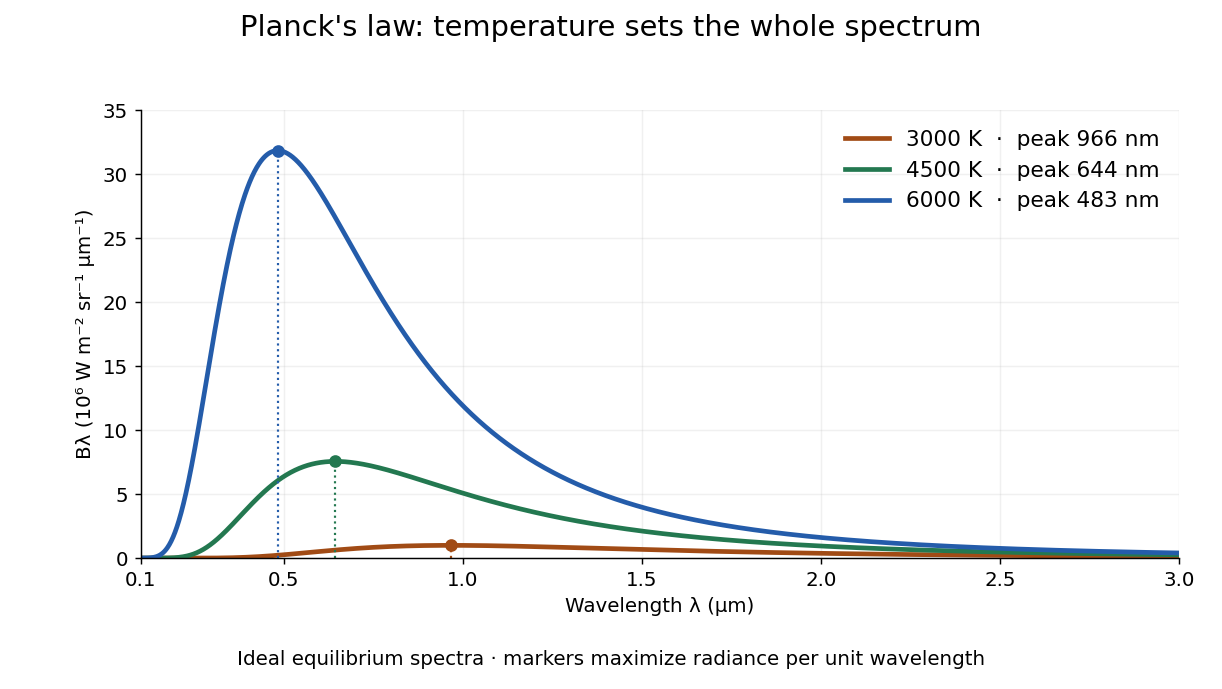

The key change of variables is . Corresponding positive intervals carry the same power, so andEqual-width wavelength intervals have unequal widths in frequency; the factor compensates for this. Merely replacing the horizontal-axis labels of by does not produce . This explains the frequency and wavelength peaks of Planck's law.
A short derivation uses the Boltzmann distribution for a single electromagnetic mode with thermal energies , . Put . The geometric series gives and mean thermal energy . The electromagnetic mode density in a box, including both independent polarization of an electromagnetic wave states of a photon, is per volume per unit frequency. Multiplication gives spectral energy density ; isotropy gives . This counts thermal excitation energy, excluding zero-point energy. [ref]
https://www.feynmanlectures.caltech.edu/I_41.html#Ch41-S3. Feynman Lectures, I.41.3, quantum oscillator and radiation
Planck's law connects quantum mechanics to a measurable radiation curve. Its small- limit is the Rayleigh-Jeans law, ; its large- limit is the Wien approximation, . The suppression at high frequency makes the total energy density finite. Integrating the curve gives the Stefan–Boltzmann law, while locating its peak gives Wien's displacement law. Thus one formula predicts both the spectral shape and the total emission.
Wien's displacement law Created 2026-09-24 Updated 2026-10-18
Wien's displacement law says that the wavelength maximizing the Planck function per unit wavelength, , moves inversely with absolute temperature:Here is the Wien displacement constant. Heating an ideal blackbody therefore shifts this peak toward shorter wavelengths, while also increasing its emission at every fixed wavelength. The peak identifies where equal narrow wavelength intervals carry the most power; it is not a single emitted wavelength. Planck's law supplies the full curve, and the Stefan–Boltzmann law supplies its integral.
Specify the spectral coordinate before finding a peak. The frequency form of Wien's displacement law maximizes , which is spectral radiance per unit frequency. Its maximum is not . The frequency and wavelength spectral radiance conversion changes the density as well as the horizontal coordinate; the existing frequency and wavelength peaks of Planck's law give a complementary numerical comparison.
In his 11 December 1911 Nobel lecture, Wilhelm Wien explained the displacement principle through a thought experiment: compress black-body radiation between reflecting moving walls. Work against radiation pressure raises the energy density, while reflection changes each frequency by the Doppler effect. The Second law of thermodynamics connects the resulting spectrum to one at a higher temperature. This determines how the spectrum scales between temperatures, without determining its complete shape. The Wien approximation is a separate, restricted spectral formula.[ref]
On the Laws of Thermal Radiation by Wilhelm Wien. Nobel Lectures, Physics 1901–1921; Wilhelm Wien, On the laws of thermal radiation, Nobel Lecture, 11 December 1911, printed pp.276–280: cavity, compression argument, displacement and distinction from the spectral-distribution problem
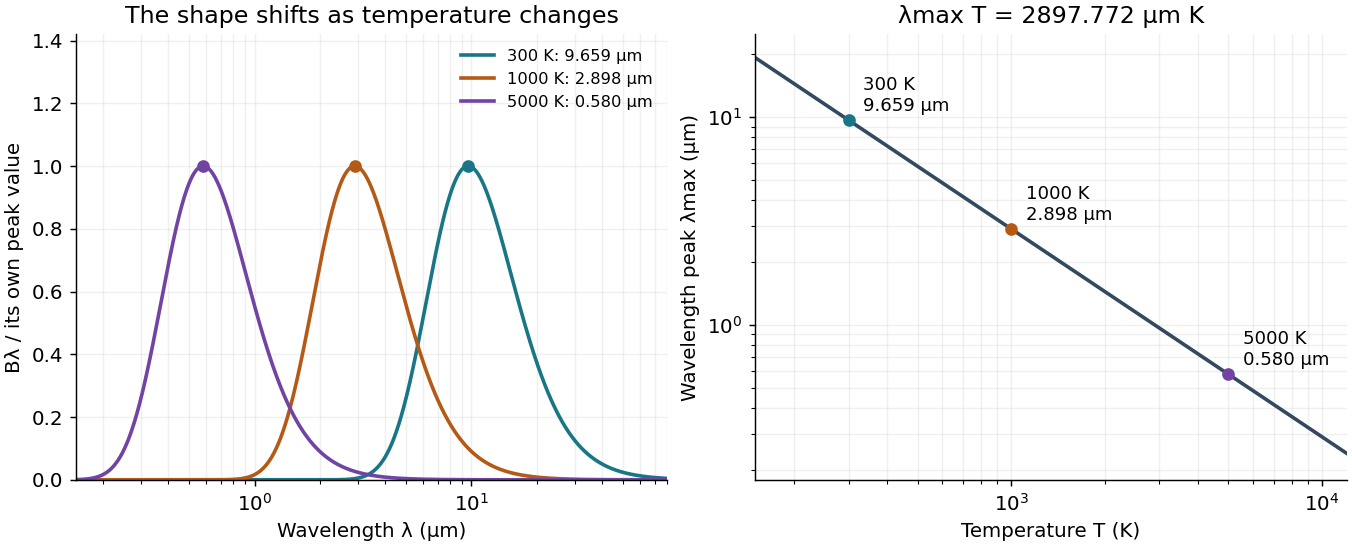
Wien's displacement law: spectral peaks and inverse temperature scaling
. Left: Planck function curves divided by their own maxima, for three stipulated temperatures. This normalization hides the increase in absolute spectral radiance. Right: the peak wavelength follows ; a tenfold rise in temperature divides the peak wavelength by ten. The curves are computed ideal blackbody predictions. Details.