X-ray astronomy infers the properties of celestial sources from their X-rays. It requires instruments above the strongly absorbing layers of Earth's terrestrial atmosphere. Riccardo Giacconi's 2002 Nobel lecture connects the early rocket detections to later grazing-incidence X-ray optics, which collect photons over a large entrance area onto a small detector.[ref]
The Dawn of X-Ray Astronomy by Riccardo Giacconi. The Dawn of X-Ray Astronomy, introduction and section 4, pp. 123–124
The measurement is an inverse problem: a count rate mixes incident photon arrival rate, detector response, and background. A point-like astronomical source produces a direction-dependent excess as the instrument scans; diffuse X-ray background contributes over many directions. Neither a count excess nor a narrow feature by itself determines the emission mechanism. The useful progression is from detecting an excess, to locating it, to measuring its spectrum and light curve.
In 1962, Riccardo Giacconi and colleagues flew three Geiger counters to search for lunar X-ray fluorescence. Different mica thicknesses tested penetration; lampblack blocked ultraviolet. Each counter sat in an anticoincidence detector using a scintillation counter to reject cosmic rays. There was no mechanical collimator. Rotation scanned the sky; optical sensors supplied orientation.[ref]
Evidence for x Rays From Sources Outside the Solar System by Riccardo Giacconi and others. pp. 439–440, apparatus and readout
Counts were sorted by azimuth; a faulty counter and tumbling descent data were excluded. A directional peak lay above a diffuse component. Window, altitude and angular responses tested X-rays against charged particles; the Moon's nondetection checked optical leakage. The authors argued for an origin outside the Solar system, while residual cosmic ray background was not directly measured and source size, position and spectrum remained assumption-dependent.[ref]
Evidence for x Rays From Sources Outside the Solar System by Riccardo Giacconi and others. pp. 440–443, Figs. 1–4 and concluding limitations
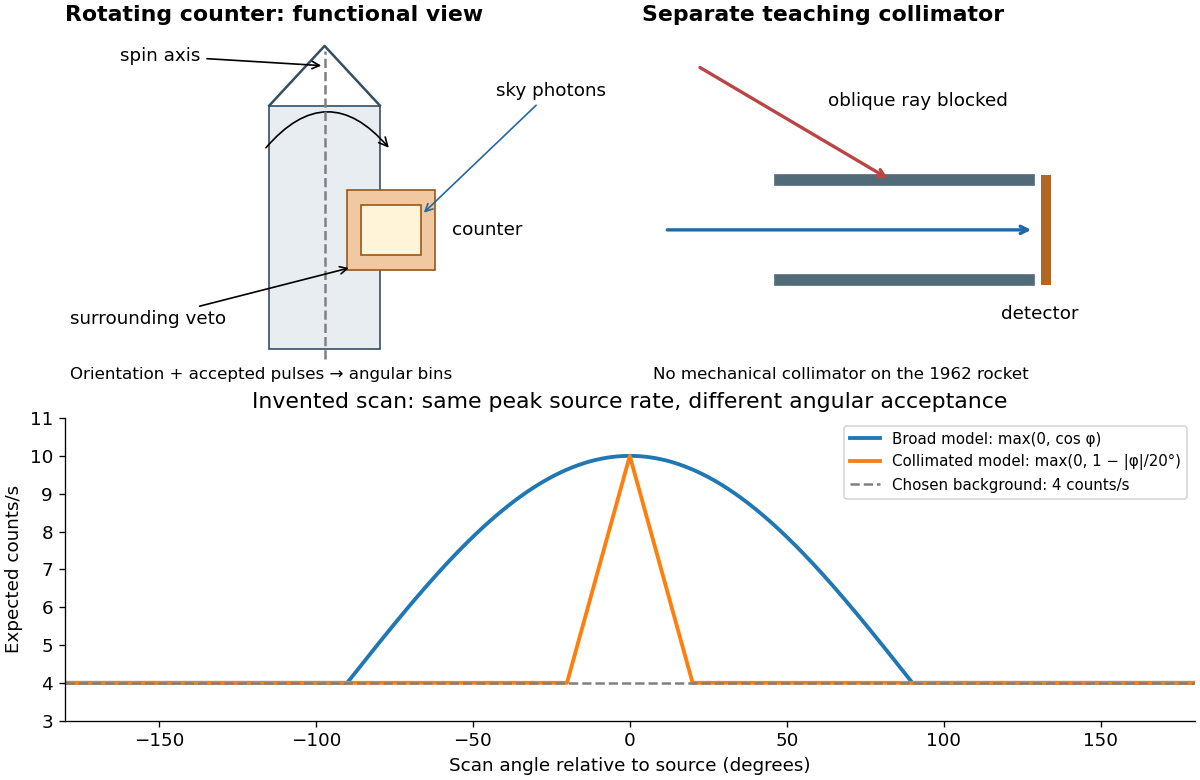
A simple original forward problem makes the distinction precise. Let be the scan azimuth, let be a dimensionless directional response with maximum one, let be a source's band-integrated photon arrival rate per unit area, let be its on-axis X-ray effective area, and let be a constant accepted background rate. The expected rate isFor a broad illustrative response , the full width at half maximum is : at . For a one-dimensional ideal collimator model , the full width at half maximum is . Choosing narrows the response sixfold without focusing any additional photons. These are teaching response functions, not reconstructions of the rocket's window transmission or geometry. A narrower scan peak can reflect the instrument response even when the source is unresolved.
Scorpius X-1 is the celestial X-ray source associated with the 1962 discovery, subsequently located more precisely. The discovery scan did not supply a resolved image of this X-ray binary.[ref]
Tracing a Bright Path by NASA HEASARC. Tracing a Bright Path: discovery scan and identification
Diffuse X-ray background is X-ray emission spread over the instrument's observed sky rather than assigned to a single resolved source. Diffuse appearance at finite angular resolution does not prove emission by a continuous medium: many unresolved point-like astronomical sources can also give a smooth signal. Instrumental background is a separate contribution, even though both enter measured counts.
X-ray effective area is the area that converts an incident photon arrival rate per unit area into an accepted count rate. For a fixed direction and a sufficiently narrow energy interval, writeHere is projected geometric area, is transmittance through windows or optics, is quantum efficiency, is the probability that a detected source event passes event selection, and is live observing time. is an expected value, not a guarantee of an integer count. Multiplication follows by counting incident photons over area and time, then applying the successive conditional acceptance probabilities. Live time already excludes intervals when the instrument cannot record events; multiplying by a live-time fraction again would count the same loss twice.
For an invented narrow-band example, choose , , , and . Then . A source with observed for gives . here counts photons; converting it into observed radiative flux requires their energies. If all have energy , the corresponding radiative flux is .
A broad spectrum instead requireswhere is the differential photon arrival rate per area and energy. A single band-averaged X-ray effective area depends on the assumed spectrum. This is why a count rate alone cannot give an assumption-free radiative flux.
Background subtraction must account for uncertainty in the background measurement itself. In an original idealized experiment, an on-source exposure contains source and background, while an independent off-source exposure contains background alone. Assume stationary rates and identical background acceptance per unit live time. With , let independent counts obey Poisson distributions:Then linearity of expectation and addition of variances for independent random variables giveThe result concerns accepted source counts , after all efficiencies. For large counts the normal approximation gives the descriptive signal-to-noise ratio in photon countingThis plug-in ratio is not an exact null-hypothesis significance. Small counts require the discrete Poisson model; searching many sky directions also changes a detection claim's p-value.
Choose and , with observed counts and . Thus , , and the estimated standard deviation is counts. The inferred uses the preceding and includes counting uncertainty only. The descriptive ratio is . Treating the scaled off-source background as exact would omit 200 counts squared from the estimated variance.
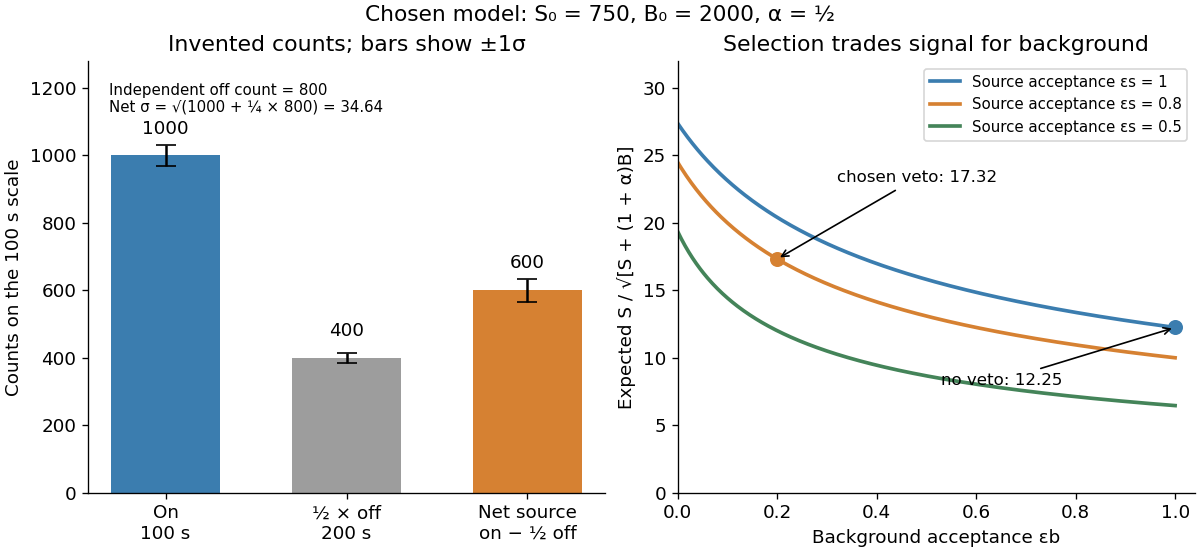
Invented on-off counts and the effect of background rejection
. All numbers are chosen teaching values, not historical measurements. Independent off-source counts contribute uncertainty. The rejection curves hold the source acceptance fixed within each labelled case. Details.For a selection-design comparison, suppose before a veto the expected source contribution is , the on-source background is , and . Let source acceptance be and background acceptance be . Then , , and , whereas omitting the veto gives . Rejection helps because the background is reduced enough to compensate for lost source events. A different veto can make matters worse; source efficiency and background rejection are separate probabilities. This comparison is an independent teaching example, not the efficiency calibration used above.
If both exposure times grow with fixed and stationary rates, and imply . Four times the live time doubles this ideal ratio. Misestimated background rates, uncertain X-ray effective area, and source variability can defeat that scaling; longer exposure does not remove systematic error.
Grazing-incidence X-ray optics redirect X-rays by shallow specular reflections along mirror surfaces. Riccardo Giacconi's lecture describes coaxial paraboloidal and hyperboloidal mirrors using two reflections, and the later Einstein observatory's imaging capability. Focusing separates collecting area from detector area: the collected source signal can remain large while the detector background is drawn from a smaller region.[ref]
An ideal lossless geometrical optics calculation explains the shallow angle. Take vacuum refractive index one and a material with real refractive index , where . Let be the grazing angle measured from the surface. Snell's law written for angles from the normal requires . A propagating transmitted ray exists only if . Thus the ideal threshold isThe last step uses the Taylor series . For a chosen , radians, or . Absorption makes the refractive index complex and softens this ideal threshold; surface roughness and alignment errors also reduce throughput or worsen the point spread function. These are reasons to calibrate X-ray effective area and angular resolution, rather than assume that reflection is perfect.
The benefit can be quantified without specifying a historical telescope. Suppose a source retains fraction of its counts inside an extraction region, while a uniform detector background contributes counts over detector area . In the background-dominated limit of the same independent on-off model,Reducing by a factor of 100 at fixed and X-ray effective area improves this ideal ratio tenfold. A collimator restricts admitted directions; focusing optics bring selected rays together. An image also separates nearby sources and identifies clean background regions, connecting optical design directly to a better constrained inverse problem.
Articles by others on the same topic



X-ray astronomy is a branch of astronomy that studies astronomical objects and phenomena that emit X-rays, which are high-energy electromagnetic waves. Because X-ray radiation is absorbed by Earth's atmosphere, X-ray observations cannot be made from the ground. Instead, X-ray astronomers utilize satellites and space-based observatories to detect and analyze these high-energy emissions.