Topics (384k) Articles (398k) Users (410) Discussions (242) Comments (383) Files (13k) New article

On a locally Noetherian scheme, a coherent sheaf is a quasi-coherent sheaf that is locally associated with a finitely generated module. Kernels, cokernels, and finite direct sums of coherent sheaves remain coherent.
A pure stationary state is dark when every jump operator acts on it as a scalar, after an allowed shift of the jump operators, and the corresponding effective Hamiltonian preserves its ray. Every trajectory that reaches such a state remains on that same ray.
On , a standard Brownian motion has pathwise quadratic variation , whereas the time-rescaled process has quadratic variation . Therefore their path laws are mutually singular when .
The quadratic covariation of two continuous semimartingales is the limit in probabilityThe polarization identity gives .
For a finite extension and all sufficiently large , the p-adic logarithm and p-adic exponential are inverse group isomorphisms
A state on a C-star algebra is a positive functional on a C-star algebra of norm one. For a nonzero unital C-star algebra , its state space is a compact for the weak-star topology convex set: positivity and define a closed for the weak-star topology subset of the dual unit ball, and the Banach-Alaoglu theorem gives compactness.
For a nonunital C-star algebra, the state space need not be compact for the weak-star topology. In , evaluations are states, but for every . Thus converges in the weak-star topology to the zero functional, which has norm zero and is not a state.
For independent Poisson observations with fitted means , the deviance from the saturated model iswith .
A Poisson observation model represents a nonnegative count as conditionally Poisson with a mean supplied by an underlying process or regression model.
The Pauli-Lubanski pseudovector is , up to an overall sign convention. Its square is a Casimir of the Poincare algebra and measures spin in a massive irreducible representation.
Transverse-traceless gauge sets the time and longitudinal components and the spatial trace of a vacuum gravitational-wave perturbation to zero.
The harmonic measure of a boundary set viewed from is the probability that Brownian motion started at first exits through . As a function of , it is harmonic in .
To couple Brownian motions starting at points exchanged by reflection in a hyperplane, reflect one path until the first path hits that hyperplane and then make the paths agree. Reflection invariance and the strong Markov property give the correct marginal laws.
Planar Brownian motion almost surely visits every neighborhood of every point. Equivalently, it hits every disc almost surely, although it does not hit any prescribed point with positive probability.
Applying any fixed orthogonal transformation to planar Brownian motion produces another planar Brownian motion. In particular, rotationally invariant initial data produce rotationally invariant hitting distributions.
The group velocity of a differentiable, real dispersion relation branch isIt describes the leading translation of a narrow-band wave packet centred on wavevector , assuming a linear model, a locally uniform medium and negligible loss. Narrow-band means that the appreciably excited wavevectors occupy a small neighbourhood on which one smooth branch can be linearized. Write its complex wavefield asThe Taylor expansion givesThus the rapid wave phase follows the phase velocity, while the slowly varying wave envelope follows the group velocity. This Fourier analysis argument is an outline of the approximation, rather than a statement that every wave packet translates rigidly forever. In one dimension a useful short-time condition is , where is the characteristic spectral width; neglected higher derivatives must also remain small. Curvature of the dispersion relation eventually changes the wave envelope.[ref]
Two nearby plane waves make the derivative visible without an integral. For equal wave amplitudes , define , , and . The superposition principle gives the exact identityThe periodic wave envelope has speed , approaching group velocity as the two wavenumbers coalesce, while the carrier wave phase has speed . Two tones alone form an infinite beat train, not a localized wave packet. The figure shows an exact two-tone surface gravity wave model with dimensionless : , . Its carrier phase velocity is approximately , its finite-difference envelope velocity approximately , and is the limiting group velocity. The marked carrier phase line need not coincide exactly with a maximum of the full modulated wave.
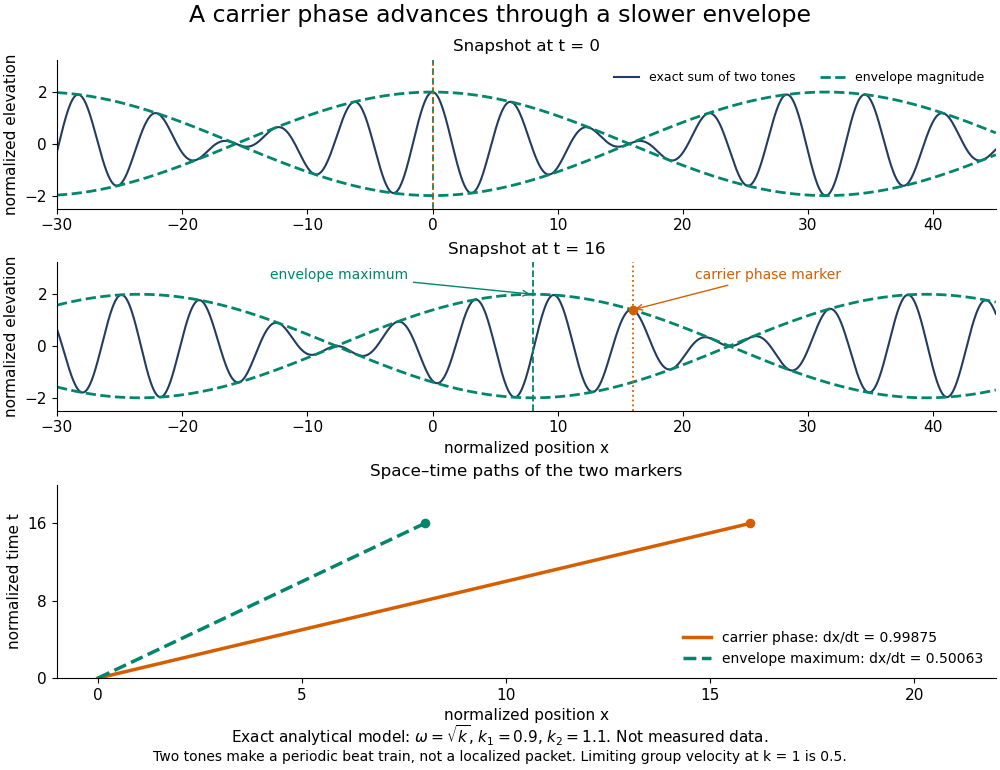
Exact analytical two-tone gravity-wave model: carrier phase advances through a slower periodic envelope
. Details. The deep-water surface gravity wave therefore has , whereas the deep-water capillary wave limit has : crests can drift either forward or backward relative to a wave envelope. For finite-depth surface gravity waves, differentiating the dispersion relation givesHere is the hyperbolic sine. The shallow-water limit has ; the deep-water limit has .[ref]
In the wave tank, produce a finite train with a smooth turn-on and turn-off and time the same wave envelope feature at two probes separated by distance ; its transit estimate is . Independently follow wave crests through that train. Techet's 2003 lab asks students to observe a deep-water train's foremost crest disappearing as the group moves forward, and to compare deep- and shallow-water cases. The interpretation is that a wave crest overtakes the slower wave envelope, dwindling at its front while other crests become visible at its rear. This is a qualitative expected observation in the teaching protocol, not a published set of measured curves.[ref]
A useful controlled version keeps the paddle wave amplitude small, records and , and checks both and . Compare runs with and , rather than assuming every ripple tank is shallow relative to every wavelength. Increase train duration at fixed central frequency to narrow its spectrum, and check that the envelope transit estimate stabilizes. Calibrate both probes, sample fast enough to resolve the carrier, and compare records before reflected waves return; an absorbing beach reduces this contamination. A current changes laboratory velocities, large wave amplitudes introduce nonlinear effects, and very short wavelengths require surface tension. Strong damping or noticeable reshaping makes the chosen threshold or peak an unreliable marker of simple group velocity. These are proposed controls and model limits, not claims that the cited lab measured every correction.
Three velocities should consequently be kept separate. The group velocity predicts narrow-band wave envelope motion. An energy-transport velocity is energy flux divided by energy density, using the appropriate time average; it agrees with group velocity in standard lossless linear wave models when all stored energy is included.[ref] A signal-front velocity concerns the earliest response to a new disturbance and requires a causal model over its full spectrum. A strictly band-limited wave packet has no sharply bounded onset, and a mathematical two-tone envelope cannot test front arrival. In strongly absorbing or broadband propagation, a single group velocity need not describe the observed peak, energy transport, or first detectable response. A complex or also prevents interpreting its derivative as an ordinary real transport velocity without further analysis.
In particular, an unusually large or negative group velocity from pulse reshaping does not establish superluminal information transmission. For the causal dielectric model analysed by Fitzpatrick, the field ahead of the front vanishes for , even when its phase velocity exceeds the vacuum speed of light . That result concerns the electromagnetic model's causality; the ideal water-wave diagrams above contain no relativistic signal-front claim.[ref]
Finally, zero wavenumber requires care: the positive-frequency wave equation branch is not differentiable at , so it has no unique group velocity there, although its one-sided values are . A smooth gapped branch such as the Klein-Gordon equation instead has despite undefined phase velocity at . The same signed branch must be used in both derivatives and ratios; a negative group velocity means an envelope moving in the negative coordinate direction, not a negative elapsed time. The practical value of group velocity is precisely this translation between a local slope on a dispersion diagram and a measurable packet transit, with its assumptions made explicit.
The Gaussian envelope in a Klein-Gordon medium supplies a quantitative next step: the first derivative translates the wave envelope, the second derivative spreads it, and higher derivatives limit that approximation. At finite spectral width, a peak's measured speed need not equal the group velocity at the central wavenumber. Neither a peak nor a fixed fraction of its height generally identifies front velocity.
Pinned article: Introduction to the OurBigBook Project
Welcome to the OurBigBook Project! Our goal is to create the perfect publishing platform for STEM subjects, and get university-level students to write the best free STEM tutorials ever.
Everyone is welcome to create an account and play with the site: ourbigbook.com/go/register. We belive that students themselves can write amazing tutorials, but teachers are welcome too. You can write about anything you want, it doesn't have to be STEM or even educational. Silly test content is very welcome and you won't be penalized in any way. Just keep it legal!
Intro to OurBigBook
. Source. We have two killer features:
- topics: topics group articles by different users with the same title, e.g. here is the topic for the "Fundamental Theorem of Calculus" ourbigbook.com/go/topic/fundamental-theorem-of-calculusArticles of different users are sorted by upvote within each article page. This feature is a bit like:
- a Wikipedia where each user can have their own version of each article
- a Q&A website like Stack Overflow, where multiple people can give their views on a given topic, and the best ones are sorted by upvote. Except you don't need to wait for someone to ask first, and any topic goes, no matter how narrow or broad
This feature makes it possible for readers to find better explanations of any topic created by other writers. And it allows writers to create an explanation in a place that readers might actually find it.
Figure 1. Screenshot of the "Derivative" topic page. View it live at: ourbigbook.com/go/topic/derivativeVideo 2. OurBigBook Web topics demo. Source. - local editing: you can store all your personal knowledge base content locally in a plaintext markup format that can be edited locally and published either:This way you can be sure that even if OurBigBook.com were to go down one day (which we have no plans to do as it is quite cheap to host!), your content will still be perfectly readable as a static site.
- to OurBigBook.com to get awesome multi-user features like topics and likes
- as HTML files to a static website, which you can host yourself for free on many external providers like GitHub Pages, and remain in full control

Figure 2. You can publish local OurBigBook lightweight markup files to either OurBigBook.com or as a static website.
Figure 3. Visual Studio Code extension installation.
Figure 5. . You can also edit articles on the Web editor without installing anything locally. Video 3. Edit locally and publish demo. Source. This shows editing OurBigBook Markup and publishing it using the Visual Studio Code extension. 
- Infinitely deep tables of contents:



All our software is open source and hosted at: github.com/ourbigbook/ourbigbook
Further documentation can be found at: docs.ourbigbook.com
Feel free to reach our to us for any help or suggestions: docs.ourbigbook.com/#contact