Topics (384k) Articles (398k) Users (410) Discussions (242) Comments (383) Files (13k) New article

An imported infection is acquired outside the population or observation system being modelled and enters it as an external source of incidence.
Type Ia supernova cosmology uses standardized supernova luminosities to measure the shape of the luminosity-distance--redshift relation. In a spatially flat universe,An unknown common absolute luminosity is degenerate with the overall distance scale but does not erase the redshift dependence.
The useful observable is a relative luminosity distance at measured redshift, rather than an object's brightness alone. Spectroscopy supplies ; repeated photometry supplies a light curve. A Type Ia supernova is a standardizable candle: a fitted relation between light curve shape and luminosity replaces the incorrect assumption that every explosion has identical peak absolute magnitude. Nearby objects establish the relation and its common intercept; distant objects test its continuation and the shape of the Hubble diagram.
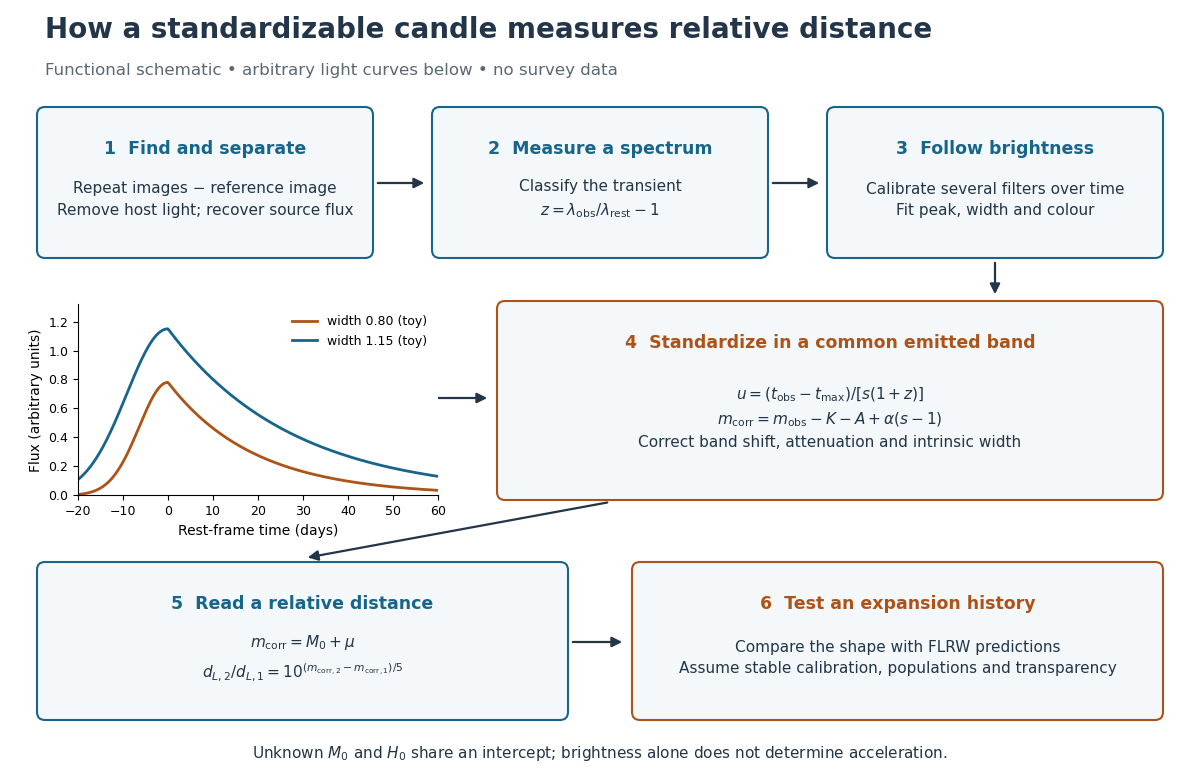
From repeated images and spectra to standardized brightness, relative luminosity distance and a conditional acceleration inference
. Functional schematic with arbitrary illustrative light curves. The redshift and distance readouts are separate measurements; inference of acceleration requires a specified cosmological model. Details.A Lorentz tensor transforms by one Lorentz matrix for each contravariant index and one inverse matrix for each covariant index. Complete contraction of all indices produces a Lorentz scalar.
A Lorentz scalar is unchanged under a Lorentz transformation. Contracting every Lorentz index in a tensor expression produces a scalar when the constituent fields transform covariantly.
Nearby lipid bilayers experience attractive van der Waals forces, screened electrostatic repulsion, and fluctuation-induced steric repulsion.
The Linearized Einstein equations retain first-order terms in a metric perturbation about the Minkowski metric. Use metric signature , coordinates , andIn Lorenz gauge in linearized gravity, , the first-order Einstein tensor is . HenceThe source must satisfy background stress-energy conservation, , since taking the divergence of the left-hand side gives zero. In units this becomes .
The equation is a sourced wave equation, not just a static Poisson equation. A retarded solution additionally needs a radiation boundary condition for linearized gravity; homogeneous gravitational waves can otherwise be added. The expansion is controlled only where the neglected higher-order metric perturbations remain small.
Neutrino free streaming transports neutrinos out of small-scale overdensities. Massive neutrinos therefore contribute to the homogeneous matter density while clustering inefficiently below their free-streaming scale, slowing the growth of cold-matter perturbations.
Suppose and minimizes the Lasso objective . With , comparing its value with the value at givesIndeed, expand and cancel . This deterministic inequality needs neither a normal distribution nor a full-rank design matrix.[ref]
Statistical Theory for High-Dimensional Models by Sara van de Geer. Section 1.3, basic inequality proof
The noise term is at most by Holder inequality. Controlling that term probabilistically leads to a Lasso cone condition; a Compatibility condition for the Lasso then converts coefficient error into prediction error. The stronger prediction inequality from Lasso stationarity uses subgradient optimality and has a different leading constant.
The effective field theory of large-scale structure describes long-wavelength matter dynamics while representing unresolved short-scale motion through an effective stress tensor. It supplements standard perturbation theory in cosmology with symmetry-allowed terms whose coefficients can be calibrated from simulations or data. A leading correction scales as . Its role is to account for short-scale influence on long-scale predictions, not to resolve individual collapsed objects.[ref]
The Effective Field Theory of Cosmological Large Scale Structures by John Joseph M. Carrasco and others. Abstract and effective-fluid construction: short-scale dynamics, effective parameters and perturbative observables
The Transverse-field Ising model is a quantum spin model with competing Ising exchange and a perpendicular field, for example . In one dimension its ordered and paramagnetic phases meet at .
The normal equation for is . Its solutions minimize ; when they exist, the unique solution orthogonal to is the Moore--Penrose solution .
Regularization replaces sensitive inversion by a controlled approximation. For a bounded linear operator between Hilbert spaces, a linear regularization is a family of bounded linear operators satisfying as for each datum in the domain of the Moore–Penrose inverse of an operator. Noisy-data convergence additionally requires a suitable regularization parameter choice.[ref] Nonlinear variational regularization can instead use nonquadratic penalties.
The noise-bias decomposition for linear regularization separates two costs: amplifying measurement noise and changing the exact-data reconstruction. Truncated singular value decomposition discards weak modes; Tikhonov regularization attenuates them smoothly. A quadratic norm penalty expresses a preference for smaller reconstructions. Neither method manufactures a missing null space component: with complete averaging, the minimum-norm least-squares solution for is , even if the original image was . The preference selects a representative; extra observations or justified constraints are needed to identify the original.
For Tikhonov regularization, the Tikhonov stability bound limits transmitted measurement noise of norm at most to . Taking while gives a sufficient rule for convergent regularization of an inverse problem. Holding fixed leaves approximation bias; letting it vanish too quickly can admit overwhelming measurement noise.
An inverse scattering problem reconstructs a medium or obstacle from measured scattered waves. Under the Born approximation, fixed-frequency far-field data sample the Fourier transform of the scattering potential on a restricted frequency surface.
At a stationary slope, an internal wave preserves frequency and tangential wavenumber. Unlike specular reflection, the reflected energy ray preserves its angle to the vertical; a supercritical slope can reverse its horizontal propagation direction.
Pinned article: Introduction to the OurBigBook Project
Welcome to the OurBigBook Project! Our goal is to create the perfect publishing platform for STEM subjects, and get university-level students to write the best free STEM tutorials ever.
Everyone is welcome to create an account and play with the site: ourbigbook.com/go/register. We belive that students themselves can write amazing tutorials, but teachers are welcome too. You can write about anything you want, it doesn't have to be STEM or even educational. Silly test content is very welcome and you won't be penalized in any way. Just keep it legal!
Intro to OurBigBook
. Source. We have two killer features:
- topics: topics group articles by different users with the same title, e.g. here is the topic for the "Fundamental Theorem of Calculus" ourbigbook.com/go/topic/fundamental-theorem-of-calculusArticles of different users are sorted by upvote within each article page. This feature is a bit like:
- a Wikipedia where each user can have their own version of each article
- a Q&A website like Stack Overflow, where multiple people can give their views on a given topic, and the best ones are sorted by upvote. Except you don't need to wait for someone to ask first, and any topic goes, no matter how narrow or broad
This feature makes it possible for readers to find better explanations of any topic created by other writers. And it allows writers to create an explanation in a place that readers might actually find it.
Figure 1. Screenshot of the "Derivative" topic page. View it live at: ourbigbook.com/go/topic/derivativeVideo 2. OurBigBook Web topics demo. Source. - local editing: you can store all your personal knowledge base content locally in a plaintext markup format that can be edited locally and published either:This way you can be sure that even if OurBigBook.com were to go down one day (which we have no plans to do as it is quite cheap to host!), your content will still be perfectly readable as a static site.
- to OurBigBook.com to get awesome multi-user features like topics and likes
- as HTML files to a static website, which you can host yourself for free on many external providers like GitHub Pages, and remain in full control

Figure 2. You can publish local OurBigBook lightweight markup files to either OurBigBook.com or as a static website.
Figure 3. Visual Studio Code extension installation.
Figure 5. . You can also edit articles on the Web editor without installing anything locally. Video 3. Edit locally and publish demo. Source. This shows editing OurBigBook Markup and publishing it using the Visual Studio Code extension. 
- Infinitely deep tables of contents:



All our software is open source and hosted at: github.com/ourbigbook/ourbigbook
Further documentation can be found at: docs.ourbigbook.com
Feel free to reach our to us for any help or suggestions: docs.ourbigbook.com/#contact